Showing posts with label Ashutosh Varshney. Show all posts

Wednesday, 20 August 2025

Uttertosh Varshney on India's foreign policy abyss

As America weakens while China continues to grow stronger, all countries are having to change their foreign policies.

My prediction is that Trump will do a trade deal with China and that they won't make their move on Taiwan till the end of the decade. Meanwhile, if Europe can rally around Ukraine and keep that war going then a European Army may become a reality. In any case, their arms export capacity is likely to rise and so, in a context where America may cease to be militarily self-sufficient by the beginning of the next decade, America may lose global market share and thus influence.

How does this affect India? Firstly, it means that talk of Quad is dead and buried. Biden's 'Indo-Pacific' strategy had always looked dodgy. Now even Article 5 of NATO doesn't mean very much. America is retreating but we can't say that there is a cohesive Eurasian power-block, under Chinese leadership, which can take its place. Still, Iran has seen that it needs some such thing so as to go nuclear. China's arsenal isn't yet anywhere near that of Russia. So, there will be increased cooperation between them. India may gain in that once Uncle Sam is out of the picture, it presents no real threat to China's soft under-belly. On the contrary, it represents a growing market and a possible partner in dealing with climate-change and the Myanmar mess which has spilled over across both nation's borders. 

The second aspect is economic. Here, Modi's having to back down in the face of recent farm protests is the clinching factor. India can't do free trade in agriculture. The thing is political suicide. Sadly, it also appears unable to do Land and Labour and Judicial reform- at least at the Union level. Everything that matters is domestic. There are diminishing returns to foreign policy initiatives. But such has always been the case. 

The cretin, Uttertosh Varshney, thinks otherwise. He writes in Print.in that 

Indian foreign policy is in free fall.

Nope. It is what it was. Nothing has changed. If you can't open your economy, you can't open your economy even if you make agreements to open your economy. Also, if Uncle Sam says he will protect you, it doesn't mean he will protect you. He will run the fuck away. Ask the Afghans. They know.  

Can we balance national pride with new power reality?

The power reality is that US power has declined. Uttertosh lives in America. His national pride may have declined but fuck does that matter to Indians living in India? 

Unless dramatic reversals take place, the core of India’s foreign policy, which, at least since 2000, has focused on the US, Pakistan, China, and Russia, stands on the verge of collapse.

That core was shit. It didn't prevent the attack on the Indian Parliament or that on the Mumbai Taj hotel. The good news is that the US had given up on the MENA. True, it bombed Iran recently- but not a lot. It appears public support for Israel is waning. It may be that Israel can do better for itself trading freely on arms markets and hiring mercs to 'mow the lawn'. Two can play the 'pay for slay' game.  

Unless US President Donald Trump’s tariff threats are primarily a negotiating ploy, India’s foreign policy has run into a virtual abyss.

If the damage to the Indian economy is just 0.2 percent then there is no fucking abyss.  

It faces its greatest crisis since 1998, when India conducted nuclear tests and was subjected to international isolation.

There was no fucking crisis. The nuclear tests were popular. Vajpayee got to complete a term as PM. What was bad about the Nineties was political instability, insurgency, and extra-judicial killing. These were curbed. Sanctions had little effect. Indeed, in some respects they were a blessing in disguise. 

The big difference is that the 1998 tests added to India’s overall power, which stands significantly diminished at the present moment.

No. What changed under Modi was that India retaliated for Pak sponsored terrorism. It is the weakening of Pak's economy which matters. China has a choice between making money in India or lending to Pakistan where its own people are the target for terrorist attacks.  

One other point. It appears that Thorium fuel is becoming viable. India has plenty of Thorium and stands to benefit. 

If the Indian economy had grown at an average of 8-9 per cent per annum over the last decade, instead of 6-6.5 per cent, and had India invested heavily in military modernisation,

and if Trump hadn't come to power 

the country’s power in the international system would have been greater.

Because economic power translates into diplomatic and military power. China has risen because of its economy. But so has India. That's why it makes sense for the two countries to work together to make BRICS a success.  

Now, a significant restructuring of policy priorities under pressure might have to be undertaken.

It was already underway. The fact is, Biden's abrupt and unilateral decision to run away from Afghanistan had concentrated minds. It is quite possible that India and China can have friendly relations with that country even if tensions with Pak heat up.  

All major foreign policies can be conceptualised as having a core, a semi-periphery and a periphery.

India has maintained good ties with Moscow. That remains the case.  

This tripartite division is not geographical, but one based on different layers of significance. The core of India’s foreign policy, at least since 2000, has focused on the US, Pakistan, China, and Russia.

The War on Terror meant that India had to shut the fuck up and watch NATO do stupid shit. But so did the rest of the world. But, by 2012, China could signal relative independence and, in 2014, Putin made his move into Crimea. The one big change we have seen this year is the decline of Iran's footprint in the MENA. That may be temporary. 

The semi-periphery includes relations with the UK, France, and Germany in Europe; Israel, Saudi Arabia, UAE, and Iran in the Middle East; India’s neighborhood beyond Pakistan and China; and Canada, Brazil, Australia, Japan, and Singapore. For reasons of space, the periphery need not detain us here.

Nothing Uttertosh writes need detain us. We understand what he is trying to say- viz. Modi is stupid and has made some very foolish error. But Modi isn't stupid. He didn't buckle when Trump put the squeeze on him. Nobody in India expected him to. They remember the farm protests. No Indian government can go against the largest voting block in the country- viz. farmers.  

Unless dramatic reversals take place,

telling the farmers to fuck off? They will block every highway in the country.  

the core of India’s foreign policy stands on the verge of collapse. To understand this, let us remind ourselves what the primary goals of Indian foreign policy have been, especially over the last two-and-a-half decades. Four such goals can be easily identified. India cultivated greater closeness with the US;

Manmohan got the Americans to deny a visa to Modi. Is that what this nutter is getting at?  

it wanted to avoid a return of equivalence with Pakistan;

Pakistan was and is a 'major non-NATO ally'- i.e. it has superior closeness. It was never equivalent to India.  

it sought parity with China;

it sought good relations with China. But that does mean keeping America at arm's length. Thankfully, no great effort has to be expended in doing so. The US wants out of the region. Indeed, it also wants to cut the umbilical cord to Europe. That is the new reality for Ashutosh's students. They need to understand that no Asian country can view the US in the way they did even a decade ago. But this is also true of Canada and France and so forth.  

and it wished to maintain cordial relations with Russia.

India knows it may have to rely on the Russian Security Council veto.  

Cordiality with Russia remains undiminished, though it is under significant threat.

Nope. Modi yields only to threats made by big Indian voting blocks- like farmers. He doesn't give a shit about POTUS.  

A large part of Trump’s tariff penalty is aimed at undermining India’s reliance on oil imports from Russia. Even if the threats lead to a diversion to some other sources of oil, such as Saudi Arabia, India’s dependence on Russia for arms and weapons will not decline rapidly, keeping India-Russia warmth substantially intact. Invulnerable to rapid erosion, India’s defence relationship with Russia is long–lasting.

As is its relationship with Israel or France.  

The other three core elements – concerning the US,

which nobody can rely on anymore. 

Pakistan,

see above. There is no point having warm relations with Islamabad because then Rawalpindi will send terrorists across the border.  

and China — are nearly in a free fall.

They are improving with China. Direct flights, border trade & business links have all opened up.  


Shadows of an earlier era

Trump has dealt two crushing blows.

Which haven't crushed shit.  

First, by threatening to impose a 50 per cent tariff on India’s exports to the US, leaving only electronics such as smartphones and pharmaceuticals out, he has essentially declared a trade embargo on Indian goods (though not on services). The US accounts for nearly a fifth of India’s total exports. It will take time for India to find alternative markets. Clothing from Tiruppur, polished diamonds from Surat, shrimp from Andhra Pradesh, machinery from Noida and Chennai, and auto parts from western and southern India run the risk of incurring losses adding up to tens of billions of dollars, at least in the short run.

Only in the short term.  There will be 'trade diversion'. Trade deals are only exciting if there will be 'Trade Creation'. But, for India, that requires root and branch internal reform. 

The second Trumpian blow is channeled through Pakistan. At least since 1999, if not earlier, the US has consistently downgraded its relationship with Pakistan, placing India on a higher pedestal.

So what? Pakistan declined because it did stupid shit.  

This was a reversal of the Cold War pattern of Pakistan first and India later. Presidents Clinton, Bush, Obama, Biden, and even Trump in his first term sought friendship with India. A bipartisan consensus greeted India’s policy makers in Washington, as both Democrats and Republicans embraced India.

I suppose this nutter is thinking of the 123 nuclear agreement. My memory is that some US company was supposed to build a nuclear reactor in India. It went bust.  

The recent India-Pakistan military conflict appears to have brought about a qualitative transformation, showing deepening shadows of an earlier era. Nothing symbolises the change more than Trump’s invitation to Pakistan Army chief Field Marshal Asim Munir for a luncheon meeting in the White House.

Why? The answer is that Trump needs a backchannel to Beijing. Munir will do for him what Yahya did for Kissinger & Nixon. You fondle the poodle of your enemy to signal your desire for an alliance.  

Military chiefs of foreign countries are not invited to the White House unless they are also the head of state, as General Pervez Musharraf was. Agreements with Pakistan on cryptocurrency and exploration of potential oil reserves (which could well be a stand-in for mining rare earths in Balochistan) have also been struck. Of course, an old-style military alliance is missing,

Pakistan has been a major non-NATO ally since 2004. There is a Bill in the House of Representatives to revoke this but Trump has sent a very strong signal against its being passed. That's perfectly sensible. POTUS should have a free hand in diplomacy. 

but one should note that the outgoing chief of the US Central Command, General Michael Kurilla, said that Pakistan was a US ally in the fight against terrorism, a surreal statement from Indian perspective and a dramatic change from the days that led to the 2011 killing of Osama bin Laden who was living less than a mile from the Pakistan Military Academy in Abbottabad.

Obama said the operation had been conducted without the knowledge of the Pakistanis (though they had initially claimed otherwise). This again was the decent thing to do. The families of Pak officers could have become targets.  

A potential role for Pakistan in Iran may also be under consideration.

No Pakistani General is stupid enough to antagonize the Iranians.  


In other words, this turn might have an autonomous strategic and economic logic. But it was almost certainly aggravated by India not recognising the US’ role in bringing about a ceasefire during the military conflict with Pakistan.

Because there was no such role. Still, it is good to see that Uttertosh is faithful to Trump and resents India's not telling lies so the fat fuck can get a Nobel prize same as Obama.  

India’s diplomacy could not muster up an appropriate response to Trump’s well-known penchant for credit-seeking. What words to use to appease egos, when policy becomes highly personalised, is always a diplomatic challenge. India’s decision-makers could not craft a formulation that simultaneously satisfied India’s sense of self-respect and the dictates of realpolitik or realism.

Trump lost face. Guess which country thinks loss of face is a big deal? China. But what really matters in India, to Indian politicians, is Indian farmers. Modi gained face with them. That's why in his very long Independence Day speech he spoke for the first time about the RSS. Oddly, Nitish didn't raise a peep. 

Let us now turn to China, the last core element of India’s foreign policy.

It is obvious that India has to choose between BRICS and Uncle Sam. Trump made it easy.  

In 1990, India and China had roughly the same GDP. But today, thanks to a blistering economic growth rate averaging 9 per cent per annum,

based on 'smashing the iron rice bowl'- i.e. firing workers in lossmaking Public Sector units. India's paternalistic labour laws don't permit any such thing. 

China’s economy is five times larger than India’s. China’s military power is also significantly greater. As Vipin Narang and Pranay Vaddi write in a recent essay, ‘How to Survive the New Nuclear Age’, China is determined to become a “nuclear powerhouse” under Xi Jinping. (Foreign Affairs, July-August 2025) And “Xi has chosen.. to build hundreds of new silos for land-based Inter Continental Ballistic Missiles (ICBMs), which can be launched within minutes to devastate the U.S. homeland.” In short, China’s military prowess is inching closer and closer to that of the US.

Which is why it has less and less to fear from India. But this also means India has less to fear from it.  

In contrast, India’s search for parity with China — both economic and military — has eluded its grasp. To reach the perimeters of parity, India’s economy needed to grow at 8-9 per cent per annum over the last 10-15 years, as it did in the first decade of this century, while heavy investments in military modernisation were also needed. Neither has happened to a desirable degree.

Because India isn't a one-party state which can 're-educate' or incarcerate anyone it likes.  

Equally, the US had begun to see India as a counterweight to China,

The US thought it could itself be a 'counterweight' to China. It can't.  

which after 2012-13 came to be viewed as America’s prime adversary. This logic drove the pro-India bipartisan consensus in Washington, though the rising capabilities of India’s American diaspora also played a role. India received valuable benefits from this turn. Defence cooperation rose

as it rose with other countries with advanced defence technology. India had become a big buyer in the global arms market. 

and, quite markedly, the world’s third-most valuable company, Apple, also commenced its switch from China to India.

because India is itself a very big market. The difference is that Chinese phones and computers may become better than Apple's. There is no such danger in India or Vietnam. Let us see if Malaysia's new five year plan to become a leading AI player succeeds.  

How will India approach China under the new circumstances? Earlier, the US sought India to counterbalance China. Will India seek China’s support for counterbalancing the US, if things worsen further? What will be the price of this greater closeness, given that Chinese support for Pakistan is longstanding and India also has an unresolved border dispute with China? India will have to approach China with a severe imbalance of power.

The border dispute is a case of 'two bald men quarrelling over a comb'. China's worry was that the US would get India to apply pressure on their soft under-belly when they were busy re-taking Taiwan.  


India’s policy makers and strategic thinkers have to find a way out of this abyss.

It has already been done. Direct flights and border trade are re-starting. The BJP needs to launch a grass-roots campaign glorifying Modi for defending Indian farmers. Will they do it? Perhaps not. Their messaging has become lack-lustre.  

The key is trying to strike a balance between the norms of self-respect, without which proud nations can’t live, and the realities of power, which can only be ignored at great peril.

Nonsense! Nobody gives a shit about foreign policy. Only cretins like Uttertosh teach it.  


Sunday, 28 January 2024

Uttertosh Varshney on why we must vote BJP

Uttertosh Varshney & some PhD scholar at Brown have published a hysterical essay in some shitty Journal or other. Varshney is Hindu. He wants to convey the impression that Muslims in India were always greatly inferior to Hindus in culture, education, wealth and political power. Basically he is calling Indian Muslims the n-word. This is very funny but is it really the ideology that Brown University wants to promote? 


Is India under Narendra Modi, who became prime minister in 2014, beginning to resemble the American South under Jim Crow?

No. Unlike the US, which does not have an Election Commission, there is no voter suppression or gerrymandering in India. 

The American South wasn't very different from the American North. Blacks and 'Injuns' were at the bottom of the pile. Still, it must be said, Jim Crow America didn't wage a war of revenge on Muslims killing 1.3 million of them and displacing tens of millions more. Since India stayed out of that horrible business, Americans like pretending that India, not America, is anti-Muslim. 

The term refers, of course, to the politics of racial oppression that came to dominate in the eleven former Confederate states following the end of Reconstruction in 1877.

Those States had practiced slavery. India did not have slavery. However as in Pakistan, Sri Lanka, etc, religion can become the basis of ethnic violence as happened in parts of Northern India in 1947. One could compare Jim Crow to untouchability. One can't compare religious nationalism in India to anything in the US. The closest analogy would be Belfast wishing to stay out of a united Ireland on the grounds of religion.  

From about 1880 to 1965, each of these states saw grave democratic backsliding as elected legislative bodies and executive authorities ignored or circumvented the citizenship, due-process, and equal-protection clauses of the Fourteenth Amendment (1868); deprived African Americans of the voting rights they had been guaranteed under the Fifteenth Amendment (1870); and directly or indirectly supported extralegal vigilante violence against blacks, especially in the form of lynchings.

Plenty of Whites were lynched by other Whites. Incidentally many indigenous Americans only got citizenship in 1924. 

Allowing for historical differences—India never had a system of racialized chattel slavery such as held sway in fifteen of the then-34 U.S. states plus several U.S. territories at the time the Civil War broke out in 1861—it remains fair to say that if Jim Crow was about the severe marginalization of black Americans on the ground of their race, then Hindu nationalism under Modi’s Bharatiya Janata Party (BJP) is about the attempted marginalization of a minority, namely, Muslim Indians, on the ground of their religion.

This would not be a fair statement at all. Muslims were marginalized in 1947. They simply don't matter at all. Manmohan briefly pretended he would do something for them but he himself didn't have any power. 

As Avidit Acharya, Matthew Blackwell, and Maya Sen argue, the motives behind Jim Crow were not only economic (a desire to keep the minority’s labor cheap) but also political and social: fear of black political power in the South, where blacks continued to make up a large share of the populace, and fear of the social equality presaged by the end of slavery and the passage of the Fourteenth and Fifteenth Amendments. 

Where Muslims are the majority they can chase out kaffirs but they are a small minority in most parts of India and get stomped if they get up to mischief.  America was a settler colony with Caucasians being explicitly given a higher status than Black, Chinese and East Indian origin people. 


Here is where the parallels with Modi’s Hindu nationalism begin. Just as a key aim of Jim Crow was to blunt the Reconstruction Amendments and turn blacks into second-class citizens,

which the Northern States had no problem with 

Hindu nationalists seek to diminish the constitutionally guaranteed equal citizenship of Muslims and turn them into marginalized, less than fully equal citizens.

Can Uttertosh point to any voter suppression? No. It is a different matter that both the US and India ban non-citizens from voting.  

-White supremacy and Hindu supremacy are twins in that sense.

In which case they are related to Islamic supremacy and Buddhist supremacy and Marxist supremacy.  

Their histories are different, but their political objectives and discourses are much the same.

Because Biden is lynching Hindus or forcing them to eat beef.  

Similarity marks even the methods deployed: exclusionary laws, segregation, and vigilante violence.

Moreover Modi has a penis. Guess who else has a penis? That's right! It is Joe Biden who, along with his pal Obama, slaughtered hundreds of thousands of Muslims. 

Just as in the Jim Crow South a combination of state-level election victories and extralegal methods was deployed to deprive blacks of their rights, Hindu nationalism is using both legislative power and extralegal methods to subdue Muslims.

No it isn't. There is no need.  

Vigilante violence, condoned or supported by the state, has been on the rise since Modi and his party came to power.

Nope. There is no statistical evidence for this.  

In short, elections are being used to create legislatures that pass anti-Muslim laws,

name one.  

while street-level vigilantism supports the formal politics of exclusion. This was also how democracy worked in the American South after Reconstruction collapsed in the late 1870s.

No. The North never gave a fuck about niggers. Southerners were welcome to fuck over niggers, spics, Injuns- you name it.  

Unlike Nazi Germany in its targeting of Jews, the Jim Crow project was not eliminationist. Hindu nationalists likewise seek not the physical elimination of Muslims, but rather their relegation to second-class citizenship.

Uttertosh doesn't give them enough credit. They would love to have a pure Hindu rashtra or Hindu Pakistan.  

The Third Reich had concentration camps for Jews. The Jim Crow South did not have such camps, nor does India today.

The Bench opened detention centres in Assam.  

To annihilate the equality that blacks were promised after the Civil War was the objective of Jim Crow.

This nutter thinks Blacks had equality in Chicago and New York!  

Hindu nationalists also seek to abolish the equality granted to Muslims by India’s 1950 Constitution.

It took away affirmative action from Dalit Muslims! The Assembly had already banned the re-entry of Muslims who had crossed the border in panic.  

Jim Crow was about white supremacy; Hindu nationalism is about Hindu supremacy.

Which was achieved in 1947.  

Jim Crow lasted for the larger part of a century, not weakening until the 1950s and not ending until the passage of the Civil Rights Act of 1964 and the Voting Rights Act of 1965.

White Americans didn't and don't give a shit about darkies or Injuns or wetbacks.  

The Hindu-nationalist project is in its early phases and can still be forestalled.

Nope. It triumphed in 1947 when hundreds of thousands of Muslims were slaughtered.  

Before a Jim Crow–style Hindu-nationalist order is institutionalized via political and legislative processes, voters can remove the BJP from power via defeat at the polls. If voters do not turn back Hindu nationalism, it is our grim prediction that its similarities to Jim Crow will only grow. Parallels are already disturbingly in evidence.

To cretins. The good news is that Uttertosh is only writing this shite because he is a racist Hindutvadi who wants to pretend that Muslims in India were always as lowly as 'nigger' slaves.  

Exclusionary Ideologies

Jim Crow was rooted in the idea of racial hierarchy

which was gladly embraced by almost all Whites 

and Hindu nationalism is driven by belief in a religiously defined national community.

Congress was, as Gandhi put it in 1939, a Hindu party.  

The notion of equality among groups is an anathema to both, and the presumption of group exclusion and hierarchy a defining feature of each.

Whites thought they were superior to Blacks. Most probably still do. This was not the case in India. There had been Muslim rulers and there was a large 'Ashraf' Muslim nobility.  

In one case, the exclusion is racially formulated and in the other, the basis for exclusion is religious, or what one might call ethnicized religion. Moreover, both are governed by historically constructed notions of honor and ignominy and do not shy away from violence as a mode of restoring honor and avenging perceived humiliation.

All that is irrelevant. In South Asia, majority religions fucked over minorities unless the minorities behaved themselves and kept quiet.  


While the United States has always had more than two races, Jim Crow focused on a racial binary. “The white people who settled this country . . . should alone govern it,” said Alfred Moore Waddell, the former Confederate officer who led a bloody 1898 white-supremacist coup against a duly elected, biracial city government in Wilmington, North Carolina.

Kill the Injuns but keep the Blacks around to pick cotton.  

What race was to Jim Crow, religion has been to Hindu nationalism

and Pakistani and Burmese and Sri Lankan nationalism.  

since that ideology’s founding a century ago.

After the formation of the Muslim League.  

 If white supremacy in the U.S. South meant rejection of racial equality, Hindu nationalism comes with the denial that Muslims and Hindus can be equal in India.

Muslims dominate Pakistan and Bangladesh and Kashmir Valley. They have to pipe small where they are the minority.  

And if India’s postindependence constitution has made Hindus and Muslims legally equal,

Muslims were deprived of affirmative action previously awarded those of 'untouchable' caste. Many lost citizenship or property or were compelled to emigrate. They became a cowed and economically backward section of society. 


Instead of punishing India’s remaining Muslims, however, the leaders of India’s freedom movement and its constitutional framers protected them.

There was a pact with Pakistan not to continue ethnic cleansing.  

The 1950 Constitution was based on the idea of religious equality. It gave universal franchise to all adults, regardless of religious affiliation.

It got rid of reserved seats. Muslims were stripped of any concessions previously offered them.  


Emerging Indian Laws

Soon after the BJP won reelection in 2019, having increased both its vote and seat share and remaining at the head of its ruling coalition, two of its biggest moves in Parliament were anti-Muslim. The first was a fundamental change in legal status of the disputed state of Kashmir. India is an asymmetric federation, meaning that not every state has the same rights. Kashmir, the only state with a Muslim majority, had greater autonomy within the national constitutional framework.

No. The Supreme Court, in 2016, said it had no 'shred' of sovereignty.  

Only defense, foreign relations, and communication were under Delhi’s control; other realms of policy and governance were left to Kashmir’s own state government.

Nonsense! Nehru jailed the popular CM of Kashmir even though he was a close friend.  

Some other states, especially in the Northeastern tribal areas, have roughly similar status. Yet Kashmir, in the eyes of Hindu nationalists, had a built-in religious defect: its Muslim majority.

It did ethnic cleansing of Hindus in the Nineties. For some reason, this does endear Kashmir to Hindus.  


In August 2019, the BJP used its new majority to strip Kashmir of its special autonomy and make it the eighth of India’s “union territories.” These federal entities are run directly by the national government in Delhi, with no governments of their own. The implication was clear: A Muslim-majority state was being shown its proper place in Hindu-majority India.

No. The police was brought under the Union Government so that it could go after terrorists without interference by Kashmiri politicians. The Law & Order situation improved. Now, the worry is that Myanmar's internecine conflicts will spill over the border into the North East. God alone knows how Modi and Shan will resolve that situation.  


In December came passage of a change to the Citizenship Act of 1955. This law had imposed no religious criteria on aspiring citizens, but the new law (called the Citizenship Amendment Act, or CAA) opened a “fast track” to Indian citizenship for “persecuted minorities” from Afghanistan, Bangladesh, and Pakistan. Two things about this law were noteworthy. First, it specified only the Muslim-majority countries in India’s neighborhood as sites of persecution.

Because they persecuted non-Muslims.  

It left out Sri Lanka, which is mostly Buddhist and has a Hindu (ethnically Tamil) minority that often complains of persecution and was on the losing side of a civil war.

So what? If the Tamils cared about this they could have asked for their inclusion. 

Also unmentioned was Burma, where a small (4 percent) Muslim minority has been the target of violence often condoned or even assisted by the government.

Nobody wants those nutters- not Bangladesh, not Indonesia, nobody.  


Not only did the CAA rest on the false premise that only Muslim-majority countries near India have religious persecution problems, but it also specified “persecuted minorities” in a way that conspicuously ignored Muslim victims of ill treatment.

Because Muslims want to kill kaffirs. Sadly kaffirs kill Muslims where they are the majority.  

The text lists Buddhists, Christians, Hindus, Jains, Sikhs, and Zoroastrians but is silent about the Shia Hazaras in Afghanistan and the Ahmadis in Pakistan, for instance, though both these groups have long suffered at the hands of oppressive Sunni majorities.

Some Ahmadis do get asylum but must keep quiet about it or else the Sunnis will start baying for their blood. Hazaras are wanted by Iran for its war in Syria. 

The plain fact is, when India gave asylum to Dr. Taslima Nasrin, the Mullahs started baying for her blood and she had to run away to Scandinavia.  

The ideological nature of this was clear: In the BJP’s eyes, no Muslim groups deserved the status of persecuted minorities.

No. In the eyes of Indians, Muslims should not be given refuge in India because either they will kill kaffirs or else the Mullahs will bay for their blood.  


Amit Shah, head of the Home Affairs Ministry under Modi, announced that the CAA would set in train the creation of a National Registry of Citizens (NRC). The need for proof-of-citizenship documents imposed by the NRC had the potential to strip millions of their citizenship.

If they are illegal migrants they don't have citizenship.  

Hindus without papers could sidestep the threat, however, by citing their status in the eyes of Indian law as members of a minority persecuted elsewhere in the region (Nepal is the world’s only other Hindu-majority country). Muslims have no such recourse. Even if born in India, they could face expulsion for want of papers.

Not really. You'd have to prove they came from Bangladesh- which would be difficult to do.  


Since voting depends on citizenship, even Muslims who manage to stay in India may find that their lack of papers will disenfranchise them.

That should be enough to appease the Assamese.  

Hindus, again as a “persecuted minority,” are less likely to be affected. States not run by the BJP denounced the NRC and said that they would refuse to implement it, so the plan remains on hold. If the BJP and its allies do better at the polls, the scheme could return. There are tens of millions of Muslims who might fall afoul of it and be declared noncitizens, but their numbers are so large that concentration camps or expulsion to Muslim-majority neighboring states are unlikely. Their disenfranchisement, however, is highly feasible and appears to be the real point of the NRC anyway.

Certainly, in the North East, disenfranchisement of illegal migrants is the only way to avoid a blood bath. Recall the Nellie massacres of 1983 which forced Indira Gandhi to negotiate with the Assamese.  


If the CAA and NRC resemble

American policy on asylum, citizenship and voting rights.  

Jim Crow’s poll taxes and literacy tests

neither exist in India 

in their intended effect of keeping a disfavored group from voting, the “anti–love jihad” ordinances of today’s India resemble the anti-miscegenation laws of the American South.

No they don't. All countries would regard a marriage entered into with an improper purpose- e.g. to extort money or to cause religious conversion- to be prima facie illegal and criminal in nature.  

Hindu nationalists have long pushed a conspiracy theory that Muslim men are seeking to lure Hindu women into marriage in order to swell Muslim numbers. Interfaith marriages, it is said, must be outlawed lest Hindus find themselves reduced to a minority. The strangeness of the math here—Hindus currently outnumber Muslims in India by more than five to one—has not stopped BJP politicians and ideologues from insisting that the love jihad is a real threat and trying to spread fear that the far-fetched scenario will come to pass. Several BJP-ruled states have passed measures to prevent Muslim men from marrying Hindu women, even if the desire to marry is wholly voluntary on the part of two adults.

It may be voluntary but may still be fraudulent and criminal in even an American jurisdiction.  


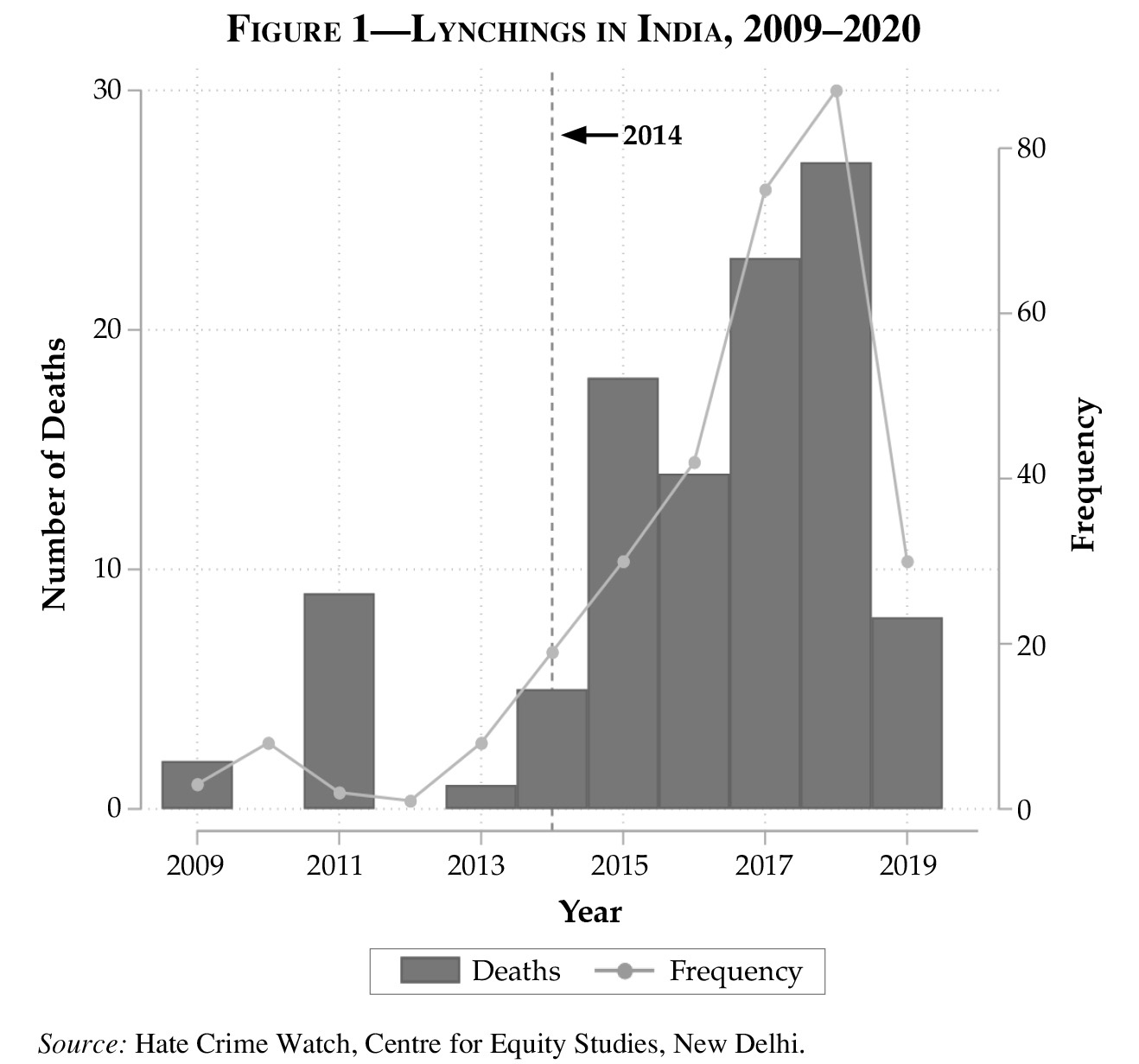
In India, the primary form of mob violence used to be the riot. Lately, however, riots have declined in frequency,22 and lynchings are taking their place. Riots and lynchings are different, and exploring how they differ will also clarify what the role of the state is in vigilante violence.


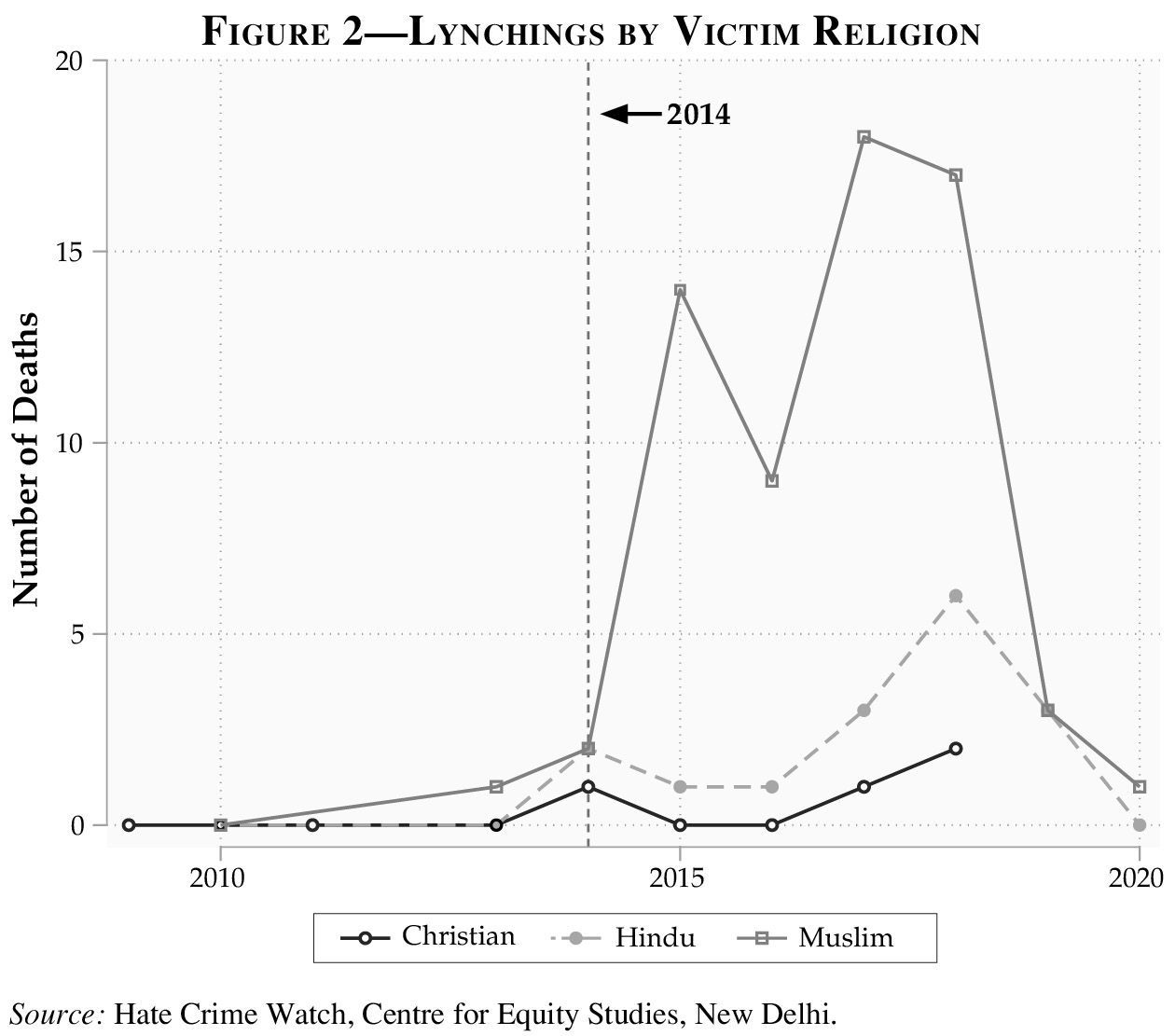
Figure 1 shows lynchings since 2009. Modi and the BJP entered government in May 2014, and after that time we see a distinct rise.23 Figure 2 breaks down lynchings by the victim’s religion. Muslim victims exceed Hindu victims several times over even though Muslims form a much smaller share of the population. The numbers leave no doubt that Muslims have been the main victims of lynching.

If the majority of criminals belong to a particular group, the majority of victims of vigilante justice will be from that group.  


It can also be shown that a disproportionately large proportion of lynchings have taken place in states ruled by the BJP.

Because these are states being targeted by anti-BJP forces though, it must be admitted, this helps the BJP gain popularity amongst Hindus. 

 This is consistent with the comparative research on ethnic or racial lynchings mentioned above. BJP governments rarely condemn lynchings in anything like forthright terms, and BJP-affiliated groups tend to celebrate the ringleaders of such violence and present the lynching as justified. A common aim of lynchings is to prevent the eating of beef, the production and selling of cow meat, and the cattle trade.

Cow protection is a Directive Principle in the Constitution.  

Because cows are sacred to Hinduism, say Hindu nationalists, these activities must be stopped. Other aims of lynchings include preventing or punishing conversions to Islam, and stopping young Muslim men from marrying Hindu women. These too are ideological projects for Hindu nationalists. So long as lynching is presented as serving a larger ideological cause, the BJP’s state administrations rarely take action.

says a guy who is anti-BJP 


Indeed, something worse is now being done. In several BJP states, local officials or the police are increasingly bulldozing Muslim homes and businesses while claiming that Muslims of the vicinity took part in a protest, impeded the celebration of a Hindu festival, or committed a crime. Court orders for these demolitions of property are neither wanted nor sought. Thirteen states today have non-BJP governments, so these punitive administrative or police actions are not yet an all-India phenomenon. But in several BJP-run states, recent years have seen instances of Muslim properties disappearing under bulldozer blades.

This is hugely popular.  


What makes Modi’s India and the Jim Crow United States comparable?

Nothing. India is like Pakistan or Sri Lanka. It is not a rich 'settler colony'.  

It is the idea that electorally legitimated majoritarianism can be used to create an ensemble of laws and practices which seek to deprive a disfavored group of its rights, subject it to extralegal violence, and reduce it to second-class citizenship.

That idea has been flourishing in many Muslim states.  


The emergence of the full-blown Jim Crow system in the post–Civil War United States took several decades. As an ideology, Hindu nationalism has been in power at the national level for only a single decade.

No. It came to power in 1947 and stayed in power. One might say that 2004-2014 was exceptional because Sonia- who is Roman Catholic- was in charge. But that was a flash in the pan.  

The political order preferred by Hindu nationalism is not yet complete or firmly in place; only the first steps have been taken. If the BJP keeps winning elections, there can be no doubt that these steps will continue and the impetus behind them will be stronger. In the United States, Jim Crow went against the Constitution, but the courts for a long time would not apply that document.

Because the US Constitution was founded on White Racism just as the Indian constitution is founded on Hindu supremacy.  

In India likewise, the judiciary is not playing its assigned role as guarantor of liberal constitutionalism against the trespasses of overweening executives and legislatures.

The Bench has been to the right of the Government.  

Although it took them until the 1950s to fulfill their role, America’s courts eventually did so and began enforcing civil rights.

Because that was good for National Security.  

Will India’s?

No.  

Whatever the answer, friends of liberal, constitutional democracy will be wise not to count on judges to salvage the situation. In the end, only the voters can decide to stop Hindu nationalism, or else underwrite its final advance. The choice is theirs.

Uttertosh is saying to his fellow Hindus- vote for Modi otherwise you will be swamped by refugees from a sinking Pakistan. They will slit your throats. Be like Europe which is now electing right-wing leaders. Modi is a bit wishy-washy. Go for stronger meat- just not beef. 

Sunday, 26 June 2022

Ashutosh Varshney on why India isn't a nation

Assuredtosh Varshney wrote some 10 years ago- 


A nation-state, as Ernest Gellner explained in his 1983 classic Nations and Nationalism, is a place where the territorial boundaries of a state and the cultural boundaries of a nation coincide.

Gellner was wrong. A Nation State exists even if some of its people are on the wrong side of a border. Indeed, it even exists if the majority of its people are on the wrong side of a border. But it too may have minorities whose closest relatives are across the border not within it.  

Modern France is viewed as the best historical example of such fusion.

Why? It isn't a good example at all. The French speaking Belgians ought to belong to it. Balance of Power considerations led to the creation of that unhappy, deeply divided country. Perhaps it will be partitioned.  

In the current literature on nationalism, however, the French model of undifferentiated citizenship is viewed as a nineteenth-century curiosity, to be studied primarily to understand why the Basques and Bretons did not rebel against Paris and its profoundly assimilationist thrust.

The French Army kicked ass except when fighting Germans. That's a good enough reason not to rebel.  

In his classic 1976 study Peasants into Frenchmen: The Modernization of Rural France, 1870-1914, Eugen Weber showed how the French central state, using military conscription and compulsory public schooling, turned Catalans, Corsicans, Gascons, Normans, Picards, Vendéens, the aforementioned Basques and Bretons, and a host of others into Frenchmen.

What happened in 1870? France was beaten by Germany. If it wanted to turn everybody into 'Frenchmen' it was because the French still believed they were good at fighting. Sadly their offensive doctrine consisted of shouting loudly and charging at the Germans who had better long range artillery. In the Second War, instead of 'attacque a outrance'  the French simply surrendered. In the end the Germans were beaten by the Russians while France itself was liberated by English speaking peoples. That's why they still hate us. 

As part of this project, the diversities that once so vividly characterized France were deliberately and systematically flattened.

You can't flatten a Frenchman. You may want to, but you can't. They re-inflate themselves too quickly. Like the Italians, they are more cunning than their own bureaucrats. So long as they continue to value their own regional cuisine and wine or cider or whatever, France can never become the subject of Foucauldian bio-politics.  

And vivid these diversities had been: As E.J. Hobsbawm reports in Nations and Nationalism since 1780: Programme, Myth, Reality, at the time of the French Revolution more than half of all those living in France spoke no French at all, and “only 12-13 percent spoke it correctly.”

The figure for those who spoke Italian even in 1890 was lower still. But this scarcely mattered- except perhaps to the Army.  

Today, Japan, Portugal, and some Scandinavian countries approximate the French nation-state model.

Very true. Many Japanese speaking people live in Belgium which lies to the north of its border. Also, Japan does not have a monarch.  Scandinavia is unique in that the divorce between Norway and Sweden at the beginning of the Twentieth Century was completely peaceful. Both, like France, are monarchies. 

Most of the rest of the world comprises either countries marked by strong ethnic diversity,

France has 8 active separatist movements. We may think they all wear striped jerseys, berets, and have a string of garlic around their neck but there's a lot of ethnic diversity there- Flemish people, Normans, Bretons, Alsatians, Provencals, Catalans, Occitanians and so forth. Admittedly Alsatians are dogs and say woof woof but the important thing to note is that they want autonomy from France because Macron isn't taking them walkies often enough. 

some of which has a territorial aspect and may give rise to demands for independence, or multicultural countries where ethnic diversity is spread around and lacks a politically charged territorial focus. The United States is an example of this latter type—its Civil War was a constitutional and, some would say, cultural fight among people of essentially the same stock who spoke a common language.

Sadly, some are now speaking of 'Texit' or a secession of Red states or some such nonsense. It is interesting that Ashutosh does not mention what happened to the First Nations. Maybe nobody told him about it.  

Stepan, Linz, and Yadav call the former class of political entities—those with strong ethnic diversity, some of it territorially concentrated—not “nation-states” but “state-nations.” Belgium, Canada, India, and Spain are state-nations, as are Nigeria, Pakistan, the Philippines, Sri Lanka, and Thailand.

This is stupid shit. India and Sri Lanka and Thailand are nations and have been so for thousands of years in the case of India and at least 2000 years in the case of Sri Lanka. The Thais may have arrived more recently but the Khmers have always been there. By contrast, Belgium and Canada and Nigeria and Pakistan are recent constructs. The Philippines is differentiated by religion from other Malay speaking countries as is Pakistan and Bangladesh from India.  

Each has geographically concentrated ethnocommunal differences. The book’s arguments, therefore, will have resonance in many societies.

Except India which has been a nation longer than the Jews or the Greeks but not perhaps the Egyptians and the Chinese.  

Nation-states tend to be assimilationist. Among their key features is the erasure of ethnic and cultural diversities.

Why should they bother to do any such thing? It is enough to have a common religion and for it to be permissible to inter-marry. Otherwise the smart thing to do is to adapt to the climate and geography of the region. A Garwalhi Brahmin would freeze to death if he dressed like a Tamil Brahmin. What is certain is that a Tamil gets exactly the same service from a Garwalhi priest as he would from a Tamil priest and vice versa.  

State-nations, by contrast, work on two levels: They strive to create a sense of belonging

Whereas Nation States employ a large class of officials to go around knocking on people's doors and shouting 'You don't belong here. Get the fuck out of this country, Mummy. Oh, btw. could I drop off some dirty laundry?  Please be careful ironing my blouse. Luv u!'  

with respect to the larger political community, and at the same time they put in place institutional protections for politically salient diversities having to do with language, religion, or sacrosanct cultural norms.

That was what General Custer was doing at Little Bighorn. He was putting in place institutional protections against Redskins not getting butchered in accordance with their sacrosanct cultural norms.  

If such diversities are territorially specific, they normally require the protection afforded by federal arrangements.

Why? Such 'diversities' can exist under a tyrant or an Emperor or a Commissar or a Unitary Democracy- if that is what the majority wants. Federations arise where a bunch of sovereign or otherwise separate administrative units come together such that each preserves a separate legal code. That's what happened between England and Scotland which is why they have separate Justice systems. It also happened in the US and Canada and so forth. But it didn't happen in India. 

This double-barreled character sets the state-nation apart from Arend Lijphart’s consociationalism, which focuses solely on setting up institutional safeguards for ethnoreligious diversity and pays no heed to the task of nurturing countrywide loyalties at the same time.

Like Lebanon? Is that what happened there? The truth is the Maronites fucked up because they were a bunch of clannish factionalized gangsters. Where does 'consociationalism' prevail? Nowhere which aint a shitshow. The word 'legal pluralism' was coined for Burma. It's still a shitshow. Ceylon got strong constitutional protection for minorities along with universal suffrage in 1931. Still a shitshow. Lebanon- but enough about Lebanon. It has great people but shitshows don't get shittier.

The concept is also to be distinguished from Will Kymlicka’s “multicultural citizenship.”

Who isn't just Canadian, he's a fucking Canadian vegan! You can't tell me he has a soul. Hopefully he'll come out for votes for, not Mounties, but Moose.  

Kymlicka, too, emphasizes recognition of certain forms of diversity, but not a coexistence of centrifugal and centripetal institutions.

Canada has indigenous people as well as French speaking people.  It needs to be give special rights to both without falling foul of equal rights legislation. But this has nothing to do with ancient nations like India. China did say it would give Hong Kong special rights but it stopped bothering with that pretense once Taiwan showed it wasn't buying it. 

According to the state-nation view, one can be both a Catalan and a Spaniard, a Québécois and a Canadian, or a Punjabi and an Indian.

The problem is that some Catalans don't want to be Spanish. Canadians of all descriptions might rebel against the 'Laurentian elite'. Canadian Sikhs tend to be Khalistanis and thus don't want Punjabis to be Indian at all. However Hindus in India don't not want to be Indian while remaining Punjabi or Tamil or whatever. Why? India has been a nation since ancient times. So has China but the Taiwanese and the Hong Kongers have good reasons not to want to be under the thumb of the Chinese Communist Party. Tibet however was never part of the Chinese nation. 

Undifferentiated and singular Spaniards, Canadians, and Indians do exist.

What's an undifferentiated Indian? The thing does not exist. You have an 'ancestral place', a 'parent's place', and then the place where you 'lodge'. Thus I'm from Kumbakonam by way of Madras and Delhi though from the legal point of view I am a Londoner and a British national. By this last piece of information people understand that I clean toilets in England. Still, the bit about Chennai and Delhi confers a certain amount of prestige unless you actually come from Delhi or Chennai in which case you become depressed.

But a lot of citizens in such countries tend to have multiple, though complementary, identities.

Very true. During the day they are billionaire playboys. At night they turn into Batman. The fact is an individual identity is denoted by a set of traits- height, weight, age, ethnicity, religion, languages spoken and so on. This does not mean anybody has multiple identities. True, some people have dual or triple nationality. Some may get to vote in more than one State or Province. But their identity remains singular unless they have gained Yogic superpowers and thus can exist in more than one body simultaneously.  

The wisdom of the state-nation approach is the recognition that trying to hammer together these various identities into a single national identity would not solidify the state, but instead would shatter it.

But that is true of families and business enterprises and social clubs and any sort of society. It is not a good idea to make Mummy sport a mustache like Daddy. The cat would protest if it were forced to get a job in Business Process Outsourcing. Baby however would thrive in that environment.  

India is an especially complex case.

Unless you are Hindu in which case your religion tells you you belong to an ancient Nation which however was a bit shit at fighting and thus which came under British paramountcy. Thankfully, Jinnah did us a favor by getting the Muslims out of our hair. We don't have to pretend that Hinduism isn't what holds the country together. But Europeans too are no longer apologizing about being White and Christian. Multi-culti is well and truly over.  

It has diversities of caste, religion, language, and tribe, the latter two of which are territorially concentrated.

Because it is big and has been around for thousands of years.  

Because of this, language and tribe—the former, especially—have become Indian federalism’s main concerns.

There is no Indian federalism. The constitution is wholly unitary.  

Fifteen languages form the basis on which state lines are drawn within India.

No. Some linguistic states have been split into smaller units. This has improved governance.  

Each state (there are 28, plus 7 union territories) has its own official language.

Nagaland chose English as its state language. This is because the indigenous people have about 20 mutually unintelligible languages.  

That language serves as the medium of instruction in government schools. Dealings among states, or between a state and the federal government, go on in English or Hindi, which is the lingua franca

no. It is is the official language.  

in six states. Most of the fifteen languages are both the main language of a single state and scarcely spoken outside that state.

But, if Hinduism prevails, there is no secessionism. 

Major language groups were

recognized and deliberately fostered and used for administrative purposes by the Brits. Why? Because that governance was better and cheaper. The British administrator had to learn at least one classical and one vernacular language to get his salary increment.  

given a direct stake in the Indian system

by the Brits. The Indians cautiously extended this. Why? It improved governance.  Still, there were some nutters- e.g. Gandhi- who wanted to impose Hindi as the national language.

as well as separated from one another.

Or not. Punjab and Haryana share Chandigarh.  

Their stake came in the form of a politically legitimized regionalism.

Legitimized by the Brits. It was they who fostered vernacular languages and chose to do so in the script of the majority. 

A political party in Gujarat, Karnataka, or Tamil Nadu cannot easily go against the commonly held notions of Gujarati, Kannada, or Tamil cultural pride.

Nor can the Indian National Congress go against the commonly held notions of the Hindu majority.  

But claims supporting Tamil heritage, for example, mean little outside the state of Tamil Nadu.

Ditto re. claims regarding Welsh outside Wales. On the other hand, English is a wine that needs no bush.  

Hindus, Muslims, and Christians can be found in most states

not Hindus if the Muslims or Christians kill them 

(and the various castes are spread out as well), but speakers of state languages such as Gujarati, Kannada, or Tamil are found only in small numbers outside their respective home states.

Very few Bengalis are found in Tripura or Assam- right?  

A state-nation means more than just a safe way to institutionalize diversity.

Why institutionalize it if it is not safe to do so?  

It also, as the authors stress, means a simultaneous nurturing of commitment to the larger Indian polity.

Back then it was the fashion to pretend that politics was about being very respectful and nurturing and empathetic to everybody else. Consider all beings as requiring gratuitous rape counselling. Then there was Brexit and Trump and Orban and so forth. The political scientists shat themselves and ran back to their safe spaces on campuses where they all got Me Too'd or else fell victim to some other variant of the woke circular firing squad.  

In India, the institutions that have played key roles in generating loyalty to the Federal Republic include the Congress party,

This was written in 2012, the year the activists fucked up Manmohan's attempt to keep growth on track. Still, it took the genius of Rahul to make Congress unelectable.  

the armed forces, the federal civil service, the Indian Institutes of Technology and Indian Institutes of Management, central high schools, the Supreme Court, and (over the last two decades) the Election Commission.

This is foolish. The vast majority of the population has little contact with any of these things. Religion matters. Local leaders matter. But, more and more, film and television matter. But this means political scientists don't matter. But Prashant Kishore does matter. He has common sense.  


Shielding diversity while building unity

and protecting fidelity while violating chastity and fostering unanimity while sexually harassing harmony and germinating plurality while fisting governmentality vigorously

is not always an easy two-step to dance.

 Unless such dancing is shielded while unity is getting built up Ashutosh's asshole.

India’s record is not perfect, and secessionism has not been unknown. The authors examine the insurgencies in Kashmir, Mizoram, Nagaland, and Punjab, finding that each arose

because non-Hindus were a majority or near majority 

largely because New Delhi seriously departed from the state-nation model. (In Kashmir, India-Pakistan tensions have caused additional problems as well.)

That's what happened in Dokhlam as well. Chinese soldiers were protesting New Delhi's serious departure from some shite Yogendra Yadav pulled out his ass.  

On the whole, we learn, state-nation policies in India have yielded remarkable success. In nationwide surveys, more than 85 percent

Hindus are about that percentage of the population 

of those polled say that they are “proud” or “very proud” of India—numbers that roughly match what pollsters uncover in Australia, Canada, and the United States, and are higher than those commonly reported by Belgians, Brazilians, Germans, or the Swiss. In other surveys, only about a fifth of randomly sampled Indians say that they consider their identity to be mostly or completely drawn from their home state rather than India as a whole.

In the case of non-Hindus, this is a function of education and mobility. India is big enough to generate a sense of hope. Your own District may be going down the tubes but there is always the rumor that things are good somewhere else. 

Thus the simultaneous pursuit of nationalism and subnationalism has been reasonably successful in India.

Because Hinduism has reformed and revived. Unlike Islam or Christianity, Hinduism is a quintessentially National religion. What's more it doesn't have a political fundamentalism. It has a political ecumenism. 

Even in 1989-90, as secessionist revolts raged in both Punjab and Kashmir,

where Hindus were getting slaughtered 

only about 5 percent of India’s vast populace was directly affected. Across most of the country, life went on more or less normally. Commitment to the larger polity has been achieved not by a suppression of diversities, but by their recognition.

and soldiers and policemen killing killers. How many died in the Khalistan insurrection? 12,000? 50,000? Extra-judicial killing is what does the heavy lifting, not fostering unity while giving diversity a handjob. 

Two chapters comparing and contrasting how India and Sri Lanka have dealt with their respective Tamil populations underscores this point.

What fucking point? Tamils are the majority in Tamil Nadu. They aren't in Sri Lanka. 

Sri Lanka’s dominant Sinhalese might have adopted federal institutions in order to reconcile the Tamils, who live mainly at the north end of the island country, but instead pursued French-style nation-state policies, much to the detriment of democracy and national unity alike.

This is nonsense. Sri Lanka's problems started when the Government weakened the Army fearing a 'Burgher' coup. First the Trostkyites and then the Tigers- under the leadership of a Christian- ran amok. But the problem in Sri Lanka has to do with leaders doing stupid shit. A bit like Lebanon really. Both countries started off with complicated Constitutions which proved useless or actively mischievous. But leaders doing stupid shit compound the problem. 

India gave its Tamil minority

India does not have a Tamil minority. It has a Hindu majority which includes Tamil Hindus and Gujarati Hindus and so forth.  

far better treatment, including a state where Tamil is the official language.

Fuck is wrong with this cunt? Does he really think that New Delhi gave this as a nice Diwali present to the poor little Tamils? Tamil was already the language of the Presidency. It was the Telugus who were going on hunger strike to get their own state. Madras was a great city when New Delhi was still a blue-print. Rajaji was the first Governor General of India. Kamraj was the kingmaker in the early Sixties. But the Kamraj plan was silly. T.N started to rise when it turned its back on Congress.  

As a result, Tamil separatism was nipped in the bud,

This is crazy shit. It was the Chinese invasion which took the sails out of it. MGR and other film-stars were busy raising funds and boosting the morale of the troops. The problem with Dravidian ideology was that the Keralites and the Andhras didn't have a problem with Sanskrit words. Karnataka had historically been the center of the Vijaynagar based Hindu revival and resistance. It is the one Southern State which might become a BJP stronghold provided caste rivalries and Lingayat v Veershaiva type problems subside. Meanwhile Tamils are hoping that Stalin can deliver rapid growth and Malayalees are hoping Vijayan will be the Deng Xiaoping of India. But this does not mean Tamils or Malyallees are less devout than anybody in any other part of India. 

and today most Tamils feel that they have a serious stake in the Federal Republic of India.

How very patronizing! The fact is the South is respected because it resisted Islam.  This deracinated cunt probably has some Aryanist bee in his bonnet. America is the right place for him. 

As much as I like this book, I do have some criticisms to offer. First, although the term “multinational” might make sense for Belgium, Canada, or Spain, it does not for India.

Because the Hindus are an ancient nation.  

Territorially concentrated ethnic diversity may well be a favorable ground for nationalist insurrection, but it does not have to be. India’s various geographically based groups are at best ethnic groups, not nations.

Jinnah's two nation theory prevailed. But whereas Hindus stick together as a Nation, Muslims don't even if they were originally Hindu.  

Even before a state-nation model was explicitly embraced after independence came in 1947, most linguistic groups had shown no desire for independence.

But first Buddhist Burma split off and then the majority Muslim areas. One reason Hindus want to stick together is because they fear a resurgence of Muslim power. At any rate that is what Gandhi said in 1939.  

Feeling a regional as well as a larger all-India national identity has been a feature of Indian politics at least since the freedom movement became mass-based under Mahatma Gandhi in the 1920s.

It was a feature of Swami Vivekandanda and Swami Dayanand Sarasvati's thinking. Indeed, it was a feature of every Swamy or Acharya or Yogi's thinking. Gandhi was a fuckwit who screwed up his one job which was to keep the Muslims on side till the Brits agreed to negotiate with the Congress-Khilafat combine. Gandhi's unilateral surrender made Partition inevitable. Look at it from the Muslim perspective. What is the point of being chained to a very large number of whiney pussies who talk incessant bollocks? Let those fuckers starve and surrender to any fucking foreigner who turns up. Create a Pakistan where Indic people aren't saddled with a religion fit only for cowards and crackpots. 

Indeed, it is striking that Kashmir, Mizoram, and Nagaland were all places where the British or princely authorities did not allow the freedom movement to emerge, and all would be wracked by secessionism after 1947.

Crazy shit. What happened in Hyderabad? Patel sent in the Army though, no doubt, the RSS and the Mahasabha also played a role.  

Punjab is a prominent exception to this pattern (it had an active freedom movement yet witnessed secessionism).

Because Sikhs have very good reason to get away from cowardly casteist cunts who refused to let that State develop industrially on the grounds that the Pakis might invade and take it over. To be fair, it was Leftists who dictated this stupid and evil policy which refused to admit that Sikhism is a pure spiritual one hundred percent anti-caste Religion. But then so is Hinduism according the best of its own Brahmin Acharyas.  

Still, the pattern remains strikingly suggestive.

The pattern is simple. Hindus are the majority. If they get behind cowardly crackpots or Socialist shitheads then minorities should get the fuck away from that Hindu majority because it is useless and talks incessant bollocks. But if the Hindus do sensible things then everybody benefits.  

Second, was France not turned into a nation-state

Napoleon turned it into a fucking Empire. Then it was cut down to size though it kept doing stupid shit. Germany too became an Empire and did even stupider shit. Then it became a thousand year Reich which did such incredibly stupid shit that Europe itself declined to a dependency of either America and Communist Eurasia. That may well be the ultimate outcome of the Ukraine conflict. 

despite some territorially concentrated diversities? Is that not one way to read Eugen Weber?

Why read that shithead?  'Modernization theory' is as dead as a dodo. Still, he wrote like a gentleman. 

If so, would it not be more accurate to say that France became a “nation-state” due to the exigencies of early-modern times, and not because it lacked territorially specific diversities?

It would be accurate to say that the levee en masse against the crowned heads of Europe's attempt to reimpose the ancien regime created the French Nation in the same way that the Spanish Armada soldered together the English speaking people though Catholicism continued to be a problem. In other words, the thing didn't actually happen but the myth was stronger than the reality. Henry V was wrong about St. Crispin's day. Every Englishman above a certain age- and I include myself here- remembers the glorious feats we performed though, truth be told, we are a bit ashamed that our valor was expended on cheese-eating surrender monkeys. Fortunately, first the Kaiser and then Herr Hitler gave us a chance to square off against a sturdier, if stupider, enemy. As for the Rooskies, we'll just sanction them and take away their yachts. That will teach them. 

Would today’s minorities readily accept the superiority of a “high” culture imported from and imposed by Paris and the Ile-de-France?

Today's minorities, in France, are of migrant descent.  

The question has implications that go well beyond the French case. These point in the direction of constructivism, now the mainstream view about national (and ethnic) identities.

 A view which is mainstream among stupid peeps is still a stupid view. Did these guys predict Donald Trump? There's definitely an identity of some sort being asserted there. What is it? Fuck if I know. 

All nations are constructed.

In the sense that cats are socially constructed. If we treated cats the way we treat dogs they will say woof woof and want to play fetch.  

But in the late twentieth and early twenty-first centuries, heavy-handed nation-building à la française seems neither possible nor desirable.

Tell that to the Uighurs and Tibetans and so forth.  

It is too likely to undermine rather than bolster unity, even as democracy suffers collateral damage amid violent ethnic or ethnosectarian struggle.

So, that's what happened to Ashraf Ghani in Afghanistan! He succumbed to 'ethnosectarian' struggle. Democracy was collateral damage. Nothing was the fault of Trump or Biden. Good to know.  

Arguments about some languages, races, or ethnic groups being intrinsically superior will today be called colonialism in another form, and resisted as such.

Fuck that. Everyone is welcome to say their own language is super-cool and their Mummy is the bestest Mummy in the Universe and so on and so forth.  

That was not so in the late eighteenth century when France as we know it today came into being: Ernest Gellner’s “high culture” could more easily spread and assert its systematic dominance over “low cultures” because the localism of the “low” cultures had only raw custom or inarticulate habit on its side, and could not draw on a powerful modern doctrine such as anticolonialism to spur it to resistance.

So, the Gascon and the Breton was like the Tamil of Ashutosh's imagination- an inferior being who was bound to imitate 'high culture'. Sadly, in India, New Delhi told the Tamils that they could speak their own  jibber jabber and awarded them a nice little State of their own. Had this not happened those Madrasi monkeys could have evolved into proper human beings. Ashutosh himself might be prepared to visit that benighted place. However he will refuse to do lungi dance like Shahrukh. This is because he draws on powerful modern doctrines such as anti-colonialism which disappeared sixty years ago because colonialism had  disappeared by then. Still, that counts as modern to academics in shite subjects because their brains turned to shit decades ago. 

Saturday, 15 August 2020

Ashutosh Varshney, Ambedkar & the vacuity of political philosophy

Writer of assured tosh Varshney, reviewing a book by fellow cretin Madhav Khosla, writes in the Boston Review- 


Since the mid-1960s social scientists have agreed that, of the countries where democracy has emerged, its flourishing has been most improbable in India.

But everybody has since agreed that Social Scientists are as stupid as shit. America started off as a democracy because it could be nothing else. So did India. There was no force in India strong enough to turn it into something else. America, it is true, became rich and other countries became democratic as they became richer. This led them to think of Democracy as some sort of luxury rather than the cheapest way to extract a little in tax in return for a small amount of social services and public goods.  

Of course, the health of Indian democracy under Prime Minister Narendra Modi, incumbent for the past six years, has caused widespread concern.

Because of the incessant propaganda of a senile, deracinated, academic elite. But Indian voters, who know the reality, show no concern whatsoever.  

The Swedish V-Dem Institute’s

which is as stupid as shit.  

recent Democracy Report, which laments the decline in democracy globally, warns that India “is on the verge of losing its status as a democracy due to the severe shrinking of space for the media, civil society, and the opposition.” Yet the report also suggests that India’s democracy is in decline, not collapse.

But Swedes know shit about India. What they say does not matter in the slightest. On the other hand, potatoes are well informed.

Rather than understanding social conditions as a creator of politics, India’s democratic project was based on the notion that politics could change adverse social and economic conditions.

This is foolish. Everybody says politics should make things better. What India said was the guy who gets a lot of votes can probably do stuff more cheaply than a guy whom nobody likes. This is because votes reflect popularity.  

That judgment, in part, reflects the long-recognized exceptional nature of India’s democracy, established where political philosophers thought its emergence impossible.

But political philosophers are as stupid as shit. Nobody listens to them. As the Chinese say 'Science students look down on Arts students. Arts students look down on Politics students. Politics students look down on their teachers'.  

At a time when countries around the world are experiencing democratic backsliding—Freedom House’s widely read annual report warned that “2019 was the 14th consecutive year of decline in global freedom”—we may have much to learn from India’s example.

No we don't- unless we are very large countries with lots of languages and castes and an enormous population of very very poor peeps and the name of our country happens to be India and we happen to be located exactly where India is located.  

But to understand what it tells us about the prospects for democracy in difficult settings we must first understand India’s democratic founding.

There is no such need. The Brits were increasing the amount of representative government for one simple reason. They wanted to raise a little more in tax and spend a little more on social services so that Income could rise a little and thus tax revenue could increase. They had tried 'tax farming', but the 'zamindars' kept most of the money and so the share of land revenue in the budget kept declining. Taxation without Representation is possible- but it is costly. There is a danger that the people will rebel. During the Boston Tea Party Whites dressed up as Red Indian. In India, barristocrats discarded their Savile Row suits for loincloths.  


This August India celebrates seventy-three years as an independent nation. During these decades of independence, the country has been run democratically (aside from the twenty-one months of the infamous Emergency from 1975 to 1977).

Actually, Mrs Gandhi had a majority. So India was run democratically but not under the Rule of Law.  

With the exception of Costa Rica, no other developing country has enjoyed as long a democratic run since World War II.

Sri Lanka got Universal Franchise some 20 years before India. It has been run democratically ever since. Varshney doesn't know this. Why? He teaches a shite subject which makes people stupider and more ignorant than the layman.  

And in the case of Costa Rica, it is worth bearing in mind that the country is small, with a GDP per capita six times that of India’s (in 2019 Costa Rica’s GDP per capita was $12,238, while India’s was $2,104).

Sri Lanka too is richer than India though it may get poorer if its leaders continue to do stupid shit.

Modern democratic theory holds that democracies generally live longer when their citizens have higher levels of income.

So the theory is false. Junk it.  

And in societies with lower incomes, the mortality rate of democracy is often high.

Because it isn't getting stuff done as cheaply as possible.  

For decades now India has defied this conventional scholarly wisdom.

Because democracy is clearly the cheapest way to get what little gets done, done.  

Surprise at India’s democratic success is well documented.

What is better documented is the stupidity of Political Scientists.  

Barrington Moore was the first major social scientist to note the uncommon and the unexpected.

I've never heard of him.  Apparently he was famous for saying ' "no bourgeois, no democracy,". It did not strike him that there had been plenty of countries with no democracy which had a bourgeoisie. This guy must have heard of Franco and Hitler and Mussolini and Salazar. 

In 1966 he observed that “as a political species, [India] does belong to the modern world. At the time of Nehru's death in 1964 political democracy had existed for seventeen years. If imperfect, the democracy was no mere sham.”

But it also existed in Sri Lanka! 

Half a decade later, in 1971, Robert Dahl—arguably the most influential figure in democratic theory—wrote that India was a “deviant case . . . indeed a polyarchy.” Polyarchy, so used, was Dahl’s conceptual term for democracy. By 1989 Dahl had no doubt that India was “a leading contemporary exception” to democratic theory.

But he too forgot Sri Lanka! By 1968, Mauritius too was a democracy. 

Astonishment at India’s success continued to register among political scientists into this century. On the basis of a massive international dataset spanning 1950 to 1990, Adam Przeworski concluded in 2000 that “the odds against democracy in India were extremely high.”

The odds against any other system were much higher. Congress was too factionalized and weak on the ground to turn the country into a One Party State. No one ethnicity could dominate the country, or even hold a particular State without party rivalry, because of the caste system.  The Army didn't want, and couldn't, hold the whole country down. Communists were too stupid. The Hindus had never had a centralized Religion. So what else could India be save what it is? 

It then comes as a surprise that Madhav Khosla, author of the new book India's Founding Moment: The Constitution of a Most Surprising Democracy (2020), remarks that the founding of India’s democracy—particularly, its constitutional founding—has been “neglected within the history of political ideas.” Khosla is a political philosopher, a faculty member at both Columbia Law School in New York and Ashoka University in India. His surprising observation speaks to the divide between political philosophy and the more empirically driven social sciences—a divide that renders both fields intellectually poorer.

But both disciplines attract cretins. The wonder is that they can tie their own shoelaces.  

There should be some degree of intellectual trespassing between political philosophy and the social sciences; without it, neither field can know the other nor heed the other’s explorations. Khosla forgoes any discussion of India’s representation in empirical democratic theory and instead responds to the intellectual terrain of political philosophy.

Which everybody knows to be pure horseshit.  

He begins with G. W. F. Hegel,

For heaven's sake why? Where in the world will you find a country whose ruling political philosophy is Hegelian?  

who thought that India was doomed to be a despotic polity and speculated that Indians lived according to age-old caste rules rather than as autonomous agents capable of making conscious choices.

So what? All Hegel's ideas were shit. The guy was a shithead. No doubt he said nice things about the Prussian State because Prussian academics were Civil Servants but Prussia didn't actually turn out so great- did it? 

In such a society, made up of citizens supposedly devoid of agency, the older order—hierarchical, oppressive, and despotic—would continue ad infinitum, and a modern political order breaking from tradition was virtually impossible.

Unless it was cheaper than any other alternative.  

Approximately half a century later, John Stuart Mill considered India through the lens of colonialism. Mill distinguished between colonies that were “of similar civilization to the ruling country, capable and ripe for representative government, such as British possessions in America and Australia” and other colonies “like India (that) are . . . at a great distance” from the British civilization.

Mill had worked for the India Office. His dad had turned out to be right. The Indian comprador class wanted the Brits around because that was the cheapest way for them to get rich. But while Mill was writing shite about India, British officials were realizing that their own salaries and pensions would decline in purchasing power unless the tax-base was increased. The cheapest way to do this was through representative institutions rather than tax-farming. That's why some British officials set up the Indian National Congress. Manchester's Liberals and Radicals started to see that India represented a stagnant market. British manufacturers would benefit if India gained more freedom of a democratic type. Meanwhile, in India, those who got rich through the  cotton boom (caused by the Civil War) were financing a new Liberal type of Indian politician. One, Dadhabhai Naoroji, got elected to the British parliament. His statistical work showed that a despotic type of revenue extraction would render India unprofitable to defend. This argument was not compelling so long as British Naval Supremacy was unchallenged and India got a 'free ride'. But geopolitical changes in the Twentieth Century made it inevitable that India would go down the democratic route- if only to be able to pay for its own defense. 

These polities, so different from that of their colonists, only allowed for “a choice of despotisms.” Following this interpretation, British tutelage in the form of colonization was India’s best option. In contrast, the advanced European civilizations and their cousins—Australia, New Zealand, Canada, and, earlier, the United States—could have democratic rule owing to their higher capability for rational conduct.

But, they would have taken such power in any case. India could have been conciliated so long as it was getting a 'free ride' on British Naval power. But once that power was challenged India would not, indeed, could not, pay a fair price for this 'public good'.  


Khosla’s book largely seeks to remedy political philosophy’s failed portrayal of India. In doing so, the book presents an ambitious and novel claim:

The historical conditions of India’s creation should encourage us to see it as the paradigmatic democratic experience of the twentieth century, in much the same way that Tocqueville had seen the United States as the model nineteenth-century democracy.

This is nonsense. India's experience is only relevant to countries with a deeply rooted caste system which has been instrumentalized for political purposes. The other point is that India is Hindu. Hindus had realized that they needed to unite against a renascent Islam. Otherwise, the country would once again be conquered by 'salami' tactics. 

Khosla concentrates on India’s democratic origins,

No. That would require explaining why India's own indigenous ideas about 'loyalty' and the need for a virtuous Prince broke down. This would require an encyclopedic knowledge of Indic languages and texts.  Khosla, poor fellow, lacks any such expertise. We are happy if he does not masturbate in public. More than that we can't hope for. 

while the aforementioned empirical theories examine democracy’s persistence. The question of democracy’s persistence is not fundamentally a normative one; it has well-known empirical tests. But when an institutional framework is originally established, the normative visions of the founders—about the kind of society they wish to build and the reasons for its building—are on full display, and an analytic space for political philosophy clearly emerges.

'Analytic space?'. What if politicians tell lies or are fantasists- as has been known to happen? What sort of space do you get then?  

So how did India’s founders come to imagine a democratic polity in a setting that conventional wisdom

Wisdom? Some stupid European pedants were wise? Fuck off! They were ridiculed by their own people.  Anyway, Whitey kept saying 'listen up niggah. You iz Bleck. You can have a Chieftain. Maybe you can appoint a Witchdoctor as your Cannibal-in-Chief. What you can't have is Democracy coz monkeys don't vote.' 

had ruled wholly unfit for democracy? Who, after all, thinks of universal franchise when the literacy rate (at the end of British rule) was a mere 17 percent (Mill thought literacy had to be the foundation of franchise), when more than 60 percent of the country was below the poverty line (Mill was unconvinced that the poor should have the right to vote), and when more than twenty languages were spoken in the country (Mill thought that all citizens must speak the same language if democracy was to function)?

The Brits did not listen to Mill. Universal suffrage, which they gave Ceylon in 1930 worked well.  

At independence in 1947, India possessed each of these disqualifying conditions.

But Mill was dead and forgotten. 

But India’s early leaders did not view these as insurmountable obstacles. Instead they decided that voting rights would not be based on literacy, income, property, or gender.

This had been done in 1930. Had the minorities not kicked up a fuss. India would have got this in 1935. 

Each citizen, however deprived, could be assumed to know their own interests as well as the privileged knew theirs. And, respecting India’s linguistic diversity, citizen education was made multilingual to generate a public sphere diverse in language.

It was the Brits who, over the course of the Nineteenth Century, introduced vernacular education and who encouraged literary production in the mother tongue. However, the linguistic re-organization of the States took some time in independent India. 

The founders had confidence in these historically unprecedented

unprecedented? The Brits had provided the precedent! They separated Burma from India and made Sindh a separate State in accordance with the will of the people there. They gave universal suffrage to Ceylon in 1930 and would have given it to the Indians too if the minorities had not objected.  

interventions. At the time of independence, as Khosla strikingly puts it, India’s political leadership held a Hobbesian view of politics,

Rubbish! They were either Gandhian or Democratic Socialists. A few were Stalinists but Congress showed it could beat the shit out of them if they wagged their tail.  

and “at the heart of the Hobbesian project was the independence of politics.”

Nonsense! At its heart, the Hobbesian project is about concentrating power in the person of the Prince. There is no independent Judiciary or Church or countervailing Guild based power.  

The notion of necessary democratic preconditions—literacy, income, language—implied that “human behavior was not the consequence of politics, but instead its cause … a scenario that Thomas Hobbes would have regarded as placing the cart before the horse.”

The truth is we are speaking of a chicken and egg situation. Horsepower can be applied from behind or from in front. It does not greatly matter if you have forward wheel or backward wheel drive.  

Rather than understanding social conditions as a creator of politics, India’s democratic project was based on the notion that politics could change adverse social and economic conditions—that “the practice of democracy would create democratic citizens.” If politics was supreme, the improbable could be achieved.

This is false. Elected ministries soon saw that it was difficult to get kids into schools and even more difficult to keep teachers from playing truant. They soon stopped talking about 'each one teach one' and so forth. They concentrated on caste arithmetic and begging bowl diplomacy.  


India’s leaders were, of course, not alone in assuming the primacy of politics.

India's leaders soon saw that running the country was difficult. So they relied on the Civil Service just as the Viceroys did. The primacy of politics simply meant Parliamentary Musical Chairs. Cabinets became bloated because everybody wanted to be a Minister. Factionalism was rampant. The politician was primarily seen as 'Aaya Ram, Gaya Ram'- i.e. a man who would turn his coat for a price.  

In China, Mao Zedong, too, had similar beliefs.

No. The guy was crazy. He figured out that sowing chaos at the grass-roots level was a good way of getting rid of his internal opponents. Never mind that millions starved. What mattered was that he got to remain Emperor.  

For example, the underlying tide of the Chinese Cultural Revolution (1966–76) rose from the belief that politics could create a new man—one unconcerned with greed, unselfish, laboring for the country, and obedient to Maoist diktat.

Nonsense! Mao told the students that Exams were a tool of oppression. They should beat the fuck out of their teachers and any one else he didn't like. Then he got the workers out of the factories to beat the fuck out of the students and send them into the countryside to do manual labor.  

But despite the deployment of the world’s largest Communist party, no such transformation came about in China.

But Mao stayed Emperor while a lot of people starved or had the shit kicked out of them.  

Only after Mao’s death was China fundamentally transformed, albeit in the opposite way. A few years following Mao’s death, Deng Xiaoping took control and spread the dictum that “to get rich is glorious.”

In the Eighties Chinese Marxists discovered that what Marx actually said was 'to each according to his ability, to each according to his contribution'. This also meant that property relations should be brought into line with the potential contribution of the worker or entrepreneur. China began to get rich when it discovered that Marx was not Hegelian. He was not a political philosopher. He was a Classical Economist.  

In other words, following a Hobbesian conception of politics does not guarantee political transformation:

for the same reason that following a Hogwartsian conception of politics does not guarantee that everybody can ride a broomstick to work. 

the result depends on what ends are being pursued and how such pursuits are shaped through institutional designs

No. The result depends on Economics of the old fashioned competitive kind.  

. Ideas, practices, and leadership matter.

Nonsense! A Hogwarts with great ideals, practices and leadership still won't be able to get broomsticks to turn into a form of aerial transportation.  

If the architecture of the polity is adequately imagined, put in place with resolve and determination, and practiced with nurturing care, the historically exceptional can be realized.

at exactly the moment that pigs start flying around on broomsticks. 


With this understanding of politics, Khosla fixes his gaze on India’s Constitution—produced in 1949 after three years of intense deliberation by a Constituent Assembly and still intact today.

Intact? It has been amended out of all recognition. India's First Amendment is diametrically opposite to the US First Amendment.  

He focuses on three central constitutional elements:

whose precedent was the British 1935 Act. Incidentally, Burma got out a more Lefty Constitution before India. Indeed, every country got a Constitution. But Constitutions don't matter a damn unless you have a well functioning judiciary and an efficient enforcement mechanism.  

the codification of formal rules as opposed to a reliance on tradition,

The Brits codified the shit out of everything from the Nineteenth Century onward.  

the centralization of political authority as opposed to villages governing themselves as self-sufficient democratic units,

which had never happened and would never happen because people run the fuck away from villages the moment it starts to happen.  

and the prioritization of individual representation as opposed to that of communities.

The Minorities, it is true, were stripped of all they had battled for.  

Today India has the longest constitution in the world.

It's not size that counts, darling. 

This is largely owed to B. R. Ambedkar, the chair of the Constitution Drafting Committee of the Constituent Assembly (1946–49).

But Ambedkar dismissed his contribution to the Constitution as 'hack work'. The thing has a Directive Principle on Cow Protection! 

Jawaharlal Nehru, India’s first and longest-serving prime minister (1947–1964), was opposed to extensive codification. However, Ambedkar had other ideas and, in the end, Ambedkar triumphed.

No. Nehru amended the Constitution immediately. Nehru triumphed. That's how come his descendants took over the Congress Party and ruled India longer than any rival collection of parties. 


As a central figure in Constitution-making, Ambedkar’s intellectual persona and personal history were both imprinted in the democratic imagination that formed the Constitution.

Sadly, this wasn't the case at all. He was smart but he was in a very weak position. His pal, Mandal, had chosen Pakistan and then been chased out of there.  

Having received two PhDs—one from Columbia and another from the London School of Economics—Ambedkar was the most highly educated leader in India in the first half of the twentieth century. Yet, according to caste background, he was Dalit. This label relegated him to the lowest social tier, deeming him “untouchable” at that time.

That wasn't the problem. Jagjivan Ram was Dalit and in the Cabinet. But Jagjivan commanded a lot of votes in UP. Ambedkar didn't- even in Maharashtra. That is why Prakash Ambedkar can't get elected whereas Jagjivan's daughter was Speaker. Mayawati, also Dalit, ruled UP and was once considered a future PM. 

Though Dalits were not legally bought and sold as commodities as the slaves were in the United States,

Prior to 1860 some High Caste Hindus were castrated and bought and sold as slaves by Muslims.  

the institution of “untouchability” deprived Dalits of basic rights and elemental dignities for centuries.

Caste was based on a primitive pathogen avoidance theory. It was not linked to rights. Indeed, it gave countervailing power of the sort enjoyed by Trade Unions. By contrast, slavery had existed in India till it was abolished by the Brits about the same time it was abolished in the US. However, hereditary 'debt bondage' persisted. 

The symbolic significance of Ambedkar leading the making of the Constitution is monumental. Imagine W. E. B. Du Bois as a key architect of the U.S. Constitution, were he alive in the 1780s.

This is silly. Ambedkar was put in as Chairman because he was the Law Minister just as his pal, Mandal, was Pakistan's Law Minister. But Mandal had to run away and Ambedkar too was marginalized after he had played a tokenist role.  

In India—a starkly unequal society attempting to institute a democracy—the Constitution needed to function as a kind of political teacher.

But every newly independent country got a Constitution! The thing was just make believe.  You can't learn anything by reading a Constitution. You have to open your eyes and see how things actually work. Gorbachev, a lawyer, read the Soviet Constitution. That's why the fool inadvertently brought down the Soviet Union. 

Ambedkar knew that caste prejudices were deeply entrenched in India, with group and human inequality the system’s governing idea.

But he also knew the solution was economic. The Dalits needed to practice 'Tardean mimetics' and rise up by emulating the smart and enterprising mercantile castes. They needed to get the fuck out of involuted agriculture and benighted villages.  

Brahmins—at the top—enjoyed unencumbered privileges,

Nonsense! The vast majority were as poor as shit. These guys thought they had won the lottery if they got a job as a cook for a Dalit Millionaire in Kanpur! 

and Dalits—at the bottom—enjoyed none at all. In both government and socio-economic life, Brahmins and the other upper castes dominated positions of power.

That's the reason they were hated. They were disproportionately represented in Government jobs. These weren't well paid but they provided security and sources of unjust enrichment. To this day, a lot of Indian politics is about who gets these jobs.  

Regardless of whether those in power were raving casteists, the hegemonic hold of caste-based beliefs in India made it clear to Ambedkar that an insidious form of caste prejudice was only to be expected.

But the thing didn't matter provided Dalits could rise up economically and if they had enough solidarity to create a countervailing power to defend their interests.  Still, spewing hate at Brahmins and Banias (businessmen) is sensible because they are a minority. The dominant 'backward' castes don't like them. 

As a result, Ambedkar did not want to give discretion to legislators. Rather, he believed that “constitutional morality is not a natural sentiment. It has to be cultivated.”

But it was killed by the First Amendment. The Legislature is Supreme. True, at a later point, the Bench tried to make out that the Constitution had a 'Basic Structure'. But what that is, nobody knows.  Anyway, Judges depend on the Ruling Party for post-retirement sinecures. Sooner or later a Party which keeps getting re-elected can do anything it likes. However, it is wiser for it not to do so. Why? Sooner of later it will be out of office and at the mercy of its rivals. 

From his perspective, the Constitution had to be an elaborate document with extensive codification containing not only the larger framework within which the legislature and government would function, but also specific laws. It also had to include the details of pivotal administrative arrangements.

But Nehru quickly showed that Ambedkar had been wasting his time. 


In India—a starkly unequal society attempting to institute a democracy

though Sri Lanka had done so already 

—the Constitution needed to function as a kind of political teacher.

But a teacher who gets amended and bent out of all recognizable shape is not one who has any credibility 

This could only be accomplished if it went beyond the two standard and contrasting constitutional doctrines: the constraining of executive/legislative power (“legal constitutionalism”),

which India does not have as its First Amendment proved 

or the enabling of executive/legislative power (“political constitutionalism”).

which it doesn't have because constitutions can't create resources by magic. What enables executive power is tax revenue which in turn depends on the productivity of the working population.

At its deepest level, the Constitution had to nurture a system of “meanings” that all actors in the polity—executives, legislatures, bureaucracies, citizens and even courts—would share.

It failed to do this as was made obvious almost immediately. 

The Constitution had to be a “textbook . . . a pedagogical apparatus,” not solely a “rulebook.”

It was neither. The first Amendment showed Parliament was Supreme. Judges were chosen by the Government. Later, politicians saw the wisdom of a 'Collegium' system. After all, they might lose the next election and be at the mercy of their rivals.

The unprecedented length of the Indian Constitution was thus dictated by

the fact that Indian lawyers are gaseous windbags. In the old days they would charge by the word for petitions they drafted. 

However the precedent for the Indian Constitution's inordinate length was the 1935 British Act which is the longest law it had ever passed. 

the country’s undemocratic social circumstances: the necessary restriction of legislative and judicial discretion in a land of caste prejudice, and the need to create both democratic powerholders and democratic citizens. Ambedkar knew that democracy and its democratic citizens would not organically emerge; they had to be created by design.

Nonsense! Ambedkar had stayed both in America and Britain. He could see that Britain's unwritten constitution was better than America's constitution- at least for 'coloured' or poorer people. Remember, Frankfurter- a progressive Judge- told B.R Rau not to have a due process clause. Back then, the guys chiefly interested in the Constitutions were Princes and 'zamindar' tax-farmers. They thought of the Constitution as their last line of defense in hanging on to their inherited privileges. However, Mrs Gandhi amended the Constitution to strip them of their titles, immunities and privy purses. At the time Left-Liberals viewed the Constitution with dark suspicion. Only in the Eighties did its reputation, and that of the Bench, begin to revive. But Governments too found it convenient to refer things to the Courts and thus kick the can down the road by saying 'sab kuch sub judice hai'- I can say nothing because this is the hands of the Court. 

The allocation of power between the judicial, legislative, and executive branches turns on the distribution of horizontal authority. But those making the Constitution also had to consider the vertical distribution of power. Which levels of government—central (federal), state, and local—would have what kind of power?

The short answer is that Power was centralized in the hands of the Prime Minister. There were no 'States rights'. The Constitution itself could be amended by the ruling Party. Thus it was merely hot air and pi jaw. 

A strong central government was integral to the success of national integration; but, to Ambedkar and Nehru, it was also necessary to shatter the power of tradition.

The power of tradition had already been shattered when the Princes acceded. India was determined to have a strong center without any minority protection because it had seen for itself that a weak center with minority reservations meant famine and ethnic cleansing on a massive scale. 

Ambedkar’s response to this question was again informed by a distrust of Indian social norms.

He, quite rightly, hated them. 

Much like Jean-Jacques Rousseau,

who was literally insane 

Mahatma Gandhi

who was stupid and ignorant 

had long argued in favor of empowering local governments and encouraging local participation, asking for “village republics.”

Gandhi went further. He wanted to forbid trade and the division of labour. But his big idea was- no sex. The human race should die out.  

Ambedkar fundamentally disagreed with this perspective.

He thought, quite rightly, that Gandhi was a maniac 

In his eyes, villages were “the ruination of India . . . a sink of localism, a den of ignorance, narrow-mindedness and communalism.” Nehru concurred, and, together, the two left behind the Gandhian idea of village republics.

Because it was as crazy as the notion that we should give up sex and modern education and hospitals and Armies and trade and the division of labour.  

Untouchability’s lived effects informed Ambedkar’s perspective on village rule.

To be fair, Ambedkar did a lot of research and found out that 'village republics'- i.e. places where the land revenue was collectively discharged in an equitable and voluntary way- did not exist. Indeed, some India returned MPs were pointing this out in Hansard in the 1860s! Even where pro-cultivator legislation was brought in, farmers were losing their land. Why? You must have Cooperative Credit alongside pro-tenant legislation. As the Shah of Iran was to discover in the 1960's, Land Reform without access to credit hurts the peasant. He has to flock to the shanty towns in the Cities. The Regime has dug its own grave. 

Unlike race, untouchability was not inscribed in the color of one’s skin, the texture of one’s hair, or the shape of one’s nose.

This was also true of 'one drop' Jim Crow states. A person may look white, pass as white, yet be subject to highly discriminatory laws.  

It was given away by one’s name and, often, one’s traditional profession. One could easily recognize castes in a village, less easily in the anyonymity of a city, and only with great difficulty at the national level. Caste names tended to be regional or local, because India hosted many languages and names were understood in a linguistic register. Brahmins and “untouchables” were found everywhere, but there were no comprehensive caste names in the country.

Actually, Sharma is such a name.  

Brahmin names in the South were very different from those in the North,

No. Plenty of Sarmas in the South.  

and the same was true of “untouchable” names. Local or regional knowledge was necessary to correctly identify caste.

So what? One could always find the thing out- if it really mattered as it did when it came to marriage. 

Though Khosla largely ignores this anthropological reality, his conceptualization of caste allows him to explain the vertical distribution of power in India. To counter the impact of caste and to foster the idea of uniform citizenship and equal rights, Ambedkar thought it necessary to concentrate power at the federal center with less authority given to the states.

This is nonsense. Ambedkar had no power whatsoever. He had been brought in because he was smart. Better to have him inside the tent pissing outward than outside the tent pissing inward. Anyway, if Jinnah has Mandal as his Justice Minister, Nehru must have his pal as his Justice Minister. 

The reason power was concentrated at the center was

1) India had had a disastrous experience of a weak center

2) The demand for the linguistic reorganization of the States, more particularly after the accession of the Princely Realms, meant that the Center would have to cut the Gordian knot and re-draw India's internal map.  

This would launch a top-down battle against the hierarchical, caste-based, local power structures.

This is mad! In the Nineteen Fifties, there was no 'top-down battle' against Brahmin/Kayasth/ Bania domination. In the Sixties there was a rebellion from below. The dominant agricultural castes kicked the 'Forward Castes' in the crotch and stole their lunch money. 

He saw no other way to defeat a deep-rooted ascriptive caste hierarchy.

Ambedkar was not a fool. He knew he was doing 'hack work'. But he did a good enough job of it- precisely because he was smart.  

This approach did not stray far from that the United States took during Reconstruction (1865–77).

Very true! Dalits were appointed lieutenant Governors and swaggered around in top hats with their carpetbagger buddies- like the scene in Gone with the Wind. Then Scarlett O'Hara organized the Ku Klux Klan to put dem uppity Dalits in their place. How fucking stupid and deracinated is Varshney?  

Political leaders and citizens all knew that race relations in the South would never reconstitute themselves and federal oversight and push were necessary. The project of racial equality could not be left to the discretion of the southern states.

This is crazy! Varshney has lived for many years in the States. Does he really not know what followed Reconstruction? It was the Klan and Jim Crow and Woodrow Wilson chucking 'Negroes' out of Federal Employment.  

Substituting caste for race, Ambedkar’s mantra pushed for a stronger Delhi and weaker states.

Ambedkar had no say in this whatsoever. He did have a mantra. It was that Dalits can only arise through Tardean mimetics. The first step is to adopt a prestigious Religion- Buddhism- and a better lifestyle and mode of making a living. He had seen the Dalit Millionaires of Kanpur. He knew what the Justice Party and one or two of the Princes had done for Dalits. He had backed the wrong horse, like his pal Mandal, but he was not jealous of those Dalits who had backed the right horse and who had risen by merit into the Cabinet.  

This approach had an interesting manifestation for local governments. Ambedkar knew that political power in villages would likely mirror social power—oppressing Dalits. Accordingly, he persuaded the Constitution drafters to not legally require elections for the third tier of government.

They needed no persuading. Elections are expensive. The country faced a fiscal crunch. Land Revenue was still a sizable proportion of the budget. The question was, how could it be cheaply collected? If you have elected panchayats they will refuse to hand over the land revenue unless they get something back for it. But what could the Government offer? Only pi jaw.  

It was not until 1992, decades later, that two constitutional amendments were passed by parliament, mandating elections for local government. Prior to these amendments, India had only two tiers of elected government: central and state.

This came to be known as centralized parliamentary federalism.

Why? The State was unitary, not Federal. The Center can change the borders of a State or turn it into a Union Territory without any consultation with the State Legislature.  

It received huge support in the Constituent Assembly, but not for the reasons that Ambedkar advanced. Many members worried that, in the absence of a strong national government, some regions might secede. The fact that Muslim-majority states had broken away and formed Pakistan only deepened this anxiety. Indeed, a strong central government was integral to the success of national integration; but, to Ambedkar and Nehru, it was also necessary to shatter the power of tradition.

Which had already been shattered when the Princes acceded. Both Imperialism and Monarchical Government were dead.  

In writing the Constitution, the final matter to address was political representation: would India be conceptualized as a society composed of communities or individuals?

This had already been decided by Congress in 1930.  

The British were convinced that Indians could not reason as individuals.

But the Brits also thought Hitler was a nice guy who had no further territorial demands in Europe. They believed a 'ten year rule'- i.e. the assumption that nothing will change over each and every decade- kept Malaysia and Singapore and so on safe from the Japs. 

British voters decided their ruling class could not reason for shit. So they kicked out Churchill and gave Labour a Majority. 

Rather, they believed that ascriptive communities of religion and caste were so preponderant that they preempted individual agency. Accordingly, the British formed separate electorates at the local and state levels. In separate Muslim electorates, only eligible Muslims could vote and run for office—non-Muslim participation was forbidden in Muslim constituencies.

The Brits did this because that's what the Muslims wanted. True, they were pissed off with Congress but they didn't create Muslim suspicion of Hindus, though they turned it to their own advantage. 

Individuals needed to form judgements autonomous from their birth-based groups, and this required new rules of representation.

Varshney is being silly. So long as you have a vote and anyone can stand for election, your autonomous vote may be for your 'birth-based group' for the excellent reason that kin-selective altruism has evolutionary survival value.  

India’s freedom fighters believed that this communal structure of British Indian polity had prevented the emergence of a common political arena, one that could have joined the Hindus and Muslims—India’s two largest religious communities—together as a coherent nation.

They were proved wrong by the 1946 election. 

If anything, they thought the colonial privileging of a group-based polity created the Muslim nation of Pakistan.

Non Muslims getting massacred or forcibly converted or having to run away from Muslim majority areas showed that 'colonial privileging' meant shit. Islam just isn't very nice to minorities- or so its long history would suggest.  

Separate electorates promoted separatism, not integration.

But the only way to deal with separatism was either to run away or to beat it into submission. Nothing else works.  

Upon independence India moved to privilege the political representation of individuals, rather than pre-determined group identities.

But Dalits got reserved seats because, by and large, they had been loyal to Congress. This was also the reason more Muslims weren't chased away.  

It did away with religion-based electorates. Instead “a model of citizenship centered on the political participation of individuals…would allow the categories of majority and minority to be . . . defined and redefined within the fluid domain of politics.”

But if that domain really was fluid then so were any definitions it created. But, a definition which keeps changing is itself indefinite. It is not a definition at all. 

Ambedkar, though a proponent of individual autonomy, also favored group-based representation for specific categories. In particular he believed that electoral constituencies should be reserved for Dalits and Adivasis (the tribals) in accordance with their demographic proportions. Because Dalits comprised 16 percent of the national population and Adivasis 6.5 percent, the Constitution reserved 22.5 percent of parliamentary constituencies for these two groups. Each state assembly was also required to make reservations based on the demographic share of these two communities in their state populations.

So the guy looked out for his own people. But the reason they got protection is because they were by and large loyal to Congress.  

But the reserved constituencies differed from the despised separate electorates.

Why? Because Gandhi had gone on a fast unto death till Ambedkar agreed to let the majority chose which Dalit got a reserved seat. Had Gandhi died, Dalits would have been slaughtered in the villages. The Brits and the Muslims would have abandoned them to their fate.  

The key difference lay in the conceptualization of the voting publics. Like separate electorates, only Dalits and Adivasis could run for office in the reserved constituencies, but all communities, unlike separate electorates, could vote in the elections. In other words, Dalit politicians could not win these seats by appealing only to Dalits. They needed the support of the larger community to win office. Herein lay a significant tension: How could one allow group reservation, however different from separate electorates, if individuals were to be the unit of representation? If religion was to be dropped as a basis for electoral constituencies, why were the lowest castes worthy of special group representation?

Because they had plenty of meritorious candidates who backed the ruling party.  

Khosla’s resolution to this puzzle is noteworthy.

There is no puzzle. Look at the quality of Dalit politicians like Jagjivan Ram. The bureaucrats came to feel that these guys did well no matter which portfolio they were given. Dalit merit, on the one hand, and Dalit support for the ruling party on the other, are the reason Dalits do well in Indian politics.  

He extracts from Ambedkar’s argument a threshold-based reasoning: “Caste based domination was so entrenched that the problem could not be entirely solved by suffrage. . . . the path to individualization of identity lay in permitting special treatment towards members of groups that had remained constrained.” In other words, “for individual liberty to be realized, the stubborn practice of superior groups needed to end.”

Ambedkar had no illusions about his 'hack-work'. It was meaningless pi-jaw. Nehru could do what he liked so long as he commanded a majority. Dalits needed to work out their own salvation in the time honored way- by adopting a prestigious Religion and living better lives than others in a similar socio-economic position. But this has been happening all over India for thousands of years! It also happened in Europe and America. You became a Pietist or a Quaker or Unitarian or whatever so as to rise up socially and economically. In the Seventeenth Century, the 'Dissenter' was a ranting agricultural labourer. By the beginning of the Twentieth Century these guys owned the biggest Banks and Newspapers and so forth. Plenty of them had risen from the 'purple of Commerce' into the ranks of ermine clad Peers of the Realm. This is also happening in India.  

In a society that is deeply unequal, democracy will have a great deal of difficulty unless the architecture of the polity devises means to address its inequalities.

The 'architecture of the polity' is nothing but a 'hasrath-e-tameer'- a blue-print for a Castle in Spain. It means shit.  

Groups such as Dalits that had faced centuries of social repression needed state support.

Hilarious! No. What they needed for the police to stop raping their women and burning down their huts. But we all need that. That's why we may vote for a gangster of our caste. He will kill policemen if they go too far. Anyway that was the old theory. Now we wonder whether the gangster is in cahoots with the Station House Officer.  

Only after a certain threshold had been crossed and some semblance of equality had been reached could one rely on individual agency to climb the economic and social ladder.

This is sheer fantasy. India was and is a very very poor country. The Government can't extract more than ten percent of Gross National Product- not Surplus, mind you!- and it needs to spend that just on the 'night-watchman' basics. Since the country is very big, there is a little money to be spent on cretins like Varshney talking bollocks in crap Departments of increasingly ramshackle Universities. But most students of Poli Sci end up earning the minimum wage in menial occupations. So do a lot of engineers- coz the standard of instruction is so low. But fixing Engineering Colleges can raise productivity. There is no point fixing Poli Sci. It is utterly shite.  

Muslims did not need the same kind of support, as they were not part of the Hindu caste system and therefore not repressed by the force of tradition.

Amazing! Varshey does not know that Muslims in India have castes as well as a notion of 'najis' untouchability! The Hindus pretended this was not the case so as to exclude all Muslims from reservations. Thankfully, this has changed and is changing.  

Though many Muslims were indeed poor, Muslim princes and aristocrats had ruled large parts of India for several centuries. Dalits, entirely devoid of such privileges and never part of the ruling class, were comprehensively subaltern. After centuries of being rendered destitute, Dalits required affirmative action.

They got it because they had meritorious leaders and were themselves very able and productive. However, they would have done far better under free Enterprise, provided availability of credit was rational and fair. In other words, market failures in finance had, and have, to be tackled by proper mechanism design.  

One other point- there are plenty of Royal and Warrior lineages of Dalit origin. Why? Dalits have often shown superior courage and military skill. Ambedkar's own 'Mahars' helped the Brits win their wars against the Marathas. Later, however, they excluded them from Army recruitment. This was a foolish mistake.

Though empirical theories have long recognized the exceptional nature of India’s democracy,

though Sri Lanka has had universal franchise longer 

political philosophy has largely ignored the country’s remarkable democratic founding.

but political philosophy is utterly shite. 

By grounding Indian constitutional debates in political philosophy, Khosla has given an entirely novel

but wholly vacuous when not misleading or actively mischievous 

perspective to India’s democratic origins. Perhaps now political philosophers will have reason to more intimately engage with India’s constitutional ideas—ideas addressing codification, the conceptualization of separation of powers, and balancing individual and group representation—critical areas of thought for any modern polity and constitution.

I don't get this. Every Western country has had these ideas. Group representation turned out to be foolish- as Lebanon now realizes. India's affirmative action for Dalits on the other hand will continue because Dalit tend to be more, not less, able than average. This is also the case with women- and we may see a Constitutional change to give Women half the seats in Parliament. But these are pragmatic measures. More important than either Dalit or Female representation is throwing criminals out of politics. Lock them up. Don't let them loose on the floor of the Legislature. 

India’s constitutional history also presents lessons about creating democracy in unlikely settings,

i.e. places where people have dark skin 

highlighting that progressive politics and careful institutional engineering can be used to sustain democracy.

No. What India shows is that Democracy can be the cheapest way of providing a very basic system of governance though its reach may be very limited. But India had no other alternative. It didn't want to turn into a bunch of princedoms perpetually at war with each other. But the only alternative to that was Democracy of a somewhat vacuous, but earnest, kind.  

In a society that is deeply unequal,

India wasn't deeply unequal. Almost everybody was as poor as shit.  

democracy will have a great deal of difficulty unless the architecture of the polity

and the cosmography of the celestial underpinnings of the hegemonic Sublime 

devises means to address its inequalities.

Very true! We need to know the mobile phone number and Email address of various types of inequalities. Then we can ring them up, or email them, and tell them to quit being so mean otherwise we will beat them with our hockey sticks 

Clearly the value of such lessons has not yet disappeared.

Such lessons have no value whatsoever. Let them disappear by all means. Good riddance to bad rubbish is what we will say in between texting threats to Inequality.