Friday, 31 October 2025

Origin of Naxalites


When Hitler & Stalin divided up Poland between them, Communists in India sided with Congress against the British Viceroy & War Effort. However, once Hitler invaded the Soviet Union, they turned their coats and began to prosper under the patronage of the British more especially in Provinces where the Congress administrations had resigned. During this period the ideas of the American Communist, Earl Browder, gained traction. Perhaps Communists should align with the left wing of the Bourgeois parties and form 'United Fronts'. Many Communist idealogues- e.g H.N Goshal (in Burma)- opposed Browderism. After all, Chairman Mao had defeated the KMT and taken power through the barrel of a gun. Indian Communists should launch an armed struggle and take over the villages and encircle the towns- etc. Sadly, the Indian State was vastly more powerful than the cadres. Stalin advised collaboration with the left wing of Congress to achieve land reform. The Americans too were great believers in land reform.

The mainstream of the Communist movement entered parliamentary politics and did well. In Kerala, they were able to form a government- the first time a Communist government had been established in a legal, democratic, manner. The problem was that those who gained Parliamentary seats or Ministerial office might come to be seen as 'revisionists' by those toiling at the grass-roots level. 

The Sino-Soviet split was bound to cause a split in the Indian Communist party. The pro-Moscow faction tended to see Nehru & his daughter as 'progressive'. The other faction- which couldn't be too pro-Beijing after the 1962 war with China- was more militant. However, within three years of the split, it was willing to make common cause with the Bangla Congress (i.e. leftists who had split from the main Congress party) and was able to come to power as part of a United Front coalition. A senior Communist was now in charge of Land Revenue- in other words, there was a legal path to redressing the grievances of the landless labourer and the sharecropper. Unfortunately, for geopolitical reasons (China and Pakistan had an incentive to create trouble in India's strategically vital 'chicken neck' or Siliguri gap) there was outside support for an insurgency in Darjeeling district. 

This was the supposed 'Naxalbari' uprising whose aim was to split the CPM by creating a Maoist party which rejected Browderism and embraced the fantasy that 'armed struggle' could lead to the conquest of the country. It was fanatical pro-China. In its Bangladeshi incarnation, this involved approving of the Pakistani army (which was allied to China) committing genocide on Bengalis while condemning Sheikh Mujib as a Soviet puppet. This stupid, puerile, sociopathy attracted 'intellectuals' and ''artists' but it could be easily suppressed with a brutality it had itself displayed. 

Killers can establish themselves in any sort of territory provided they can extort money and buy arms. Pockets of Naxal activity could establish themselves in backward parts of India where the State had little presence. But, if locals were paid to kill Naxals, the State prevailed. The question was whether it was worth making such payments. After all, the Naxals might sell the resources of territory they controlled at a cheaper price. After all, the world needs rare earths and other valuable minerals to be found in backward districts. If the local people control their own territory, they may insist on environmentally sustainable development. Indeed, that's the problem with Democracy and the Rule of Law. Compliance costs are too high. It would be cheaper to deal with gangsters or Al Qaeda or Maoists or whatever. 

In an article title 'once upon a time in Naxalbari', Cultural historian Sumanta Bannerjee wrote

Covering an area of 300 square miles, Naxalbari, Phansidwa, and Kharibari were the three important bases in the Darjeeling district,

which the British had taken from Sikkim and Bhutan. 

where the peasants were mainly comprised of the tribals – Santhals, Oraons,

immigrants from the South and South West. They were a minority. 

and Rajbanshis.

who were autochthonous as were the Lepchas in the hilly regions.  Some were landowners or head tenants (jotedars) 

Exploited by the jotedars under the adhiar system

because they were descended from immigrants fleeing famine. Being exploited meant having almost enough food to eat. Not being exploited meant starvation.

they were mainly employed on contractual basis. The landlords provided seeds, ploughs and bullocks, in exchange for which they cultivated the plots and got a share of the crops.

They took their share when the harvest came in and prices were low. Since they had the means to store and transport grain, they could sell when the price was high or just lend to the needy at high rates of interest.  

Disputes over shares leading to evictions of the peasants were quite common,

especially if a new Government was promising to pass laws favourable to tenants 

and increased with the coming to office of the United Front.

This happened in early 1967. Congress had lost, for the first time since Independence, to a coalition of leftist parties including erstwhile members of Congress. Some of these people returned to the fold after Indira Gandhi asserted herself and broke with the 'Syndicate'- i.e. the older stalwarts of the party.  

To quote Harikrishna Konar,

who was the new Minister in charge of Land Reform 

“No sooner than the United Front had formed the government, the jotedars

i.e. richer tenants who possessed local influence. Speaking generally, they paid much lower rent in return for helping the landowner extract higher assessments from the small fry. Could party cadres take the place of the jotedars- i.e. run the village- and thus help up prop up the Administration in Calcutta with rural votes? But, from time to time, there would have to be a show of force. Ultimately, those best at beating people would prevail regardless of which party claimed their allegiance.  

and other reactionary elements began to spread the lie that the United Front government would rob small and medium owners of their land.”

Konar wasn't able to spread the lie that the reactionaries would bite off their own heads and die horribly. Sad.  

The first response of all the land owners — whether big or small — to such a propaganda was to get rid immediately of the sharecroppers who worked on their plots and who might, they were afraid, demand possession of these blocks.

In other words, they acted rationally.  

As a result, there was a spate of evictions in the countryside. In fact, right in Naxalbari, just after the United Front came to office, a sharecropper, Bigul Kishan, was evicted by a landlord

a Congress politician by the name of Ishwar Tirkey. Since his party lost the election, he could expect trouble from the new administration. Bigul Kishan was a member of Konar's wing of the Communist Party's Agriculturalists Association which had decided to withhold the entire crop rather than give half to the landlord. 

in spite of a court judgment which favoured the sharecropper. The landlord and his gang attacked Bigul Kishan and got away with it. If anything else was needed, the incident coming fast on the heels of the United Front’s assumption of office, opened the eyes of the peasantry to the futility of expecting the coalition government to help them.

This is unfair to Konar. There were legal steps which could be taken to redistribute surplus land. Indeed, over a million acres were in fact redistributed. Interestingly, British law permitted the taking of evidence from the local residents so as to establish the facts of the case even if they contradicted documentary evidence. In other words, this was a problem which could have been tackled at any time since 1937 when a popular elected government took power in Bengal. 

Konar understood that if legal steps were not taken, anything the sharecropper took by force could be taken by force from him. Moreover, the District was ethnically mixed. There was a risk that Bengalis would be disintermediated as Nepali speaking people reasserted their rights.  China and Pakistan might sponsor anti-Bengali ethnic cleansing. As a matter of fact, in the Eighties, the Nepalis did begin asserting themselves by demanding 'Gorkhaland'. But, speaking generally, all the local people were unhappy with Calcutta's misrule. Subsidiarity or devolution of power was vital for development. 

There was also a considerable number of workers in the tea gardens, most of whom were also tribals who worked as sharecroppers on the tea Garden owners’ surplus land.

They had been brought in a century previously 

Used for Paddy cultivation, these lands were shown as tea Gardens to escape the ceiling on paddy lands. The sharecropper cum plantation workers were often retrenched by the employers, and they were thrown out of their homes. The CPI (M) dissidents wanted to draw in the tea garden workers into the peasants’ struggle. Kanu Sanyal claimed later that tea garden workers armed themselves and participated in every struggle from May 1967, which “helped the tea garden workers to come out from the mire of simple trade unionism and economicism.”

They remained very poor. Tea bushes should be replanted every 45 years or so. Currently, many estates in the region have bushes which are 150 years old. The youngest are  80 years old. Thus quality has declined and estates often go bankrupt. There are notable exceptions, but, by and large, the plight of the 70,000 plantation workers is pitiable. The Trinamool administration in Calcutta has written off the district. It is said that Government funds are looted by party goons. 

Naxalbari had a strategic importance too. A look at the map of West Bengal would reveal that the northern tip of the state has only a slender and vulnerable connection with the rest of India, through the Naxalbari neck.

This is the crux of the matter. In 1962, the Chinese invaded. This coincided with the Sino-Soviet split which Ho Chi Minh had told Konar about. Might the Red Army come to the aid of a pro-Beijing splinter group in the CPM? Moreover, since Pakistan's generals were very friendly to Mao's China, might they give money and weapons to pro-Beijing insurrectionists? After the 1965 war with India, some Pakistani military officers thought the 'chicken neck' (i.e. Siliguri gap) represented Indian vulnerability. Insurgency there could cut India off from its North Eastern States. Thus a lot of troops could be tied up in that area thus reducing the odds faced by the Pakistani infantry on the  Western border. 

Naxalbari wasn't important in itself. Nobody cared about its poor people. But, if China invaded then those who supported it would become powerful and wealthy. Sadly, China's Cultural Revolution had been a disaster. It wasn't concerned with spreading its crazy ideology. The US used Pakistan to get closer to Mao. But the US didn't rescue Pakistan from defeat in the Bangladesh war. Ludicrously, Bengali Maoists thought Sheikh Mujib was evil because he was allied with the Soviet Union whereas the Pakistani Army was virtuous because it was obsequious towards Beijing! Bernard Henri Levi, the French philosopher, had gone to Bangladesh and was working for the new government. Then he had to leave after publishing an interview with a crazy Maoist praising Pakistan and condemning Sheikh Mujib! 

The neck is sandwiched between Nepal on the west and then East Pakistan (now Bangladesh) on the east. Between Naxalbari and Nepal flows the Mechi river, which in winter, can be crossed on foot. All these conditions render the area ideal for rebel activities, providing them with an opportunity to set up a liberated base area for some time, and with an escape route to foreign countries if things became too hot.

Would China supply guns? There's a lot of profit in gun running.  

The Siliguri subdivision peasants’ conference proved to be a great success. The peasants, quickened and strengthened by their earlier militant struggles, looked forward expectantly. Faces, deadened and dulled with the grinding routine of labor on the jotedars’ fields in sun and rain, glowed with hope and understanding. According to Kanu Sanyal’s later claims, from March 1967 to April 1967, all the villagers were organized. From 15,000 to 20,000 peasants were enrolled as full-time activists.

Kanu Sanyal met Mao in October 1967. The Chinese are very rich- right? They'll give us lots of money.  

Peasants’ committees were formed in every village and they were transformed into armed guards. They soon occupied land in the name of the peasants’ committees, burnt all land records which had been used to cheat them of their dues, cancelled all hypothecary debts, passed death sentences on oppressive landlords, formed armed bands by looting guns from the landlords, armed themselves with conventional weapons, like bows, arrows and spears, and set up a parallel administration to look after the villages.

Mao had first given land to the peasants and then taken it back again. Stalin had done the same thing. This was also the plan of Charu Mazumdar who fancied himself the Indian Mao. He was killed. His wife lost about 12 acres of inherited 'surplus' land. 

Charu Mazumdar addressed a meeting of party cadres of the area on 13th April 1967. Clarifying the attitude towards middle and rich peasants, he said, “We shall always have to decide on whose side or against which side we are. We are always on the side of poor and landless peasants. If there is a conflict of interests between the middle peasant on the one hand and the landless peasant on the other, we will certainly be on the side of the landless peasant. If there is a conflict of interests between the middle peasant and the rich peasant, we will then be on the side of the middle peasant.”

In other words if you get any land, we will kill you because you are now a 'kulak'.  

He then added, “Our relations with the rich peasant will always be one of struggle. For, unless the rich peasant’s influence is weeded out from the village, the leadership of the poor and landless peasants cannot be established, and the middle peasant cannot be drawn over to us.”

Moreover, the country should have a massive man-made famine of the type Stalin and Mao inflicted on their people.  

Finding the situation going out of control, Harikrishna Konar came to Siliguri and met some of the dissident leaders. According to Konar, it was agreed that all “unlawful activities” would be suspended. The peasants would submit petitions for the land vested with the government, and land would be redistributed through official agencies in consultation with the local peasants’ organizations. It was also agreed that all the persons wanted by the police, including Kanu Sanyal and Jangal Santhal would surrender. The dissidents of North Bengal, however, denied that there was any such agreement. They complained that the CPI(M) ministers in the government were attempting redistribution of land through the same official agencies, which were in league with the local feudal interest, and were respecting the same old colonial laws, and describing any violation of such laws as ‘unlawful activities’.

They wanted 'revolutionary justice'- i.e. chopping off heads. But landless people want title to land. Cut off heads and you put a target on your own back.          

The CPI (M), in the face of the obduracy of the rebels, pleaded helplessness. It seemed to have lost control over the police also.

Once police officers get killed by your people, they will either stop policing or else turn against you.  

In a statement released on 30th May 1967, by the West Bengal State Secretariat of the party, the latter expressed its inability to “understand why immediately after the return to Calcutta of Mr Hari Krishna Konar, a police camp was opened instead of pursuing the agreement arrived at.”

The CPM was in alliance with the Bangla Congress. It wanted to run with the hare while hunting with the hounds. This was a successful strategy when it came to driving businessmen out of the State. The problem was that extreme 'Naxals' were equally keen to drive the CPM out. After all, they had committed the sin of 'Browderism'- i.e. stood for election and entered the Cabinet. True Communists must seize power by violent means.   

Charu Mazumdar at this stage felt it was necessary to warn his comrades of the impending attack by the state. In a letter to one of the comrades, he stressed the need for rousing hatred against the police. “The police obey orders; the moment the orders come they will launch the attack. They will get scared only when we attack them… explain this to the peasant masses.”

The problem with killing policemen is that there are plenty more where they came from. They might even be joined by the army. Soldiers are trained to kill. The Naxals would meet the same fate as the Telengana revolutionaries.  

He reminded him, “The jotedars are still there in the villages; they will guide the police and take them into the villages and indiscriminately kill the peasants. So we must drive out these class enemies from the village; they are secretly maintaining contact with police thana; the police will launch attack with their help.”

Kill those slightly richer than you. Sadly, this means you then become the relatively rich and thus must be killed.  

He also urged his followers to make preparations to ambush police parties and snatch rifles from them.

Those deaths will be avenged one way or another. Control of land will revert to those most efficient at killing.  

The first serious clash between the peasants and the state machinery occurred on 23rd, May 1967, when a policeman named Sonam Wangdi

An Inspector. He belonged to the erstwhile Bhutanese ruling class. There was an ethnic dimension to this. He was killed by a woman named Shanti Munda. Mundas had immigrated to the region from the Chota Nagpur area. 

was killed in an encounter with armed tribals, after a police party had gone to a village to arrest some wanted leaders. On 25th May the police retaliated by sending a force to Prasadjote in Naxalbari and fired upon a crowd of villagers killing nine including six women and two children. While the police version of the incident was that the rebels had attacked them from behind a wall of women and children, forcing the police to open fire, the dissident Marxist leaders alleged that the police deliberately killed the women and children.

More money would become available for this. The question is whether money is a better motivator than ideology. In a poor country, money is more important when it comes to doing dirty jobs.  

Later, several peasants were arrested. In the face of persistent police interrogation as to their leaders’ hideouts and the reasons for their confrontation with the police force, their stubborn and laconic reply was that they came out “for a breath of fresh air”.

This reduced the incentive to kill them just in case they broke under interrogation and let slip valuable information.

The incident created tensions both within and outside the United Front.

The Bangla Congress was beginning to regret allying with lunatics.  

The West Bengal State Secretariat of the CPI (M) at a meeting on 29th May condemned the police firing and demanded a judicial inquiry into the incident. It added that “behind the peasant unrest in Naxalbari lies a deep social malady – malafide transfers, evictions and other anti-people activities of jotedars and tea gardeners.” It also accused the chief minister, Ajoy Mukherjee, an ex-Congressman, of laying one-sided stress on the police measures to maintain law and order.

So, there was no United Front. But the Communist party too was going to split. The Naxal faction split a further 40 times. One anti-Lin Biao faction decided to enter mainstream politics. It has 2 MPs and about 17 Assembly seats. It is part of the Congress/ RJD coalition fighting the Bihar election.  

The next day, walls in the College Street area – the scene of the Presidency College agitation in the previous year – were littered with posters carrying the slogans “Murderer Ajoy Mukherjee Must Resign!” It was evident that these were the handiwork of the CPI (M) students, who were becoming disenchanted with their parliamentary leaders.

Back then Maoism was super-cool. What was important was that students were helping to chase away their potential employers.  

Meanwhile, reports of clashes between the rebel peasants and landlords kept pouring in from Naxalbari. According to official sources, only between 8th and 10th June, there were as many as 80 cases of lawlessness,13 dacoities, two murders and one abduction, and armed bands were reported to have been dispensing justice and collecting taxes. The West Bengal chief minister told newsmen on 12th June that ‘a reign of terror’ had been created in Darjeeling. The Centre immediately took up the cue, and the next day, the then Union Home Minister, Y. B. Chavan, told the Lok Sabha that a state of ‘serious lawlessness’ prevails in the area.

Tea production was falling. Sri Lanka was overtaking India in exports. India was desperately in need of foreign exchange. Also, the Siliguri gap represented a strategic vulnerability. By the end of July, the police had the district under control. 

He added that the government had reasons to suspect that extremists were playing a prominent role in it,

Which was true enough. Sanyal really had gone to China to meet Mao. He was conspiring with an enemy power. In September of 1967, Chinese troops clashed with Indian troops in Nathu La. Sanyal met Mao in early October. Could his band be helpful to China? Perhaps the Pakistanis might be interesting in arming and training them.  

thus dissociating them from the official CPI (M) leadership. It was evident that the entire establishment was ganging up. To them Naxalbari was the signal of popular retribution at last arriving.

It was a signal that Charu wanted to split the party and revive the anti-Browder line of boycotting parliamentary elections so as to just focus on killing kulaks.  

Finally, the United Front government sent a cabinet mission to Naxalbari, consisting among others of Harikrishna Konar and the CPI peasant front leader, Biswanath Mukherjee, who was then the Irrigation Minister

he gained that post much later on in the Eighties.  

but their appeal to the rebels to give up violence did not yield any result.

So, Communists didn't heed the appeal of other Communists. There was bound to be a further split in the party. 

Two of the CPM's leaders- Benoy Chaudhury Hare Krishna Kunar- understood that redistributing land in excess of the ceiling and registering sharecroppers could create a reliable vote-bank. It could also boost agricultural output. This became the basis of 30 years in power for the Left Front. The administrative work involved wasn't glamorous. Kunar enlisted an IAS officer ,Debaratha Bandhopadhyay, to identity and take possession of surplus land.  A decade later the same officer worked with Benoy on 'Operation Barga'. Work of this sort was not romantic. It received no praise from Radio Peking or Ivy League professors. But it was useful. It raised welfare. If the reward for agricultural labour is raised, it appears that output goes up by about 20 percent. Presumably, the cost of surplus extraction, too, falls. The other side of the coin is that West Bengal lost industry which depressed 'transfer earnings' for agriculturists. In particular, the failure to get rural girls into big factory dormitories prevented demographic transition. Bengal paid a high price for its romanticization of Revolution. But, the truth is, there was a piratical aspect to the Bengali activist. Debratha says-

But an ugly feature of this magnificent effort (i.e. gaining a million acres of surplus land)  was the fierce internecine fight among the UF partners for the occupation of vested land.

i.e. nobody really cared about the poor. They wanted to create a loyal vote-bank or client-base.  

Konar who was so insistent on the legality of vesting, took a completely different line so far as distribution of vested land was concerned. Instead of going through any established procedure, he encouraged extra legal occupation by peasant groups.

The strongest would get the pick of the land- i.e. would be able to defend what they gained. This is the Darwinian, ruthless aspect of the buddhijivi. His ancestors had acquired land not just through sharp practice. There was also what Niradh Chaudhuri called an element of 'power worship'. 

This resulted in competition among the UF partners to occupy vested lands, which caused bloodshed among the partners and ultimately the second UF cracked under internal pressure.

That was inevitable once Indira broke with the Syndicate. 

Whatever the internal dynamics of the second UF, the fact remains that Konar succeeded in weaning away the poor peasantry from the naxalite movement.

Konar & Benoy actually benefitted some poor people.  

When they found that they could get land legally by joining one of the recognised political outfits, without any militancy, they promptly eschewed the violent mode of naxalism.

& when the Left Front discovered that if you drive industry away, capitalists can't finance your rivals. Instead you can go in for crony capitalism. Also, if you have a rural vote-bank, you don't need to bother with governance.  

Naxals raved and ranted against this land reform, calling it a sham exercise for defrauding the struggling peasantry. They almost abruptly stopped it when Charu Mazumdar' s ceiling surplus land of 12 acres or so got vested. Charu Mazumdar's wife wrote an angry letter denouncing the 'corrupt' bureaucracy for denying her the only means of livelihood.

Naxals turned urban terrorists soon after.

Sadly, China did not invade. Pakistan did not extend its genocide into West Bengal. Kulaks weren't killed. Once again, the Indian people had let down the Bengali buddhijivi.  


Kalyan Sanyal's cretinous critique of Capitalism


One definition of Capitalism is that it is an economic and political system in which a country's trade and industry are controlled by private owners motivated by the desire for profit. Financial Capitalism is Capitalism where investible funds are allocated through the market. 

Capitalism does not exist in a pure form. Governments collect tax in the same way as a Despotic King or Gangster who provides 'protection'. They may allocate investible funds without considering market forces. 

The late Kalyan Sanyal was shaping up to be a good International trade maven- he published a paper with Ron Jones on intermediate goods- before returning to Calcutta and turning into a Lefty cretin.

 In his 2007 book, 'Rethinking Capitalist Development', Kalyan Sanyal wrote- 

This is a description which fits incarcerated populations or displaced people living in refugee camps on territory where they are denied the right to work. It does not fit those who can migrate to places where jobs are to be found. 

Primitive accumulation of Capital means theft or forcible acquisition of valuable resources. In Singur, West Bengal, the allegation was that the ruling 'Left Front' administration had forcibly acquired land for the Tatas who wished to build a cheap 'Nano' car for the masses. Mamta Bannerjee, who had valiantly fought the Communists for decades, was able to mobilize public opinion and thus win elections from 2011 onward. She returned the land to the peasants and gave some compensation to affected people. Sadly, a Tribunal decided the State Government of Bengal owed a large sum of money to the Tatas. Whether it will be actually paid is a different matter. Cultivation has resumed in Singur though some of the land which was built upon is now a useless 'wasteland'. 

The irony here is that Kalyan Sanyal, who had moved to the Left and given up on Ron Jones style international trade theory, published a book featuring 'primitive accumulation' just at a time when it was a Communist Chief Minister who was grabbing land from the peasantry. Capitalism had to run away when 'petit bourgeois' Mamta launched a campaign against the land acquisition pushed through by 'Comrade Buddha'- the Marxist Chief Minister. 


Vinay Gidwani and Joel Wainwright pay a tribute to Sanyal in the EPW
What is the relationship between capital and its others (“pre-capitalist” and “non-capitalist”)?

They are on a continuum.  

What is the relationship between capitalism and development?

It spurs development.  

These are vast questions to which there are no tidy logical or empirical resolutions.

Nonsense! I just answered both questions.  

Yet we cannot understand the world’s present condition – particularly the violence of poverty and dispossession – without precise, thorough, and radical analyses of these questions.

Fuck off! Poor people with low productivity who keep having babies perpetuate poverty. The same point can be made about weak and cowardly people. They will keep losing territory and resources to those who are less weak and less cowardly even if their strength comes from superior technology or financial power.  

Kalyan Sanyal’s magnum opus, Rethinking Capitalist Development: Primitive Accumulation, Governmentality and Post-colonial Capitalism (2013 [2007]), is

utter shit. It was written after the cretin returned to Left Front Bengal. Bangladesh rose above West Bengal at least partly because, Kaushik Basu, says, Pakistan scrapped the Industrial Disputes Act of 1947 in 1958. India kept adding clauses to that stupid law, while Bangladesh under Gen. Ershad was cautiously privatizing and turning a blind eye to women getting work in factories. West Bengal, of course, had labour militancy and chased Capital out of the State. 

a particularly generative book with which to explore these questions. It offers an ambitious set of explanations, in lucid prose, to the puzzling persistence of need in a world of plenty and of (ostensibly) non-capitalist social relations in a capitalist world.

The explanation was that stupid cunts do stupid shit which keeps their people as poor as fuck.  

Sanyal was a development economist (PhD 1973, University of Rochester) and Professor of Economics at the University of Calcutta until his death on 18 February 2012.

In other words, he was an eye-witness to West Bengal's relative decline.  

Rethinking Capitalist Development, his final book, provides a powerful critique of his own discipline as well as the “post-development school”, which has offered a popular critique of this discipline since the 1990s.

Countries which went in for Capitalist Development didn't 're-think' it. They were too busy living large.  

For that reason alone the book deserves our attention; but it has other strengths too. Our aim here is to offer a reading that complements the growing literature on the implications of Sanyal’s work (see, for instance, John and Deshpande 2008; Chatterjee 2011; Mezzadra 2011) by offering a critical assessment of Rethinking Capitalist Development’s core insights. We begin by recapitulating the book’s five  most novel quali-ties and important strengths. 
Sanyal’s Conception of Capitalism

 was wrong.

The first essential novelty concerns Sanyal’s conception of capitalism. He claims that what we typically think of as capitalism is actually comprised of both capitalist and non-capitalist elements.

No. We think of Capitalism as a 'pure form'. A country where everything is run by private enterprise is Capitalist.  

Sanyal’s term for this differentiated unity is “the capital – non-capital complex”.

Our term for Sanyal is the stupid cunt-idiotic shithead complex.  

He first introduces this concept via his critique of Gibson-Graham (2006):Gibson-Graham problematises the economy by unsettling the ‘hegemony of capitalism’; but in her analysis, the concept of hegemony itself escapes problematisation.

As does the concept of problematisation. The thing is a waste of time.  

The flip side of this simple vision of hegemony as suppression is that when the monolith [capitalist economy] is unsettled, the ‘others’ that emerge automatically acquire a radical face.

Ayatollahs are very radical. The read Karl Marx not the Holy Quran.  

But if we allow hegemony to take a complex form, can we see the opposition character of those ‘others’ uncritically? Shouldn’t we explore the possibility that they exist as an integral part of a complex hegemonic order?

Shouldn't we run away from West Bengal the way we had to run away from East Bengal?  

We signal in passing our agreement with Sanyal’s critique of Gibson-Graham

two 'economic geographers' 

. He continues: Although I find Gibson-Graham’s counter-construction highly interest-ing, it is these questions that provoke me to attempt a different problem-atisation of the confl ation of market and capitalism. Instead of arguing that the presence of multiple forms of production in a market economy challenges capitalism’s hegemony,

That's not a market economy. It's a fucking mixed economy you morons! It is obvious that if you have a Public sector and a Voluntary Sector and a Traditional Sector, then the Market's 'hegemony' will be contested.  

I want to further problematise the very concept of capitalism by asking: Isn’t it possible to see capitalism as necessarily a complex of capitalist and non-capitalist production residing in the commodity space?

I want to problematize the very concept of Sanyal & Co by asking if it isn't possible to see them as necessarily a complex of coprophagic unicorns cavorting in the rectum of Hegemony's configuration space?  

In other words, can’t we see capitalist development as [a] process that necessarily produces, brings into existence, non-capitalist economic processes …? (pp 6-7, italics as in original).

Nope. No necessity is involved. Big Public Sectors evolved out of Total Wars and higher Income Elasticity for certain 'Club' and 'Public' goods. But first corruption and nepotism and plain stupidity and incompetence had to fall.  Only then would the Government be trusted not to just squander tax money.

Sanyal sharpens the distinction between his position and Gibson-Graham’s a few lines later: Gibson-Graham wants to shrink and emaciate capitalism to rehabilitate economic difference;

Did they succeed? No. They were stupid and useless.  

I, on the other hand, seek to produce a vision of capitalism

as a beautify naked woman making sweet love to another beautiful naked woman? No. They aren't twins. That would be yucky. 

that is malleable and protean, [and] see economic differ-ence as an integral part of that capitalism and explore how capital successfully lives in that world of difference .

I suppose, if you lived under the Left Front in Calcutta you might want some nice visions of malleable and nubile Lesbos scissoring each other incessantly. 

This argument is a version of a more general theoretical trend in recent Marxist literature, one that seeks to specify an “inside”/“outside” cleavage within capitalism.

Why bother? 

The varied con-ceptions of such an “outside” are polymorphous: it is, among others, “communism”, “socialism”, the “gift economy”, the “moral economy”, “History 2s”, “worker-owned enterprises”, the “commons”, and, latterly, the “need economy”.

Don't forget the Santa Claus economy or the Magic Money tree economy.  

The concern everywhere is to identify the nature of the “outsideness” vis-à-vis capitalism:

This was done long ago by Coase in his theory of the firm. Externalities can be internalized within the firm. That's why it can't be 'decomposed' into a set of market transactions. Well, I suppose it can but then you lose economies of scope and scale. You get lower productivity and return on Capital. This happens a lot in India because of paternalistic laws and a heavy compliance burden on Corporations.  

Where does difference reside?

In some obsolete shite spouted by useless academics.  

Is it to be found in the sinews of “civil society”, in the agonistic workings of “democracy”, in the contradictions of “economy ”, in the generative improvisations of “practice”, in the dissident rhythms of the “everyday”, in the distant reaches of uncolonised “experience”, in the vital capacities of “labour”, in the constitu-ent power of the “multitude”, in the paradoxical workings of “reason”, in the wanton excess of “energy”, in the rhizomatic interplay of “life”, in “buried” and “disqualified” knowledges or, perhaps, in the creative surge of “imagination”?

In other words, the answer to the question 'why did the Left fail?' is 'because we didn't try the ideas of even stupider Leftist academics.'  

Here is how Sanyal provides a warrant for the need for a theory of capital’s inside/outside: “The search for an alter-native to capitalism seems to be over”.

It turned out, the alternative was what Chairman Xi was doing- i.e. use the market but ensure 'residuary control rights' remain vested in the ruling party. Maybe, Trump will achieve something similar.  

But sub-sequently, he asks: what if the ostensibly universal phenomena perceived to be capitalism – a social system anchored by the market principle and the institution of private property, with history, so it proclaims, firmly on its side – has not extinguished  or absorbed pre- ( and thereby non-) capitalist forms of production by primitive accumulation, as in the standard transition narrative?

In other words, what if the Marxist narrative is pure fiction? Capitalists didn't steal land or labour power. They paid cash to use both more productively.  

What if, in fact, it continuously renews (and thereby operates alongside) non-capitalist forms of production?

British agriculture features serfs who grow turnips to feed themselves on strips of land provided to them by the Lord of the Manor.  

In short, what if capitalist production generates economic heterogeneity as part and parcel of what we name “capitalism”?

But it doesn't do so. True, we may want to pretend that serfs in England are starving or dying of the bubonic plague while the Lords and the Bishops live in palaces surrounded by every luxury. But why stop there? Why not say the Lords are all Draculas who suck the blood of the serfs?  

In taking up these questions, Sanyal’s ambition is nothing shy of a theory of postcolonial capitalism.

Which, in South Korea or Taiwan is just capitalism. India is different. It is a 'Socialist' country. That's why we can still speak of feudalism and Dynastic rule.  

The second novelty of Sanyal’s argument comes in chapter 2, “Ship of Fools”, where he argues that the way that capital lives with difference by not being capital, but by only ever becoming capital.

That's why you can continue to rail at Capitalism even where there is no Capitalism. Thus, if you are in the middle of the Sahara desert you can say 'Capitalism is denying me a nice swimming pool.'  

His central claim is that the Marxist tradition has fallen into the trap of thinking of capitalism in terms of Marx’s Hegelian conception of becoming and being, where the hinge-point from the former to the latter is the separation of the means of production from labour.

The Marxist tradition is doing well in Xi's China. He has shown that it is the Party which controls everything. Capitalists are only tolerated if they help increase the power of the Party.  

We find three crucial sub-points in his argument. First, Sanyal argues that Marx’s careful distinction between the being and becoming of capital

i.e. the notion that first you must have an industrial proletariat before it can seize power. But Afghanistan had no industrial proletariat when the Khalqis seized power. That didn't end well. Muslim Afghans are pious and very very good at fighting.  

has been lost in conventional readings of primitive accumulation, and that as a consequence the tradition has consistently erred in treating capital as “self-subsistent”.

Even where it doesn't exist. This is cool because you can blame it for everything even where it is wholly absent.  

Sanyal writes:Marxist development theorists … have missed th[e] ex-post nature of [Marx’s] concept of primitive accumulation: that it is the immanent history of self-subsistent capitalist mode of production which can be grasped only after capital has fully become, as distinct from the actual process of transition.

Penguins are transitioning into becoming a proletariat. They are oppressed by invisible Capitalists who steal all their fish.  

… What [Marxist development theorists] fail to see is that if capitalist production, to ensure its self-reproduction, has to depend on its outside, then, as Marx emphatically puts it in Grundrisse, it is not self-subsistent capital but only capital in arising.

It did seem possible, at that time, that Germany could choose another path to industrialization. The State could imitate what Capitalists in England had done and reinvest the profits.  

Capitalist production is self-subsistent only when its entire requirement of wage goods and capital goods is produced within the domain of capital , as is the case in Marx’s descript ion of the capitalist mode o f production in Capital (p 49)

Engels worked for his family company in Manchester. Marx was aware that 

.Second, against Marx’s account in Capital, according to Sanyal, primitive accumulation and the development of capitalism have not created a world in which capital is “self-subsistent” and more-or-less everyone is a member of one of the two fundamental classes. Rather, it has produced a “waste-land” of would-be proletariats who cannot actually sell their labour power as a commodity, but also lack the means of labour to become producers.

They may get absorbed in the unofficial sector- i.e. sweatshops run by politically connected gangsters.  

In Sany al’s biting prose Bereft of any direct access to means of labour, the dispossessed are left only with labour power, but their exclusion from the space of com-modity production does not allow them to turn their labour power into a commodity. They are condemned to the world of t he excluded, the redundant, the dispensable, having nothing to lose, not even the chains of wage-slavery. Primitive accumulation of capital thus produces a vast wasteland inhabited by people whose lives as producers have been subverted and destroyed by the thrust of the process of expan-sion of capital, but for whom the doors of the world of capital remain forever closed (p 53).

In other words, if a Socialist government chases away all the Capitalists, then it is Capitalism's fault that there is no Capitalism with the result that workers are worse off.  

Third, the direct implication of Sanyal’s reasoning is that any theoretical framework that continues to posit a distinction between “pre-capitalism” and “capitalism” today is mistaken:

Thus it is a mistake to think that serfdom doesn't still exist in England even though there are no serfs. 

If there is a possible tra nsition …, it is from pre -capitalism to the capi-tal –non-capital complex.

Even if all the Capitalists have run away or never existed in the first place. The advantage of this approach is that you can say the planet Jupiter has a capital-non-capital complex. We should show solidarity with the proletariat of that great planet.  

The conceptualisation of post-colonial capital in term s of this complex amounts to saying that transition in the histori-cist sense has already occurred and what we have is capitalism with an inherent heterogeneity.

even on the planet Jupiter. Did you know, it was once colonized by the imaginary Capitalists of Neptune?  

Capitalist development in this scenario means not a structural shift from non-capita  to capital, but the development of the entire capital – non-capital complex (p 40).

Such as that which must exist on Jupiter.  

This then raises the question: what constitutes “the development of the entire capital – non-capital complex”?

That which constitutes capitalism on Jupiter.  

What exactly is the relationship between capital and development in Sanyal’s schema? Here we arrive at the third novelty of his argument.

The Essential Economic Function of Development

Development means economic growth.  It is the thing itself, not a function of the thing. 

Sanyal argues that the essential economic function of development today is to “reverse” the consequences of primitive accumulation by

returning all the land in America to descendants of the First Nations? 

repairing the would-be producers who inhabit the wasteland with their necessary means of labour:

Santa Claus should set up nice factories so people will have jobs.  

Development is posited as a systematic and sustained process of elimination of poverty by enabling the poor to get access to … necessities.

Santa Claus should supply them.  

The goal of dev elopment is to engage the dispossessed and excluded in production ac tivities by uniting them with the means of labour, that is, by allowing them to have access to productive resources.

Also, death should be abolished so that people have access to immortality.  

And it is h re that a reversal of primitive accumulation occurs whereby resources are made to flow from the domain of capital to the wasteland to institute a need economy (p 65, our italics).

Capitalists should stop thinking of profit. They should set up factories for free. No. They won't go bankrupt. Santa Claus will give them plenty of money from the magical money tree.  

Against those Marxists who claim that development’s eco-nomic function is to extend primitive accumulation and/or deepen capitalist relations (thus facilitating the expropriation of surplus value, either immediately or in the future), Sanyal contends that, by reversing primitive accumulation, development produces and reproduces the capital – non-capital complex.

i.e. instead of taking resources from people, giving them lots of factories in which they can work will make them very happy. Also, if death is abolished, people won't keep dropping dead.  

Developme nt’s Novel Politic al EffectsIt follows that development has distinct and novel political effects. Why must development (qua reversal of primitive accu-mulation) occur at all, if not to facilitate capital accumulation? Sanyal answers: because this is how the postcolonial state governs the excluded of the wasteland.

Postcolonial state has magical money tree. It can set up lots of nice factories. Also, it may very kindly abolish death. I'm not getting any younger you know.  

To make this argument, Sanyal turns to Michel Foucault. The postcolonial state governs as it does, he claims, as an effect of a new global “governmentality”:

Death is occurring due to 'Death-ality'. Post colonial State should transition to a Deathality-Immortality complex. Foucault died only because Post Colonial France did not reform 'Death-ality'.  

If by development we mean planning for accumulation, then there is no denying it is an anachronism

Why plan when a magical money tree exists?  

…. But it hardly means that develop-ment is dead. Far from it. The accumulation-centric vision … is fast fading away but is yielding place to an entirely new imaginary of de-velopment, one that is rooted in governmentality rather than in the project of planned primitive accumulation (p 191).

Governmentality has magic powers. It should abolish death.  

Here, Sanyal appears to say that the postcolonial state is operated by development discourse rather than being the operator of it. Hence his emphasis on this “new … imaginary of development … rooted in governmentality.”

i.e. wishful thinking. Why are so many economists obsessed with economizing on the use of scarce resources? Magic money trees are rooted in governmentality. This is the 'imaginary' we should embrace while starving to death.  

A bit later, Sanyal crystallises its essence:[The] goal [of development today] is to constitute an economic space outside and alongside capital, for its castaways…. Development is alive and kicking; only instead of identifying itself with capital, it now seeks to create the conditions of existence of the latter [i e capital] on the basis of an agenda of its own. What it is engaged in is the management of poverty…

i.e. buying votes with hand-outs.  But this means letting Adani & Ambani produce stuff they can sell at a profit. Otherwise there is no tax revenue. 

).The postcolonial state is therefore the congealment of a governmentality defined by poverty-management that operates by repairing the consequences of primitive accumulation. This means that the centre of development activity is, geo-graphically speaking, the urban and peri-urban slum, and, economically speaking, the informal sector (pp 192-207).

No. The centre of development activity is infrastructure investment. We had hoped the World Bank for finance this. The 'andolanjivis' chased it away. So we now rely on Ambanis and Adanis.  

Theorising the ‘Need Economy’ The final original and essential argument comes when Sanyal returns to Marx’s economic thought in chapter 5 to theorise “need economy”.

Marx said 'to each according to his contribution' till scarcity itself ends. People only do a bit of work as a hobby or way to pass the time. They give away what they produce to anybody who wants or needs it.  

Here Sanyal fleshes out the conceptual distinction between need and accumulation (see pp 208-15). Sanyal begins by defi ning need economy as “an ensemble of economic activities undertaken for the purpose of meeting needs, as distinct from … systematic accumulation”

So subsistence farming is okay. Trying to make a profit and save up for a rainy day is not okay.  

(p 209; restated in the terms of classical political economy: Sanyal aligns need with use-value and accumulation with exchange-value).

Markets are places where exchanges occur. They are very evil.  

For Sanyal, need economy is “a non-capitalist economic space that is integral to the post-colonial capitalist formation” (p 209).

i.e. subsistence farmers are needed because....urm... Government has to subsidize them since, as the population rises, they eat more than they produce.  

This space is defi ned by the fact that “producers are estranged from the means of production as a result of primitive accumulation … [and] un-able to sell their only possession, their labour power” (p 209).

Very true. Bill Gates accumulated a lot of money. This caused farmers in Vidharbha to become unable to work for Microsoft.  

From these premises, Sanyal reformulates Marx’s general formula for capital from Capital (Chapter 4), M C M’, as M C C’ M’ (M’ – M, M). According to Sanyal, in the circuit of the need economy,the producer purchases materials with his initial stock of money; he then adds value to them, sells the produced commodity, and uses the pro-ceeds to replenish the initial stock and to purc hase commodities for consumption (which is equal to the value added in the activity) (p 210).

This is a steady-state economy. There is no economic growth or technological innovation.  

Abstractly speaking, this statement could also describe the circuit of capital (Marx’s M C M’). Yet Sanyal fi rmly rejects the notion that Marx’s general formula for capital describes the need economy (he must do so, or else there is no essential dif-ference between need and accumulation). How then are they distinguished?

One is nice. The other is nasty.  

Sanyal emphasises two points. The first concerns labour power. Sanyal posits that “com-modities purchased by the informal producers, C, consist only of the means of labour, and it is transformed with C’ with the producer’s own labour (or family labour) and then sold for money” (p 211).

Subsistence farmers may sell what they grow for money and use the money to buy food.  

The second concerns money, which Sanyal calls “a more fundamental difference between the two circuits” (p 211). R emember that Sanyal’s re formulation of Mar x’s general formula starts and ends with money, and passes through the commodity form – just like Marx’s. Yet he argues that in the need economy, “in the second round the circuit is exactly the same as in the fi rst: M C C’ M’ M C C’ M’ ” (p 212). In other words, there is no expansion; the need economy is a stable system.

Unless there is Malthusian population growth. Then there is famine- unless Uncle Sam sends PL480 food.  

Why? Because in the need economy, Sanyal contends: the purpose of production is consumption for the satisfaction of need, although production and consumption are both mediated by money. … I call the realm of capitalist production the accumulation-economy and that of informal production the need economy. In the first, pro-duction is for accumulation,

e.g. when US farmers produce a lot more food than they 'need'. This also means that subsistence farmers in India could be rescued from starvation by LBJ sending food aid.  

and in the second, it is for meeting need. They are two distinct economies, two systems, each with an internal logic of its own (p 212, our italics).

Why work more than you need to in order to have just enough food to survive? The answer is that you will live longer if you accumulate assets which enable you to survive bad times.  

Those familiar with the agrarian change literature may recognise this bifurcation as a reiteration of the long-standing distinction between (a) production for household reproduc-tion (aka subsistence production or traditional sector) and (b) production for market exchange (aka petty capitalist pro-duction or modern sector). Sanyal, however, insists that his need economy is not the same as subsistence production:[A]lthough they appear similar, the need economy i s not what is com-monly understood a s a subsistent-economy, an economy with no surplus. While the accumulation-economy must have a surplus , need satisfaction as a goal of production does not rule out the existence of surplus in the need economy.

There may be a bumper harvest.  The government may be able to store some grain for use when the harvest fails. But Mathusian involution (i.e. more and more people farming the same quantity of land) perpetuates poverty. The Bangladeshi approach was to encourage rural girls to enter big factory dormitories so as to boost exports. It is the classic development strategy used by all poor countries which industrialized and rose in affluence. Sadly, professors in Calcutta read too much Foucault or Deleuze and retreated into a fantasy land of 'governmentality' and 'bio-politics' based on Magical Money Trees. 


Why German Universities were more philosophical

German University students in the Eighteenth and Nineteenth Century differed quite dramatically from Anglo-American students in that
1) they were less subject to the discipline of ‘Proctors’ and, instead, were answerable to their own fraternities- i.e. the medieval notion of students as comprising a ‘nation’ continued to flourish whereas in England or France the student was dependent on his parent or guardian who expected the College to exercise an infantilising ‘in loco parentis’ type of care. In other words,
2) German students (especially those who supported themselves by giving tuition or doing copyist work etc) had more freedom- in particular the freedom to transfer to another University with a more popular or dynamic Professor.
3) Germany had fewer well paid jobs for the ‘Bildungsburgertum’ so students had to earn more and more credentials or act as an unpaid privatdocent for longer periods. Like Balzac’s idealized ‘Cenacle’, some German students spent 20 years living in garrets on starvation rations, while grappling with the most recondite and intractable of Research Programs. To be discovered in one’s lifetime was an actuarial improbability for most of them. By contrast, University education was often a good investment showing a quick return for Anglo-Americans- and even the State supported French, or Church supported Spaniard or Italian.
4) Even after German Unification and the State sponsored nexus between ‘Finanzkapital’ and Technological Industries, the Collegiate decision system common to Germany and Russia meant that the German savant/bureaucrat had a longer neotenous latency and only came into his own in advanced middle age.
Thus, the relative ‘autonomy’ of the German student (itself the paradoxical result of inferior life-chances) was the cause not the consequence of German Idealistic Romanticism in all its incarnations- including the phenomenological and deconstructive. However, this also meant the relative retardation of German Socio-Economic thought. Britain had Jevons & Marshall, Italy had Pareto, Belgium had Walras, France had a whole bunch of guys starting with Bernoulli- but when the Germans get a Gossen they ignore him and just carried on drudging away at Historical/Institutional shite- i.e. not seeing the wood for the trees.
The American Higher Education system did grow way too big between ’45 and ’69 and, no question, quality suffered. Edward Said pointed out that for the first time in history, you had Professors of Literature who couldn’t read a Classical or even a second Modern Language. David Lodge mentions an American Prof. of English who had never read Hamlet. Of course, our position now is far worse. We have Professors who think they have read Hamlet because they wrote a dissertation, in the style of Spivak or Butler, bitterly attacking the Prince of Denmark for having a penis. What's more it was a white penis. That's totes triggering to me.
 Philosophy, of course, has suffered more because a lot of young Associate Professors think they know some Math or Econ or whatever because they took Post Grad courses specifically designed to be worthless simply so as to inculcate that individually profitable but collectively disastrous delusion. Of course, the opposite is also true. Philosophy has made a sterling contribution to stupidity in every other Discipline.
This is a good thing. Society only works, we only have an incentive to use Language, if we all believe other people, on average, are stupider than us. Also a waiter with a PhD just makes the pizza taste better. Unless, of course your tax dollars paid for his PhD- in which case you should refuse to tip.

Thursday, 30 October 2025

Nozick's nonsense

In 'the essential Robert Nozick', Aeon J. Skoble writes- 

Nozick begins Anarchy, State, and Utopia with the claim “Individuals have rights, and there are things no person or group may do to them (without violating their rights)” (p. ix).

This may also be true of animals, plants, rocks, rivers, intellectual property of various kinds, and items of religious or cultural significance. Rights and remedies are matters of law or convention. There is nothing inherently political about them.  

Incautious critics sometimes take this to mean that Nozick simply assumes rights and then proceeds from there, but he does have an argument for rights. For better or worse, this doesn’t appear until the third chapter of the book, but it is there. He understands rights as “moral side constraints upon what we may do” (p. 33).

These constraints may be immoral. Equally, there may be no constraint involved. There may be no remedy provider for the right's violation.  

If there were no other beings, we would be free to do whatever we wanted to do, constrained only by the laws of physics.

This would also be the case if we didn't interact with them.  

Morality comes into play when we are considering our interactions with others. Hence, the reality of other people creates limits on our actions.

It may do, it may not. Speaking generally, grown-ups only see employers as setting limits on their actions while at work. Criminals might feel the presence of a police-man places a limit on his ability to make a living by committing a crime. A nudist may feel the presence of other people restricts him from taking his pants of. But most people aren't criminals or nudists. They don't feel constrained by other people even at work if they are habituated to the routine or are good at what they do. 

...rights are a moral concept that establish the boundary conditions of justified action (as opposed to the boundary conditions of physically possible action).

This is not the case. Rights are a legal concept though they may have a moral component under the relevant vinculum juris or bond of law. They do not establish 'boundary conditions'. They may provide an immunity- e.g. the right to self-defence may give you an immunity to use violence- but the thing is defeasible. Your immunity may be defeated by the others right not to harmed in a disproportionate manner. This varies by jurisdiction. In a 'stand your ground' state, you may have an immunity for shooting a guy who enters your property illicitly. In other jurisdictions, this may be considered disproportionate. The onus may be on you to retreat 

Smith’s rights are thus the boundary conditions on Jones’ actions.

No. They are a consideration merely. What if Jones is the obligation holder with respect to a right Smith has under a bond of law? This means there is a reason to fulfil that obligation unless there is a better reason not to- e.g. not wanting to spend the time and money required.  

Nozick understands this model of side-constraints as rooted in the “fact of our separate existences” .

No 'separate existence' is required. Suppose I dismiss my lawyer and my accountant and act for myself. I may neglect to discharge the obligation to myself to maintain accounts or protect my legal interests. 

As distinct individuals with our own lives, no one could naturally have a claim over the life of another.

They might do. I save your life at great risk to mine. You may feel you have an obligation to do the same. Speaking generally, your country has a claim to your life for purposes of collective Defence. But, it may also claim your life quite literally if you commit treason, murder, piracy, arson etc.  

Individuals are not to be regarded as means to others’ ends; they are ends in themselves. A hammer, for example, is a tool that exists in order to help people do things, it doesn’t have its own independent reason for existing apart from this.

And yet it does exist. Plenty of people who had an independent reason to exist, stopped existing or- like the son I should have had with Beyonce- never existed at all.  

It doesn’t exist for its own sake. But people do exist—they are ends in themselves, not the means to another’s ends.

Nothing wrong with hiring a person to do a particular job for you. He may use the money you give him for his own purposes.  

“Individuals are inviolable” because each is a person with his or her own life to live.

The law may take away the life or liberty of an individual.  

So it is the fact that “there are different individuals with separate lives” that produces the side constraint that no one is entitled to use another as a tool.

Don't use me as a spanner or as a spade. On the other hand, beautiful women are welcome to use me as a sex machine. 

Using a person as a means to another’s ends “does not sufficiently respect and take account of the fact that he is a separate person and that his is the only life he has” .

Yet, heads of governments may have to do so- e.g. by introducing conscription and sending young men into battle.  

So a person’s rights just are the flip side of the others’ constraints: That Jones is morally constrained to respect the separate personhood of Smith, and thus can’t act upon Smith nonconsensually, implies that Smith has the right not to be used in this way.

Thus, Zelensky is being immoral when he conscripts Ukrainians and sends them into battle. The problem with talk of rights is that they are defeasible. Ukrainians have to give up some rights in the short to medium term in order to be able to live as a free and independent people. 

Since Nozick sees rights as boundary conditions on the permissible treatment of others, he argues that to reject this conception of rights would entail either a rejection of all morality entirely—no one has any constraints at all on how they may treat others—or else a rejection of the idea of the reality of the uniqueness of each person.

No. It is enough to think of rights as defeasible Hohfeldian 'incidents'- rights are immunities or entitlements linked by a bond of law to remedies provided by obligation holders. The problem is that if remedies are not 'incentive compatible', then the remedies will disappear or be subject to arbitrary rationing.  

One school of thought that might be inclined to reject this conception of rights is utilitarianism, a view on which what is morally significant is total aggregate utility (understood as pleasure or happiness).

Justice is a service industry which creates utility. It is enough to have a 'Law & Econ' conception of defeasible Hohfeldian incidents and to do a bit of 'mechanism design' to improve incentive compatability.  

For utilitarians, there aren’t constraints on the permissible treatment of others per se, it’s just that the total goodness achieved must outweigh the bad. With such a theory, it would not make sense to talk about the inviolability of persons, since we can easily imagine situations in which sacrificing one would benefit several others.

This is what obtains in practice.  

Nozick therefore explicitly addresses utilitarianism, arguing that it implies wildly counterintuitive results. Since utilitarianism calculates utility subjectively, we can imagine a “utility monster” who “gets enormously greater gains in utility from any sacrifice of others than these others lose”.

This may be a good thing. X is super-smart. Give him more and more resources and he can endow mankind with free, 'zero point' energy. He may even be able to give us faster than light travel so that we can populate distant planets.  

This would make it morally required to sacrifice everyone to the monster in order to maximize total utility. In addition to running a foul of our intuitions about the equal dignity of all persons,

there is no such intuition. We merely virtue signal about this. Why not say 'all sentient beings have an immortal soul and are equally valuable to God'? 

this makes the theory self-undermining; implausible at least, if not internally inconsistent.

It is obvious that we don't really think a serial killer on death row is equal in  dignity to the Pope.  We may say, as a matter of Religious faith, that his immortal soul is just as valuable to God. But that is not an 'intuition'. It is a great mystery. 

It won’t even do, Nozick adds, to think in terms of aggregating amounts of respect for persons, such that we respect the rights of some large group at a cost of failing to treat some other group of persons as inviolable.

What we can aggregate is cost and benefit in money terms. It is reasonable to permit an action from which a million benefit to the tune of 10,000 dollars each even though, statistically speaking, some five or ten people may end up losing a hundred dollars.  

Rather, each individual person is to be regarded as an end and not a means, and no person should be used as a tool for others’ purposes.

Jobs should be abolished.  

He gives the example of violating the rights of an innocent person to prevent a mob rampage which would itself  yield many rights violations. He argues that this is to misunderstand the point of side constraints. It’s not that we figure in the rights of others while evaluating end states in which the rights of some are traded off for the rights of others; rather the rights of others determine how you may treat them.

We may not know when we violate another's rights. That's one reason courts will still exist even if everybody is law-abiding.  

Otherwise, they are not actual moral side constraints. Ultimately, Nozick argues that we can ground the inviolability of persons in the human capacity for self-directedness. “A person’s shaping his life in accordance with some overall plan is his way of giving meaning to his life; only a being with the capacity to so shape his life can have or strive for a meaningful life” (p. 50).

This is nonsense. A mentally incompetent person may not be able to formulate a plan. But their life would still be meaningful.  

So it is our capacity for formulating life plans and acting on them that the moral side constraints protect.

Budgets matter. Plans only matter if the budget permits their being carried forward. 

This is why recognizing the reality of other persons implies the impermissibility of using them as means to others’ ends.

Why stop there? Why not say 'recognizing reality is real implies recognizing other people really exist' ? One could then go on to say 'It's really important to recognize that recognizing reality matters' and so forth.  

Minimally, we would each see this as implying our own inviolability, and it takes only a little maturity to see why this must extend to others. So, the claim advanced on the first page of Anarchy, State, and Utopia’s preface is not without foundation after all: people have rights as a matter of their status as distinct individual human beings with the capacity for self-directedness, and that means that some things that one might do to another will be in violation of those rights, which, while physically possible, are morally impermissible.

All sorts of entities may have legal personality.  

The connection between “rights” as a moral concept and “rights” as a political concept is found in Nozick’s observation that groups of persons cannot be morally justified in doing something that the individuals that comprise the group are not justified in doing.

This is clearly false. Churchill was not allowed to go to war with Germany in his personal capacity. Only the Crown in Parliament had that legal authority.  

That is, if Smith is not morally justified in violating Jones’ rights, then a large group of which Smith is a member (or leader) will also be not morally justified in violating Jones’ rights.

Churchill's government was justified in bombing the shit out of Hitler's Germany. No British subject had the authority to do so save as part and parcel of the Government's war effort.  

Although it is true that an individual may sacrifice something for the sake of her own greater good (say, skipping a party to study for an important exam), “there is no social entity with a good that undergoes some sacrifice for its own good.

Nonsense! The British Government had to sacrifice a great deal in order to fight Hitler. One might say, 'The price for American support was Churchill having to give up his dream of hanging on to the Indian Empire.'  

There are only individual people, different individual people, with their own individual lives. Using one of these people for the benefit of others uses him and benefits the others” (pp. 32-33).

A Nation's leader has to do so. Zelensky doesn't want a single Ukrainian to suffer, yet he is obliged to send men in to battle.  

Individuals acting jointly can’t be justified in doing something they couldn’t morally do on their own.

The reverse has always been the case.  

So the rights that people have as moral side constraints against the predation of other individuals will turn out to be the rights that delineate the proper scope of government as well.

I don't have the right to blow up the world. But POTUS may be obliged to do so. Heavy is the head that wears the crown. Nations must do things which none of its own nationals are permitted to do in their private capacity.  

Tim Sommers rancid 'range egalitarianism'


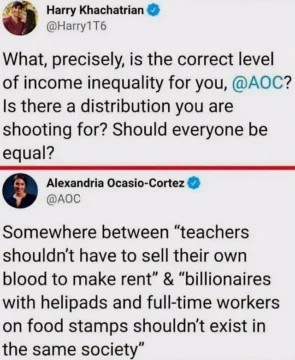
Range egalitarianism is the notion people should not be concerned with the exact level of equality, but rather with keeping inequality within a certain acceptable range. The problem is that nobody can say what that range should be at any give moment. Maybe, the current global 'fitness landscape' requires more inequality- e.g. Elon Musk having trillions of dollars so that he can invest it new technologies which ordinary people know nothing about- or less inequality (otherwise, what is to stop people quitting work and getting a Doctor's note saying they are too sick to work? This means we have to import labour. But that, by itself, could lead to a political backlash against 'demographic replacement'.) 

Tim Sommers has an essay in 3 Quarks on this issue. 


Range Egalitarianism

by Tim Sommers


Rents may be too high in some places. Those on average incomes may have to move away from there. That may not be a bad thing in itself. Chances are, their quality of life will improve. Maybe families will move out of areas where there aren't enough teachers. But their children may benefit from growing up in a less congested environment. 

We could get rid of billionaires. But what if they move to places where they pay less in tax and have more opportunities to invest in new high-tec industries? Our tax revenue will fall. We will fall behind in the new industries.  Other countries may be able to dictate terms to us because they control the vital new technology. They can 'sanction' us if we don't comply with their demands.  

The economy is not a force of nature. We have some control over it.

 We can screw it up. But we can also screw up our environment. 

Granted, it’s also not like a machine controlled directly by levers, switches, and buttons either. But when the state acts, intentionally or not, it often influences the distribution of income and wealth.

The State can encourage investment and 'R&D' in new technology. But it can also raise taxes and thus cause a 'brain drain' and 'capital flight'.  

More often than not, it influences the distribution of wealth and income in reasonably predictable ways.

Sadly, this is not the case. There are 'unintended consequences'. If factor elasticity is high, policy interventions may be self-defeating.  

It seems to me that, for this reason alone, we should care what the ideal distribution of wealth should be.

Why should I care about the ideal theory of Physics? I am too stupid to understand that subject. There were philosophers who thought that they could say, on a priori grounds, what was good or bad Physics. But they all turned out to be wrong. Ideals are misleading. Idealism, as a philosophical project, crashed and burned long ago. Kant thought he knew why Newton must be right. But Newton was wrong. 

The ideal distribution is, at a minimum, one factor we have an ethical obligation to take into account in governing.

This is like the claim that Philosophers could arrive at a priori synthetic judgments which must be true. Sadly, no such judgments exist.  

Some people say that any ideal distribution is unrealistic, impossible to achieve.

Others say that talk of this type is a vacuous type of virtue signalling. They are right.  

That’s alright though. Ideals – perfectionism, utilitarianism, the Ten Commandments – are, as they say, honored as much in their breach. We should still have ideals to follow.

There is nothing wrong with obeying or honouring imperative statements- e.g. 'Be nice! Don't be nasty!' But they have no alethic content. Sometimes, being nice involves doing things others find nasty- e.g. my teechur telling me I should stop studying Math. The answer to 2 plus 2 isn't 'Pizza'. I should quit Collidge & try to get training in mopping floors.  

Others say that trying to enforce any particular distribution – equality, first and foremost – leads to coercion and political oppression.

It may do. Alternatively, smart people may simply run away.  

I think they say this mostly because they have frightening real-world cases in mind. But people also do terrible things in pursuit of freedom, justice, or whatever.

Some crazy people who seize power may do so. But the reason they are doing so is in order to have even greater power and impunity.  

You certainly can pursue equality in a repressive way. Say, seize everyone’s property,

and keep it. 

redistribute it,

Don't redistribute it. Those who get it will have countervailing power over you.  

and redo that every so often to maintain equality.

The guys who were with you when you gave them property, may try to kill you if you show signs of taking it away.  

But you could also, as I implied above, mostly regard equality (or whatever the correct principle is) as a kind of tie-breaker.

Two kids are quarrelling over who gets to play with a toy. As a 'tie-breaker', Mummy says that if they can't agree then she will donate the toy to Goodwill. The kids become quiet. They agree to take turns playing with the toy.  

For example, the point of health care is not the distribution or redistribution of wealth per se, but when you must decide between two approaches one of which takes you closer, the other further away, from the ideal distribution, there’s nothing repressive about going with the one that also has a positive effect on the distribution of wealth and income.

Sadly, this may backfire. If people feel healthcare will go disproportionately to the poor refugee, they may support politicians who dismantle the Public Health system.  

In other words, there is nothing inherently oppressive about pursuing more distributive equality. It just depends on how you do it.

You have to be strong to actually oppress people. If you are weak you can talk bollocks but everybody will ignore you.  

Some people (libertarians, for example) believe that people deserve whatever they can obtain from fair or just initial aquations and/or just transfers – where neither the acquisitions nor the transfers involve force, fraud, or theft. Where these are unjust, the state should act to rectify the situation, but at no point does it rely on the distribution of wealth to decide anything.

Speaking generally, this is a justiciable matter- i.e. one resolved by courts of law. Unconscionable contracts may be struck down. If there is a gap in the law, the Legislature may pass a law and set up an Enforcement Agency.  

One problem with this view is that the current distribution of wealth is largely the result of force, fraud, or theft.

Nonsense! It is largely the result of some people having really smart parents or grandparents. Also, if you do stupid shit, chances are you end up poor.  

Robert Nozick, plausibly the most influential libertarian of them all, surprisingly suggests that solution (at least sometimes) is to follow John Rawls’ preferred distributive principle – the least well-off should be as well-off as possible.

The least well-off are dying or close to death.  In any case, nobody knows who is worst-off. Bernie Madoff's investors thought they were well-off. They weren't. 

A more serious problem for libertarians is that it is not clear that one can even define just acquisition or transfers without resorting to distributive claims at some point. John Locke

who lived at a time when Englishmen could go off to the New World and create any type of Society they liked.  

and Nozick both say just acquisitions involve “mixing your labor” with something, but then say it is limited in that you must “leave enough and as good for others.”

the native Americans?  

Isn’t that a distributive principle?

It is meaningless. Still when helping yourself to cake, it is polite to leave enough for the next guy.  

Or consider property rights. Not the version of property rights that philosophers often focus on, because it doesn’t seem crazy, at least about these sorts of property rights, to say they are “natural” rights.

Sadly, those who spoke of 'natural rights' didn't think Native Americans had any.  

Consider zoning law instead. It involves property rights, but zoning law doesn’t seem like it can be derived from natural laws.

It is derived from a 'collective action problem'. Everybody wants to live in a nice residential neighbourhood. But they may also have an incentive to get lots of money by setting up a drug den or brothel in the basement.  

Zoning and rezoning creates or addresses various problems, creates or forecloses various opportunities, and it also impacts the distribution of wealth.

It affects property values- i.e. wealth. It may not change the distribution of it.  

It seems arbitrary to me to say that you should never take the distributive impact of zoning into account.

Unless you are a Town Planner, you should only focus on how you are personally affected. Will the value of your property rise or fall? What about your quality of life? You may have to trade-off the one against the other.  

So, far I have argued that even if distributive justice it is an ideal that we will never fully achieve, it’s still worth trying to figure out what it is.

In mathematics, there are 'existence' proofs. However, if we also have a proof that the thing is not effectively computable, we ought not to waste time trying to figure out what it might be. Since there is a mathematical representation of the economy, we know that it is futile to try to figure out things which are not effectively computable.  

I argued that there is nothing inherently repressive about attempting to achieve a just distribution.

But, it is inherently stupid. The thing may exist but is not effectively computable.  

And that focusing only on rights to obtain or transfer property to avoid distributive questions is probably not workable.

Yet courts in affluent countries work well enough. The problem is always with the cost of enforcement. In practice, this means the Social Contract is 'incomplete'. There is wriggle room. Control rights aren't perfectly aligned with beneficial rights.  

We are likely to fall back onto questions about the fairness of various possible distributions.

Only if we don't understand that problems of concurrency, computability, complexity and categoricity render the thing a complete waste of time.  

So, what is the ideal distribution of wealth and income?

Nice people get plenty of people. Nasty people starve to death.  

In a Kindergarten everybody gets an equal share.

But the mean kid may knock you down and steal your lunch. That's why I gave up teaching.  

Our first thought is probably to distribute the coconut on the desert island on which we are stranded equally. Equality is the default distributive principle in many contexts.

In the short run- yes. We think we will be rescued soon. But the longer we remain on the island, the more likely it is that coconuts will be distributed according to 'Shapley values'. Those who are more productive and who have a higher threat point get more.  

Funny thing about equality, you can always make things more equal, reduce the amount of inequality, by just taking stuff away from the well-off – even if you don’t give it to anybody.

They may kill you.  

You can always get closer to equality by taking stuff away – which makes some people worse off – even if you don’t give it to someone else (who would then be better off). In other words, equality tells us to sometimes prefer situations were some are worse off and none or better off relative to the status quo. This is called the leveling-down problem. Many philosophers take it to indicate that equality, in an of itself, is not what people care about. What do they care about? Maybe, poverty, immiseration, the plight of the worst-off?

No. They care about their own material standard of living and then have some sort of kin selective altruism linked to reproductive success for those of their own lineage. But, because of radical interdependence, (your distant descendants may marry the distant descendants of people you are not currently related to) this may broaden to include everybody.   

Rawls argued for the “difference principle,” which says that inequalities are only justified if they also work to the advantage of the least well-off.

He was wrong. He didn't understand that the way to deal with uncertainty as to your future status (you may be hit by a bus tomorrow) is to go in for 'risk pooling'- i.e. you hedge or buy insurance.  

This is called prioritarianism since it gives distributive priority to the worst off.

This is called stupidity. I buy fire insurance just in case my house burns down. I don't support a law saying all those whose houses burn down will get a big sum of money. Why? Careless people benefit. Cautious people suffer. There is 'moral hazard'. Moreover, the fire insurance company has an incentive to push for better provision of Fire Fighting services as well as for changes in building codes to reduce the risk of fire. 

Rawls argues for absolute priority. But this seems to create a nested leveling-down problem. For example, if there were a policy that would increase middle-class wages, but from which no benefit at all would go to the least well-off, it violates the difference principle.

People dying of old age get no direct benefit from spending on kindergartens. Thus, no money should be spent on kiddies. The least well-off are very old. Their existence is quite miserable.  


Here’s a different way to deal with the least well-off. Why not say that everyone is entitled to a sufficient amount of income and wealth to avoid poverty and have enough to lead a decent life?

Why not say 'It is nice to be nice. Be nice. Don't be nasty.'? 

Call this sufficientarianism. One issue is how to set the sufficiency level. What is the minimum?

Unemployment benefit. Should this be turned into 'Basic Income'. No. There will be a disincentive to work.  

Also, it’s exclusive focus on the less well-off means it ignores another possible concern about inequality.

Limitarianism argue that no one should have more than a certain amount. “No billionaires,” for example. They argue that democracy and liberty are impossible in a society with too much inequality. One problem limitarians share with sufficientarians, however, is how to set a threshold. How much is too much?

The problem is not that nonsense can be talked. The problem is that if shitheads take over, smart people run away. The State goes off a fiscal cliff.  


If we combine these two views, we get a promising distributive approach that we might call sufficiency limitarianism. No one should have too little or too much. But this doesn’t solve the issue of how to set a threshold.

Any cretin can set any threshold. Try to implement it and the State goes off a fiscal cliff.  

Consider this. What if people don’t care about things being as equal as possible, but only about avoiding things being too unequal.

In that case, such people run away from America. They become subsistence farmers in underdeveloped countries. 

The distribution within a certain range would be a matter of indifference, but falling below or exceeding the range would be considered problematic.

This is the view that I have come to. I call it range egalitarianism. Empirical research suggests that most Americans believe that

they have been anally probed by aliens in flying saucers?  

there is too much inequality, but that some level of inequality is morally fine. Most Americans are range egalitarians, then.

That's why Trump won the popular vote- right?  

It is a response, again, to the idea that you don’t have to love equality as such, to fear inequality that leaves some unable to meet their basic needs and others with the power to bend the rest of us to their will.

Americans don't just care about Equality. They also support Diversity. That is why Kamala Harris is POTUS.  


_________________________________

Appendix: Nozick on Rawls

“Assuming (I) that victims of injustice generally do worse than they otherwise would and (2) that those from the least well-off group in the society have the highest probabilities of being the (descendants of) victims of the most serious injustice who are owed compensation by those who benefited from the injustices (assumed to be those better off, though sometimes the perpetrators will be others in the worst-off group),

i.e. African Americans and First Nation people. Should they be given reparations? The problem is that a lot of White Americans are descendants of poor immigrants who worked in sweat-shops or coal mines etc.  

then a rough rule of thumb for rectifying injustices might seem to be the following: organize society so as to maximize the position of whatever group ends up least well-off in the society.”

The least well-off have the strongest incentive to rise in 'general purpose productivity. Raise factor mobility and elasticity (this means high 'transfer earnings'- i.e. workers can easily switch to just as well paid jobs in other industries). This raises total factor productivity and thus increases GNP and Tax Revenue. This in turn means a better welfare 'safety net' can be provided. But this, by itself, reduces risk aversion and thus raises factor mobility and elasticity. It is a virtuous circle.

In the late Sixties, many politicians believed voters cared about equality. Harold Wilson's Government in the UK increased labour's share of National Income to 83 percent. But, it had to devalue the currency. The working class rebelled against having to pay more for their holidays in Franco's Spain. They voted for the Conservative party. Over the course of the Seventies, even the Scandinavians came to understand that the working class didn't like 'solidarity wages'. They didn't care about inequality. They wanted a higher material standard of living in absolute terms. Mitterrand, becoming President with Communist support had to do a U turn and support more free-market policies. But China was more thorough-going in embracing the Market. Equality simply didn't matter- save to some brain-dead academics regurgitating the warmed up sick of the Seventies.