Showing posts with label films. Show all posts

Thursday, 25 April 2024

Rachel Dwyer on Satyajit Ray

Satyajit Ray had the three hall-marks of genius

1) he was intensely productive and individualistic. He was a true auteur who, as he gained in confidence, took over almost every aspect of film-making. Indeed, he was smart enough to make himself  independent of the financiers and distributors. 

2) Ray set limitations on himself the better to develop his strengths. Thus he wouldn't have 'playback singers' or 'item numbers' etc. Also, he refused to go in front of the camera precisely because he was so handsome and physically imposing. One may say, by scrupulously observing the limitations he had placed on himself, Ray had made himself truly autonomous and thus able to follow the promptings of his own 'daemon' or native genius, regardless of worldly considerations.  

3) at his best, his art was universal. True we can say 'Piccasso was Spanish. Such and such trait he displays in such and such work, has deep Spanish roots'. But, the fact is, it has deep roots in every other civilization. Ray is like Picasso in this respect. Indeed, he too was a hugely talented painter. On the other hand, it must be admitted that universality doesn't always go with 'kairos' or timeliness. Things may have been different in the Fifties, but after the Chinese invasion in 1962, Ray's films seemed irrelevant or exercises in obfuscation or self-deceit. 

However, mine may be a parochial, desi, view. 

The brilliant Rachel Dwyer writes of Satyajit Ray as 'the mind of Bengal' in Open Magazine

Ray’s powerful cinematic images were my foundation for a sense of India.

This is unlikely. Rachel had seen films set in India on TV as a kid. She thinks she first saw Ray's movies in 1980 when she moved to London to study Sanskrit at SOAS. This suggests an earlier interest in India. Surely she would have read 'Jungle book' and watched the Disney animated movie?  

I could imagine the Bengali countryside by recalling Apu and Durga in the kash grass seeing the train, or understand the beauty of the monsoon by recalling the rain on the pond with music by Ravi Shankar (Pather Panchali, 1955).

Sadly, my own imagined India was based entirely on 'It aint half hot, Mum'. This is because I had actually lived in the place.  

I could envisage the zamindari world by thinking of the chandelier in Jalsaghar (1958), or recall the stylish life of contemporary Calcutta from the trilogy (Pratidwandi, 1970, Seemabaddha, 1971, Jana Aranya, 1975), while seeing love grow in the crumbling world of the middle class (Apur Sansar, 1959) or the older city through the street life glimpsed through the shutters by Charulata (1964) and the splendour of now decaying mansions and their decaying families in it and in Ghare Baire (1984).

I suppose Rachel is saying that she was a serious student. If you study Sanskrit, you stay away from the riff-raff who watch Sholay or Guru Dutt films. Incidentally Sholay was shown on British TV in 1981.

Other highlights included the aesthetics of religion as portrayed in Devi (1960)

Religion is bad unless it is very very boring.  

and encounters of the urban youth with another India in Aranyer Din Ratri (1969).

I have to take my hat off to Rachel. Few Indians showed up when I ran those films at the LSE in 1980. I complained of this to Pamela Cullen at the Indian High Commission. She had heard the same complaint  many times before. My memory is that she suggested I invite some Bengali professors to talk about each film. Their PhD students would feel compelled to show up with their friends.  I explained that Bengali professors ran away when they saw me approach. They may be good hearted, but they don't tolerate stupid Madrasis. 

The stylish world of Uttam Kumar, the film star on the amazing train and Sharmila Tagore’s iconic glasses in Nayak (1966) and of the town of Darjeeling in Kanchenjunga (1962) are among the other lasting impressions of India bequeathed by Ray. Who can forget comparing his Bengali Varanasi in Aparajito (1956) with Joy Baba Felunath (1979)?

Who can forget that the latter film was infinitely worse? 

People have sometimes said I was bound to like Ray because he wasn’t Indian in his aesthetics.

He was a self-hating Indian. His uncle had introduced play-back singing into Indian cinema thus giving it its 'killer app' or u.s.p. Ray stayed away from anything which might make his films popular with Indians. We must keep out the riff-raff, you know.  

Yet, he was indisputably a true Bengali.

Bengal had thrived under the Raj. True Bengalis, like Niradh, yearned for the day Whites returned to rule over them. Not Italian Whites. Any other sort.  

Born in a well-known family and raised in Calcutta, a writer in Bengali (I’m proud to say my basic Bengali has allowed me to read a little)

She probably understands more of what she reads in Bengali because of her solid grounding in Sanskrit.  

and English, his Feluda stories are loved by the bhadralok middle class who admire his films (according to a Bengali famous in the Western academy, Ashis Nandy),

I think Rachel published this article before Nandy published an essay taking down Ray as a deracinated snob. He asked ' Was Ray really Indian? Or was he basically a highly westernized, deracinated cosmopolitan who dealt with Indian themes merely because he happened to live in India?” Nandy, a Christian, suggests that Ray knew little about village India, caste and society.

Other Bengalis suggested that the bhadralok only pretended to like Ray because he was famous in the West.

though they aren’t known in the West.

Ray stands higher in the West than in India.  

Ray was simultaneously at home in Western high culture and in Bengali, though perhaps somewhat unfamiliar with the rest of India.

He got married in Bombay where his Uncle was a leading director. Prithviraj Kapoor attended his wedding.  However, he doesn't seem to have watched many films from the South. 

Ray doesn’t seem to have been comfortable with Western popular culture,

he says he was a big fan of the popular films of the Thirties and Forties. Deanna Durbin was a particular favourite perhaps because, like Ray's wife, she was a gifted soprano.  

his admiration being for European art cinema rather than Hollywood.

He admired the Italian neo-realists. Then Nehru and Marie Seton got Rossellini to make 'Matri Bhumi'. Sadly, that Latin Lothario eloped with Bimal Roy's niece.  

Nor do his films showcase contemporary popular culture—he seems to have enjoyed the old-fashioned Europeans such as Miss Gilby (Jennifer Kendal) in Ghare Baire rather than the hippies of Pratidwandi.

Ray's generation hated the hippies. They showed no color consciousness.  

The latter and Jana Aranya show the grim realities of contemporary Calcutta and the boredom that ensues, while Seemabaddha depicts the shallowness of the allegedly glamorous lives of some the Calcutta elite.

Ray was following a long tradition of elitists scolding the slightly less elite. Think of Madhusudhan's 'Ekei Ki Boley Sabyata'. Still, anything in which Sharmila Tagore appears is worth watching. Her son too is a great actor. 

In Aranyer Din Ratri, the male group of modern, educated and seemingly ‘Westernised’ youth that travels from the city, is selfish and insensitive, and crass in seeking thrills in the forest.

They are tourists. Tourists are bad. Why can't they be Maoists instead?  

Aparna (Sharmila Tagore) is composed and dignified, even when seeing them bathing in their underwear or dancing the twist at night, deliberately loses the memory game and has an impressively cool book and record collection. The story is again from literature (it is based loosely on a novel by Sunil Ganguly), but seems very Western in its characters and style.

It has a dated, Fifties, feel. By 1970, tribal areas were seen as centres of Naxal activity. Jayprakash Narayan had begun his dialogue with the Maoists in Bihar in that year.  Still, it could be seen as a critique of the 'urban bourgeoisie' or something of that sort. 

It is easy to see why Ray’s films were classed as arthouse in the West.

They couldn't be classed as entertainment. If they weren't art, what were they?  

In Calcutta, they were screened in cinemas which showed regular Bengali films, whose audiences in the 1950s and 1960s didn’t watch much Hindi cinema, but enjoyed middle-class Bengali films, including the Uttam-Suchitra romances.

Ray did get Bengali audiences but those audiences didn't get much out of Ray. 

Ray doesn’t fit into the history of Bengali cinema in Calcutta, always standing apart.

He does. His uncle was the cinematographer of Tagore's one and only venture into film. Ray praised Ravi Shankar's eldest brother's experimental 'Kalpana'. Ray went in the opposite direction to his Uncle- Nitin Bose. Thanks to Marie Seton, he was seen as Nehru's favourite director. Indira, a fellow Shantiniketan alumni, had a soft spot for him. Thus he was India's official 'Art Cinema' auteur. Ray was wise enough to hedge his bets. He made some commercial movies in the early Sixties and later made a good enough fist of 'Sociological' movies in the Brahmo, Tagorean, tradition.  

The true heirs of the New Theatres were those who migrated to make Hindi films in Bombay, such as Bimal Roy, Hrishikesh Mukherjee and Shakti Samanta.

and Ray's uncle Nitin Bose. Ganga Jamuna was a big hit in 1961.  

The loss of the audiences of East Pakistan was probably a major factor in these directors looking for wider audiences, though they continued their relationship with the Bengali cultural world and worked closely with other Bengalis.

The Bengalis felt that Mumbai had more venture capital and a more entrepreneurial culture.  

In the 1970s, the Bombay Bengali filmmakers, including Hrishikesh Mukherjee and a younger generation, made middle-class or middle-brow cinema, often remaking Bengali films.

There had been a migration from Calcutta to Bombay even in the Thirties. Bengal had talent but less entrepreneurship. Still, generally speaking, Bengali films were remade in Hindi rather than the other way around.  

RAY HAS CLEAR links to the world of Bengali literature.

If he took his time, he could 'story-board' Bengali novellas like nobody else. One might say that Hindi Cinema offers an ersatz 'Bengaliness' which, I suppose, those who know the real thing might find meretricious.  

He made films based on the fiction of the most highly regarded Bengali authors, including Tagore and Bibhutibhushan Bandyopadhyay, as did Tapan Sinha who drew also on Tagore and many others. Shankar (Mani Shankar Mukherjee) provided the stories for two of Ray’s Calcutta Trilogy—Seemabaddha and Jana Aranya—but also films for other directors, including the wonderful but non-art film Chowringhee (1968), with many of the great stars of Bengali cinema: Uttam Kumar, Supriya Devi, Utpal Dutt and Biswajeet.

Bengal has always had a surplus of talent. The allegation is that their producers were short-sighted or just looking for a tax write-off.  

It’s striking that Ray eschewed the most popular Bengali author for adaptations, that is Sarat Chandra Chattopadhyay,

perhaps because Ray wasn't comfortable with strong roles for women.  

whose many novels and stories were made into Bengali films, notably Devdas (many versions), Krishnakanter Will (1932 and 2007), Rajalakshmi O Srikanta (1958), and Hindi films, some of the latter by Bimal Roy—Parineeta (1953), Biraj Bahu (1954), Devdas (1955)—as did the 1970s Bengali and Bengali-influenced directors who made Majhli Didi (1967), Choti Bahu (1971), Khushboo (1975), Swami (1977). It would be fascinating to know more about why he didn’t use these famous works and how he chose others.

Sharat's work is psychologically complex. Ray was like Tagore, he threw so mighty a shadow that no intricacy of emotion was possible, more particularly for women, in his shade.  


Ray made many historical films, including the classic Jalsaghar, whose use of classical music and the crumbling world of the zamindar makes it among my favourites,

It is terrible. If you have Begum Akhtar- who started off as a film actress- you should get one or two specially commissioned ghazals to ensure the movie will be a super-hit.  

or his Tagore-stories (Teen Kanya (1961), Charulata, Ghare Baire).

Charulata is good. Ghare Baire was terrible.  

His Calcutta Trilogy can be compared to Mrinal Sen’s, whose trilogy is more radically arthouse.

It was more 'radical' but Sen changed direction later on. There was less to him than met the eye. Still, he launched Mithun.  

The fame of Ritwik Ghatak, regarded by some as a greater filmmaker than Ray,

one of his films was. He was a Jungian.  

has remained mostly among Bengalis and cinephiles. Even though the British Film Institute has issued DVDs of some of his films, and an excellent book in their ‘Classics’ series on Meghe Dhaka Tara (by Manishita Dass), his films have not found an audience in the West.

It is said that Congress and the Communists ganged up to make him unpopular in his native Bengal.  

Ray tried to promote him, but they differed temperamentally and occasionally clashed.

Ghatak got into films before Ray did. However, unlike Ray, Ghatak was seen as political. He couldn't be a 'sarkari' director. 

Rachel goes on to show her considerable knowledge of Ray's influence on contemporary Bengali cinema which, however, will be of little interest to non-Bengalis. 

The following, however, is interesting- 

Martin Scorsese says his Taxi Driver was influenced by Ray’s Abhijan (1962),

which was a commercial success. It is very well cut and has Waheeda Rehman. It is said that Ray took on the project for a friend who got cold feet. I suppose, under the Studio system, Ray would have produced a whole bunch of successful 'noir' type movies while still getting big budgets for prestigious or passion projects. As in other industries where Bengal previously had the lead, the quality of indigenous entrepreneurship was somewhat lacking. The rise and rise of Telugu Cinema has a lot to do with the success of the 'Andhrapreneur'.  

while others, including Francis Ford Coppola and Wes Anderson, have praised his work fulsomely.

Coppola's 'Godfather' has been hugely influential in India.  

Very few cultural figures from India were widely known in the West before Rushdie’s Midnight’s Children and the subsequent interest in Indian English literature.

I think that is still true. Vikram Seth seems to have stopped writing. Rushdie has just brought out yet another big big book.  

Before the 1980s, the only household names I recall were Rabindranath Tagore, Ravi Shankar and Satyajit Ray.

Ravi Shankar did the music for a film by Chetan Anand which, I believe, was the first Indian film to win an international award (at Cannes). But it wasn't released in India because it was miserabilist shit.  

It’s striking that the three acclaimed figures were all Bengali upper-caste men.

They were from families deeply engaged in the Arts. Tagore came to Okakura and Rothenstein's attention through his nephew who was an artist. Ravi Shankar was the younger brother of Uday Shankar whose dance troupe was internationally famous. Interestingly, William Rothenstein played a role in promoting both Tagore & Shankar. The wealthy Brahmos of Calcutta were highly regarded by the British. 

Is the work of Ray another case of Bengali exceptionalism?

No. It is a case of Bengal's decline. Ray was considered great in the West but the Bengali masses found him boring. Cinema, for ordinary people, is a window into a wider world. But, intellectuals too are keen to gain new ideas and new vistas. 

By the late Twenties, Bengali poets had rejected Tagore for T.S Eliot. Indeed, many Bengalis eagerly devoured French and other foreign literature. Their excellent Schools and Colleges gave them self-confidence. 

It the mark of genius is productivity, we must admit that Tagore, Ray & Shankar had genius in abundant measure. 

 Ravi Shankar was the music director for AIR in Delhi before he started touring internationally. Previously he was in Mumbai where he did the music for 'Dharti ki Lal'. His connection with Bengal was somewhat tenuous. By contrast, Ray- like his father and grandfather- remained rooted in Calcutta whose literature and cultural scene he greatly enriched. 

Bengal’s sense of (not entirely unjustified) cultural superiority makes many Bengalis comfortable in their own culture as well as in others.

They were culturally superior to the rest of us. Indeed, in our hearts, we still think that is true. The problem is that many Bengalis pretend to have read obscure authors or seen art movies. We can't tell the bluffers from the genuine article.  

They keep pre-war British food traditions alive and about 90 per cent of the queue outside 221B Baker Street is for those waiting to see the home of a Bengali who happened to be born British.

There is a very good Tibetan writer who has conclusively proved (to my mind) that Holmes was a Tibetan Yogi of some very advanced description.  

Ray’s films guide us through Bengali culture from the nineteenth century adaptation of Western ideas and culture,

No. He gives us a glimpse of the Tagores' rejection of the entrepreneurial legacy of Dwarkanath.  

through communist and leftist eras,

Not really. He had a vague sense that he ought to be on the side of the Naxals. But he had little understanding- perhaps he had little interest in- what was actually happening.  

to the loss of Calcutta’s status as a global city,

because the Brits left.  

economic powerhouse and India’s cultural heartland.

It wasn't the heartland. It was a 'City of Palaces' where new Western (but also Eastern- e.g. from Japan) ideas were first introduced. But resisting the partition of Bengal was a mistake. The bhadralok, despite Tagore's warnings, insisted on slitting their own throats again and again. Perhaps Mamta will stem the rot. Calcutta is still the Indian City with the biggest and most promising economic hinterland. It is more livable than Dacca and can rise swiftly because plenty of 'low hanging fruit' are available.  

Bengal has been apart from the rest of India in many ways, seeing itself as a leader more than an equal.

The founder of the current ruling party was the son of Sir Ashutosh. That's one reason Modi is so keen to win over the Bengalis.  

Bengal has even followed its own unique politics, from Netaji to Didi.

Netaji and his brother failed. Didi is far smarter. She will use the Muslims. She won't become their dupe. I say that with fingers crossed.  

One can only speculate how Ray would show the current political shifts whose results will coincide with his birth centenary.

Nonsense! Ray would show that Modi is Hitler. Mamta would pat him on the back. Rahul will explain that the real meaning of 'Abhijaan' is India should break up. The problem with the buddhijivi is that they need a foreign hand to lick or one to give them awards for being too proud to lick a hand nobody wants slobbered over. The rest of the time, they enjoy scolding everybody for being Bengali or not being Bengali enough. 


Wednesday, 6 September 2023

Why Mrinal Sen failed.

A movie which changed Tamil Nadu was Nandanar (1942). I was unaware that the first version was made in Calcutta by M.L Tandon and a pal of his from UCLA back in 1932. A female singer played the male Saint. She was paid one lakh. The total budget was 3 lakh. The film was a flop. Kalki made fun of it. The three best actors in it were, he said, the coconut tree, the cow, and a goat. 

But, it must be said, it was Calcutta which first turned the 'kathakalakshepham' of Bhrarati Gopalakrishna into a more than Wagnerian 'total' art form which actually changed Society (in the reverse direction from what was intended) and established a dynamic, 'dhravya', hypokeimenon or hypostasis for every intensional, that is epistemic, discourse for all us 'Madrasis'-  Iyers more especially. Mani Shanker getting elected by gormandizing mutton biryani and Mani Ratnam doing its Cinematic equivalent displayed this distressing fact. On the other hand, Ilayaraja- a Dalit- showed Indian Music was essentially symphonic, had a well tempered scale,  and thus was playable anywhere to any purpose- just like Wagner. 

Then Jayalalitha got elected and stayed elected. Mother, it seems, is the breast upon which, both the infantilism of ideology and the fatuity of film, build their fantasises- which is cool provided their respective finances are sound. 

The film industry is an industry. Its job is to make money or beg for a handout from the Government. A profitable industry can take over a politically bankrupt Government- which, in a Democracy, is simply a service industry of a different type. 

 Grow the economy- i.e get more 'bums of seats' for the splendiferous 'Starship Enterprise' type saga of always increasing productivity and commercial contact, and you get more tax revenue with which to buy votes. Of course, we can say the same thing about Religion or Justice. They are service industries. If they do smart things, they get more revenue. They can also figure out how to improve 'mechanism design' in the wider economy and this can enable them to transform the polity. What matters is whether the film industry responds to what people need and want. If if fails to entertain, or, it tries to foist its own views or values on the people, absent great coercive power, it will fail. 

Mrinal Sen was born a hundred years ago. He was a Communist film-maker. But, like other 'great' Bengali Directors, he was useless. Tamil Nadu now has a Chief Minister named Stalin. His father was a great script-writer and poet who enabled 'Reel Society' take over 'Real Society'. Meanwhile, the Communist Party in Bengal is dead. The Chief Minister is a Brahmin lady who will pass power to her Brahmin nephew. Meanwhile Stalin's son, also a film actor, is threatening to wipe out 'Sanatani' Hindus. Thus it was Madras, not Calcutta, whose Cinema achieved the Communist objective of wiping out 'eternal' Hinduism. Still, it must be said, in Sen's last film, where- because all the characters- even the moneylender!- are Muslim, there is a happy ending. One elderly Hindu- a Mr. Chatterjee- is allowed to join in at the end because he can't live much longer. This shows there can be a humane solution to the big problem facing Bengal- viz. the presence of Hindus. Once they all die, things will be hunkydory.

Even 40 years ago, it was obvious that the Madrasi Film industry had succeeded whereas Calcutta's Film industry had failed. At this late date, have Bengali intellectuals at last woken up to the fact that Bengali film directors were shit compared to Tamil or Telugu film industry people? Let us see. 

Devarshi Ghosh writes in Jacobin of 
 'a scene from Sen’s anthology film, Calcutta 71 (1972)... the director takes us to a party full of uptown liberals waxing eloquent about India’s burning political issues in the 1970s: poverty, corruption, unemployment, and so on.

Indira Gandhi had liberated East Bengal. But it had already slit its own throat by going down an infantile Leftist path. Bangladesh, under Mujib, became a one party Socialist State after suffering a big famine. Then Mujib was killed and there were coups and counter coups. In the early Eighties, Gen. Ershad had to embrace privatization and permit the exploitation of cheap female labour in textile factories. Bangladesh began to grow economically and has now overtaken West Bengal.  

Leading the pack is a political figure who laments about the 1943 Bengal famine, widely attributed to Winston Churchill’s policies,

not by Bengalis alive at the time. The Muslim League was just as corrupt in 1943 as the Awami regime in 1974. They made money out of the starvation deaths of millions. Churchill had nothing to do with it. 

which claimed millions of lives. But, we learn, it was the famine that helped this person grow his business as a black marketeer.

Was he an Ispahani? No. Wrong religion. Mrinal Sen was telling a stupid lie. Why the fuck would Suhrawardy line the pockets of a Hindu? His own people would have got angry and arranged a nice beating for him.  

Later, this same profiteer drunkenly argues for revolution.

Fuck was Sen arguing for?  

Meanwhile, striking workers have forced his factories to sit idle.

Which was cool because he didn't have to pay them. Also the tax-man would leave him alone. He could concentrate on piling up black money. Come to think of it, financing a flop film was a way of laundering black money. I.S Johar had a movie on this theme around that time. Anyway, that was the Bengali buddhijivi's own theory of why buddhijivi films were so utterly shit.  

What, the scene forces us to ask, does politics mean to a middle class

the Bengali middle class was malnourished. The profiteer was upper class. What the middle class wanted was Government jobs. The Communists could deliver this at the price of fucking up the private sector. That was cool because there was a caste angle to it. The upper castes dominated the Communist party. In 1979, they could even massacre Bengali Dalits in Marichjhapi.  

that can throw around the word revolution so casually while exploiting workers?
But the workers were on strike. There were creating no 'surplus value' which could be taken from them. Sadly, they also didn't get paid. This is why everybody wanted a job with the Government or a Nationalised firm where actually doing a little work was not a condition of employment. 
All the while a rock band performs live.

Was it any good? If so, Sen could have made money of music sales. Lots of Movie Producers balanced the books that way.  

The music is intercut with images of the famine and on-screen text: “unemployment, degeneration, hunger, betrayal of our ancestors.” Finally, the charade is interrupted by an explosion. From the darkness emerges the disembodied head of a communist activist who was shot dead by the police. He announces that he is dead before adding:
Can you guess why I am here? I have come to tell you that I know who murdered me. But I won’t tell you their names. I want you to find out who they are. You might experience discomfort in the process, but you will not stay so comfortable, so indifferent.

The problem here is that the CPM was cool with slaughtering Naxals. Once those more extreme Maoists killed judges, nobody had any problem with extra-judicial killing on an industrial scale. It is foolish to say people didn't know who the 'murderers' were. They either got promotions and medals or became Ministers. One prominent Left Front Minister had killed a couple of Congress supporters and then mixed their blood in rice and forced their mother to eat it. Pranab Bardhan had a very high opinion of this great buddhijivi who successfully adapted Marxist doctrine to indigenous conditions. Mamta got her start fighting the Commies in the streets. They kept trying to kill her- also one IPS officer bit her- but she prevailed. Then she beat the fuck out of the Commies and sacked the IPS officer when he objected to her goons killing his constables.  

The roots of such storytelling lie in Sen’s past.

No. They lie in the buddhijivi proclivity to slit its own throat while babbling modish bollocks.

Unlike Ray, Scorsese, and most great filmmakers, Sen came to filmmaking later in life.

By which time there was a small international market for Leftist shite from a shithole country whose 'intellectuals' slavishly imitated gimmicks to be found in 'New Wave' European films.  

He was first an activist,

a useless one 

then an intellectual,

a stupid one 

followed by a short stint as a film critic,

an unreadable one 

after which he eventually managed to find a gig as a director.

As a Communist, there was a chance the Soviets might buy his shite. Sen also did a film with a Chinese dude. But Mao didn't want it. He wanted to take Nehru's pants down and make fun of his puny genitals.  


Sen’s father Dineshchandra was a lawyer closely associated with Indian freedom fighters.

i.e. guys slitting their own Hindu throats in East Bengal 

His son had his coming of age as a student in the teeming metropolis of Calcutta, now Kolkata. There he witnessed firsthand the savagery of the Bengal famine.

Under Muslim League rule. Suhrawardy's mistake was to get his people to slaughter Hindus on 'Direct Action Day'. The Hindus turned out to be better at killing and thus Calcutta was preserved for India. Otherwise Sen would have had to run away somewhere else.  

While riots and World War II raged on, Sen associated with the Communist Party’s cultural wing and locked himself up in the library. During the war years he discovered Rudolf Arnheim’s influential Film as Art and turned his attention to aesthetics and film theory. In 1945, Sen published the article “The Cinema and the People” in a magazine rolled out by the Indo-Soviet Friendship Society. By the early 1950s, his first book on cinema, about Charlie Chaplin, was out.

So, this was a Communist who was brought into the film industry because he was useless in every other field. Still, the Indian Government and the French Government and the Soviets were prepared to give this cretin awards. The market, however, would not reward such programmatic stupidity.  

To be fair, as he got older, Sen gave up on Communism and gimmicky movies. By the Eighties, it was obvious that Satyajit Ray was shit. There was no point in getting the silver medal for being shit. Meanwhile, Mithun Chakroborty- whom Sen had given his first big role- had become the poor man's Amitabh. He became a big star behind the Iron Curtain with films like 'Disco Dancer'. 

Another Bengali intellectual, Abhrajyoti Chakraborty, has an essay in 'the Point' on Mrinal 

in Kharij (The Case Is Closed), from 1982, a woman is getting her child ready for school when she tells her husband that she would like someone—“preferably twelve or thirteen, someone who doesn’t talk back”—to help with the chores in the house.

Why would a twelve year old want to 'help with chores'? The answer is, such a child might want to gain a reliable source of food and clothes and shelter. Sadly, in this particular case, the kid dies from monoxide poisoning while sleeping in the kitchen. But, if some relatives, escaping pogroms, had turned up at the family's door then it would not have been a servant kid but one of their own kith and kin who would have died while sleeping in the kitchen. 

Their own child is in the room with them; but already it is lost on the couple that the 12-year-old they want as hired help may also be someone else’s child.

Everybody' is somebody's child. But some Mummies and Daddies don't have the money to feed their kids. 

It is at home where we first learn to alienate, home where we first feel alienated—home that engenders Tagore’s “suspicion of man for man.” 

No. Home is where we gain 'oikeiosis' or a sense of belonging and guiltless appropriation. Chances are a child living with a family as a domestic servant will be better off than one living on the street. A certain, lower, level of oikeiosis would be extended to the child. Yet it may gain a superior support network. No 'alienation' is involved not even Marxian alienation which is an economic theory which only applies to commodities, not services.

Home does not engender 'suspicion of man for man'. If Mrinal Sen's family fled East Bengal it is because their suspicion of their Muslim neighbours was well founded. Had they stayed, they may have been killed.  

If you are suspicious of a person, you don't employ them in your home. There is some peculiar buddhijivi logic at work here which I fail to understand.

Seventy years after independence, Indians still view each other in the shadow of that suspicion.

No they don't. I don't think a guy named Narendra is likely to kill me because of my religious beliefs. Narendra too may feel reassured if he hears my name is Vivek.  

It is a view that, at its worst, has manifested in riots and indiscriminate violence, the recurring violations of women’s rights, the lynchings of Muslims and other minorities that have become terrifyingly frequent since Narendra Modi first became the prime minister in 2014.

This gentleman who writes for the Guardian and other such Western newspapers and magazines, hasn't noticed that NATO killed 1.3 million Muslims and displaced tens of millions more. Still, Westerners aren't Indian. Thus they could have no suspicion of Muslims at all. As for 'violations of women's rights'- no such thing happens in a proper Muslim majority country. West Bengal has a long way to go before it becomes Muslim majority and accedes to Bangladesh. We sympathize with this young buddhijivi. Still, under Mamta or her nephew, his dream of living under Muslim rule may come true. 

The crowd has become a murderous mob. Education can only do so much to eradicate this apathy, as we see with Chinu’s family in Ek Din Pratidin and the couple in Kharij.

Mrinal Sen was educated. Many Communists were. But their militancy was more poisonous than apathy. It destroyed the productivity of the Province. The underlying problem of the families and individuals shown in Sen's films was that lack of productivity was causing poverty. But the pedagogy of the buddhijivis destroys productivity. It creates the illusion that condemning other people will cause all social problems to disappear.  

In a country like India, where films are still valued essentially as fantasy,

Entertainment, not fantasy. The problem with the fantasies of the buddhijivi are that they are boring and stupid and based on the notion that scolding other people can make the world a better place.  

If anything, Modi’s uncomplicated popularity among the country’s urban middle class

Gujarat, like Bengal, is majority rural, not urban. Modi is popular in rural Gujarat as well as urban areas.  

and wealthy expatriates abroad would suggest that the desire to have a good life is synonymous for many Indians with a wish to

get the fuck out of rural shitholes and then get the fuck out of urban shitholes 

be indifferent.

Indifferent to Bengali bores- sure.  

Artists and intellectuals are not exempt from this: too many of them have, for too long, kept themselves apart from the crowd.

The author never sleeps in a bed on his own or with just one or two other people. If there isn't a big crowd around him he can't fall asleep.  

Sen’s willingness to put art at the service of politics

shit politics. The Tamil film industry was very political. Then it took over politics and did a better job than the Communists in West Bengal. But the Tamils initially made better movies. Sadly, it is now the Telugus who are on top.  

—his skepticism toward every orthodoxy, the anger of his films—is missed in these complicit times. 

Which is why these times are better than those times.  

Perhaps the film that Sen will be remembered for most is Akaler Sandhane (In Search of Famine).

Buddhijivis like Amartya Sen were already cashing in of the Great Bengal Famine. Was Mrinal's film intended as satire? No. You can't satirize a Pavlovian reflex you yourself display in more rabid fashion. 

It was released in 1980, a year after Ek Din Pratidin. Sen again steps out of his home into the world—but now he is also questioning his own impulse to be in the crowd. The film is about the making of another film, also titled Akaler Sandhane.

East Bengal had a big famine in 1974 because it was run by a Leftist dictator.  The amazing thing about Mrinal's movie is that he wrongly says the famine occurred in 1971. Perhaps he thought the refugees who had fled the Pakistani Army's genocide were actually fleeing famine. No doubt, Hindu profiteers in Dacca were responsible for everything that happened in that terrible year. 

The crew has arrived in a village called Hatui, almost 40 years after the 1943 Bengal famine, to shoot a film with the famine as a backdrop. They are boarding in an old mansion nearby, once a royal stomping ground

the 'zamindars' were tax-farmers. Speaking generally, they did not have royal status. 

but now empty except for a woman and her comatose husband who occupy a room on the first floor.

no doubt the symbolize something or other.  

In his efforts to faithfully recreate the period, the director is oblivious to the effect his film is having on the village. Hatui is still a place where The Guns of Navarone is screened every month in an open field, where those who usurped land from starving farmers in 1943 now claim to be survivors of the famine.

They survived the famine by not fucking dying. Farmers didn't starve, landless labourers did.  

Crowds flock around the set at all hours to watch the shooting.

No crowds flocked to watch Sen's shite. 

The crew’s indulgent tastes

How? The village shops don't stock luxury items- like soap or toothpaste. You can't drive up the price of what doesn't exist. Still, it may be the 'crew's indulgent tastes' led them to consume 10 kilograms of rice at a sitting. 

drive up prices in the village. When an actress pitches a fit and returns to Calcutta, the director wants to audition some local women. Each of them is asked, in turn, to play the part of a prostitute: the implications are dire in a society that has more or less no reason to distinguish between reality and make-believe.

I frequently asked Mrinal Sen to play a rent-boy in a porn movie Nobodyjee was making . Sadly, he refused to take it up the ass from the assortment of hobos I had assembled for the task.  

The villagers refuse to cooperate, bringing the production to a standstill. The crew decide to leave the village and resume shooting in a studio. 

'Grapes of Wrath' and 'the Good Earth' were mainly shot in studios in America. They were good films and had positive political effects. Sen's films were shit. He got to make them and was given awards for political reasons- but those reasons were shit. Infantile Leftism has bad economic and social effects. 

Akaler Sandhane is skeptical about the breakthroughs of neorealism.

Rising affluence in the West killed off that shite. Why be 'neorealist' when you have millions of dollars in the special effects budget?

But Sen’s larger disappointment is utilitarian: what effect did landmarks like Pather Panchali, even Baishey Sravan, ultimately have on Bengal’s political landscape?

It made it worse. If educated Bengali people- Ray had an Economics degree, Sen had studied Physics- display their great stupidity about Economics and Politics and if they get lots of Government awards for doing so then the conclusion is inescapable- the Bengalis are stupid and destined to decline more steeply yet. Bombay made entertaining movies which made a lot of money. So did the Tamils and 'Andhrapreneur' Telugus. Bengal was shit because the fish rots from its buddhijivi head. 

At the end of a day’s shooting in Akaler Sandhane, we see the crew relax by playing a strange game. One person pulls out a photograph from the director’s research notes, while the others take turns to guess when it was clicked. In every image we see faces and bodies hollowed out by hunger and heat. None of them, however, are from the 1943 famine. One is from a crop failure across West Bengal in 1959;

there were no famine deaths thanks to Uncle Sam. The Commies pretended there was but this hurt them at the polls.  

another from a food shortage in 1966;

when Uncle Sam once again came to the rescue 

yet another from 1971, when refugees fleeing the war in Bangladesh turned up in Calcutta with nothing to eat.

There was no famine then. There was in 1974 because of Mujib's crazy Socialist policies.  

For Sen, the famine never ended. 

Then he died. But his stupidity did not die entirely with him. Buddhijivis will write shite about him decade after decade till, finally, West Bengal accedes to Bangladesh and Hindus from that region will find that blaming all the World's ills on Hindu 'profiteers' wins them little sympathy.  

Friday, 27 May 2022

Ritwik Ghatak vs Satyajit Ray

Ritwik Ghatak was a film and theatre professional whose first acting role was in a 1950 film which did well in the Soviet Union. This was the period when the Left realized it had to capture the Hindu refugee vote in Bengal otherwise they would support the Jan Sangh. They were very successful in this strategy which suited Congress- the other party responsible for the horrible plight of the refugees. 

Ghatak's first film was completed two years later in 1952- 3 years before Ray's first film- but was only released after his death.  He also worked as a scriptwriter on 'Madhumati'- a big hit- in Mumbai. By contrast, Satyajit Ray worked in advertising and developed a passion for avant garde Western Cinema. He financed his first film with his own savings and that of his friends and relatives. The C.M of West Bengal also gave him some money from the Highway budget because Ray's film had 'Path' in the title. 

Ray's film went down well in the West because his cinematic grammar was Western. The truth is Bengal has very talented crafts-people- cinematographers, lighting people, etc. I suppose a lot of them ended up in Mumbai. Ray himself says that his first film was a big success in Bengal because it was so faithful to a book the audience had read growing up. His second film took some liberties with Bibhuti's beloved text and did not do so well. It was then that Ray began to consider the Western 'art-house' market as an alternative revenue stream to break even. 

Ritwik, a refugee from East Bengal, had been part of the Communist theatre movement which had to adapt to Indian conditions to retain an audience. They were particularly good at song-writing. He himself suffered from a fractured and fractious 'anima' (Ritwik was a Jungian) such that the three aspects of the Mother Goddess were at war. In his best movie, the heroine, representing Saraswati is doomed because her mother, fierce Durga or Kali, prefers to marry off her swain to the other daughter (Laxmi) simply because the family needs the heroine's meagre earning to survive. Ritwik could have made good melodramas, provided there was some human interest angle to the plot,  which would have been marketable or, at the very least, which Bollywood could have remade for a bigger audience. It is doubtful if Ray could ever have made anything which appealed to the Indian masses or, indeed, classes. But Ray wasn't a Communist. He was perfectly comfortable with a haut bourgeois niche-status. His films broke even because their international release was profitable. Ray was an auteur like Woody Allen- he loved Cinema but his later films were narcissistic, if not virtue signalling, shite whose touches of virtuosity were ultimately meretricious. The difference between Allen and Ray was that Allen was making films about successful people in places that mattered. Calcutta, however, had ceased to matter even to Indians. 'Apu' in the Simpsons represents Ray's Cinematic legacy. But Apu has a Peter Sellers accent. 

Ghatak was an alcoholic who passed away in 1976 at the age of 50. He was well respected in India- he had served as the Vice Principal of the Film institute in Pune- but was considered a difficult man to work with. Ray's reputation in India peaked around the time Ritwik died. Shatranj ke Khilari came out when Sanjeev Kumar was a big star. Amitabh Bacchan provided the narration. Bacchan had been bitten by the acting bug when working as a Business Executive in Calcutta but it was Mumbai that he had to migrate so as to rise in the movies- initially by playing a Bengali Doctor in 'Anand' which was directed by Hrishikesh Mukherjee. By comparison, Ray's only Hindi movie was as boring as shit- but surely that was Premchand's point? Be boring. You owe it to Mahatma Gandhi if not Kali Marx. 

 Ray's reputation declined thereafter. David Lean and Richard Attenborough made successful movies about India. Victor Bannerjee shone in 'Passage' but even he bombed in 'Ghare Bhaire'. The bigotry of the buddhijivi- the belief that anything commercial was evil- made both Ray, the talented hobbyist, and Ritwik, the programmatic professional with flashes of genius, deeply boring and stupid. They advertised a product which they could not themselves provide because they disdained their own milieu but could represent no other because they knew no other. But that knowledge was shallow because they  didn't bother with 'market research'. Commercial cinema has to be on the qui vive regarding public tastes and trends. 

Swagato Chakravorty writes in the LA review of books 

the historical formulation of categories like “global art cinema” or “world cinema” rests upon

a niche market. There would have been Film festivals in any case so that different countries could learn new techniques or adapt novel plots or (in the case of Hollywood) spot and recruit talent. However 'world cinema' as a category catered to a Left- Liberal or pseudo-intellectual market. Nevertheless, some film-makers or stars could cross over to the mainstream.

Cinema is a highly entrepreneurial commercial activity. Its categories arise for purely economic reasons. 

Swagato, whose PhD is from Yale, takes a different view. Reality is actually determined by ideas in the heads of philosophers. Those ideas have

certain premises which determine how cultural texts outside Euro-American frameworks are read.

This is certainly true of cultural texts like Japanese tentacle porn. The premise is that octopuses are good at pleasing pussies.  

One such premise, as the postcolonial historian Dipesh Chakrabarty influentially argued in Provincializing Europe (2000), is historicism — which “made modernity or capitalism look not simply not global but rather […] something that became global over time, by originating in one place [Europe] and then spreading outside it.”.

Modernity originated in America. Europe was playing catch up. India did not became 'modern' under the Raj. The place was overrun with be-jewelled Maharajas and half naked Mahatmas.  

 This logic of deferral translates historical time into “a measure of cultural distance,” securing for Euro-American cultural institutions the conditions for admitting a Ray but denying a Ghatak, saying “not yet.”

This is foolish. Both started off making at least one watchable movie. Ray's movies were marketed abroad because Indian foreign policy consisted of passing around the begging bowl. Ghatak's case was different. Since both Congress and the Communists could be blamed for Partition and the plight of the refugees, both ganged up to ensure that Komal Gandharv was a flop. Partha Chatterjee wrote-

The knowledge that Komal Gandhar‘s box-office potential was sabotaged by people who were once his friends, deeply hurt Ghatak. It is to this day widely believed in Calcutta that the Communists and Congress joined hands to finish him off. A large number of tickets were bought by goons of both the parties who then disturbed the viewing of the legitimate viewer by sobbing loudly during funny scenes and breaking into uproarious laughter at the serious ones. The audience was alienated and the viewer-ship fell dramatically after a promising run in the first week. The film had to be withdrawn. He, being the co-producer, had to share the burden of the financial loss. It broke him. His descent into alcohol began soon after

 Ray doubled down on being a bigger bore than Tagore. Ritwik's personal life was soon as miserabilist as his oeuvre. The two fused into one in his last film. By then, Calcutta had acquired the reputation of being the arsehole of the Turd World. It was obvious that the place had turned to shit after the departure of the Brits.  What was the point of watching a movie by a Bengali which admonished Bengalis to stop being so shitty when, it was obvious, every Bengali was already admonishing every other Bengali in precisely the same manner with the result that the place had turned to shit?

The former becomes a global citizen,

Ray could have directed a film based on an original story of his for Columbia. His talent was of a type Hollywood could understand. After all, the bloke had worked in advertising- including a stint in London. His knowledge of American and European cinema was encyclopaedic. Ghatak's 'Meghe Dhaka Tara' was good but its idiom was Indian. However, not even Indians- like this Swagato dude- get the Jungian angle even though Ghatak explained it. 

India’s contribution to a global cinematic modernism, because he is first read as such.

I think early Ray was read as 'Humanistic'- this was important during the Cold War. He could be the cinematic equivalent of Pearl Buck. Alternatively, he might turn totes Hollywood and start making films with titles like 'Tarzan vs King Kong'.  

The history of Ghatak’s reception in the West, both a prolonged deferral and a cycle of discoveries and rediscoveries,

Not really. Lefties tried to build him up but the message of his films was that Marxism can maybe polish up the Turd World a little but the place would remain a shithole.  

underscores the temporal asymmetries

This nutter thinks Time in America flows in a nicer way than back home. That's a good reason for emigrating. Incidentally, premature ejaculation is an example of temporal asymmetry.  

implicit in such notions of global art, which always presumes a legibility that originates within European contexts.

No. Japan's Samurai films influenced Hollywood. Hong Kong's Kung Fu films totally changed fight choreography. When I was a kid, big fat men would trade punches. Now it is very slim girls who jump into the air and kick the shit out of each other. 

If Ray’s Pather Panchali alerted the Western world to the emergence of a modernist idiom within Indian national cinema,

This is nonsense. The handful of people who knew Ray also knew that most Indian movies had lots of songs and dances and fights and villains in dark glasses. The problem was that Westerners didn't like our music and the fight scenes weren't very good. Also the movies were just too darn long. 

Indian film was 'modernist' long before Ray. Dungan- the guy who launched M.S Subbalaxmi and Sivaji Ganesan and Karunanidhi's career- was American. In Tamil Nadu, Cinema, in becoming political, took over Politics. In Bengal, such Cinema as became Marxist was deemed unwatchable even by Marxists.  

it — and the continuation of Apu’s story in Aparajito/The Unvanquished (1956) and Apur Sansar/Apu’s Household (1959) — also told a story of uplift. Throughout the trilogy, Apu moves from rural poverty (pictured early on as coeval with pre-modern pastoralism)

pastoralism means living off the produce of your cows or goats. Apu grows up in an agricultural, not a pastoral, environment. 

to establishing, and securing, a domicile under industrialized modernity in the metropolis of Calcutta.

Very true. He works for a Hedge Fund and drives a Porsche.  

This politics (and poetics) of uplift is crystallized in one of the most rapturous scenes in the history of cinema: a near-fantastical vision Apu experiences as a child when, playing in a field of kaash flowers with his elder sister Durga, he sees a train thunder past. Ray films this scene in a way that makes clear the momentous impact this romanticized vision of radical modernity would have on Apu, changing forever the course of his life.

Fuck would he have done if he'd seen a plane? Become Elon Musk and launch his own Space Travel Company? 

Ghatak’s Meghe Dhaka Tara, the first of three films to confront the shocks of Partition, brutally undoes Ray’s romantic visions of modernity just five years later.

Nope. This is a story about a girl- the breadwinner of the family- dying of tuberculosis just when her family's finances turn the corner. She wants to live. Ray's characters can't be greatly bothered either way.  

Portraying an impoverished, displaced East Bengali family as they negotiate life in a refugee settlement just outside Calcutta in the 1950s, Ghatak sees trains as exemplifying modernity as a force of personal and cultural alienation.

East Bengali Hindus had to flee the murderous Muslim majority. That's what caused their 'alienation'. Trains weren't the problem. They'll come in handy for Hindus when West Bengal becomes Muslim majority. 

In the film, Neeta, the eldest daughter, shoulders the impossible burden of providing for her entire family: her older brother, who dreams of success as a classical singer; her mother who has grown bitter over their reduced circumstances; her father, an absentminded schoolmaster who seems to embody

a belief in Science and Technology. He admires those who do scientific research rather than getting a job with a commercial enterprise. He is very unhappy when his son gets a job in a factory.  

the bhadralok  humanism that sustains Ray’s Apu trilogy; as well as her younger sister and brother. In one memorable scene, Neeta and her suitor, Sanat, sit under a tree by the river as they discuss their current circumstances and hopes for the future. Abruptly, a train cuts across the frame, its clamor completely obliterating their conversation.

The world is moving on. Sanat will marry the pretty sister after getting a well paid job. Neeta is doomed to an early death. Since Ghatak has no God this is an unrelieved tragedy.  

What Swagato doesn't get is that it is rivers, not railways, which are important for Ghatak. Yami that is Yamuna is the Anima. Yama is Death and Social Justice. 

The noise caused by the train seems inordinately loud given its distance within the frame,

but we are grateful because the dialogue was boring.  

in what is a typically unsettling instance of Ghatak’s audacious play with sound against image, refuting Ray’s seamlessly realist aesthetic and use of synchronous sound. It echoes, with amplified violence, a striking shot in the first moments of the film when Neeta is framed in a tight close-up along the same riverbank,

Because that river is also the Subarnarekha and the Titash. Ghatak got to go back to his ancestral home to make that last film at the invitation of the new Bangladeshi Government. 

listening to her brother practice his singing while a train passes by in the distance. Elsewhere in the film, Neeta’s father has a fateful accident when he breaks his leg in a fall on the train tracks, precipitating a course of events that will see Neeta give up on her education — and indeed gradually give up on living for her own self — as she must attend ever more to her family’s demands.

Railways are bad. They hurt my daddy.  

Another startling sequence in Komal Gandhar/E-Flat (1961), the second in the loose “Partition trilogy,” showcases Ghatak’s most uncompromisingly Brechtian commitments, which draw on Ghatak’s own experiences with the Indian People’s Theatre Association.

A Commie outfit which clamoured for Partition because of Stalin's 'Nationality' policy.

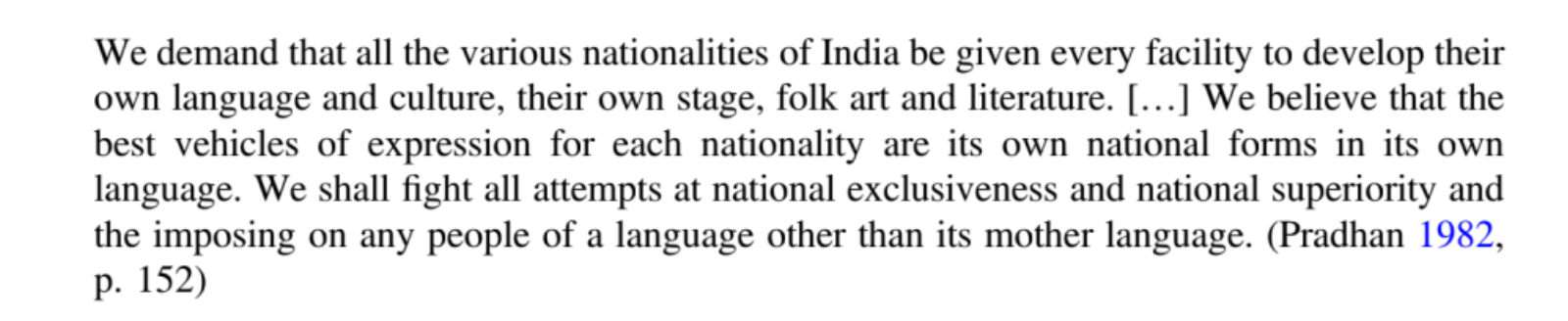
Their manifestos contained shite like the following-

 Some Nationalities in India wanted Hindu Bengalis to fuck off from their territory. Ghatak's family had to run away from their ancestral homes. 

The film weaves together a romance with an investigation of the possibilities for artistic and secular collectivity against the backdrop of a nationalist crisis.

The Muslims had kicked out Ghatak's people. Would the Bengalis kick out the Commies? Ultimately, yes. Mamta's goons were better at beating people than the Left Front's goons.  

It is also the most forthrightly theatrical of Ghatak’s films — it is worth recalling that Ghatak had extensive experience with the theater, and wrote at length on the relations between theater and cinema.

But Bengal fell behind in Film. Talent went to Mumbai.  But, in TN and then Andhra Pradesh, Cinema could do a reverse takeover of Politics. This was because Cinema can do stuff which Theatre can't. It is a dream factory, not shite that puts you to sleep.  

Komal Gandhar is deeply informed by the jatra, a rural Bengali theatrical form that

is as boring as shit.  

Ghatak once described as “kaleidoscopic, pageant-like, relaxed, discursive.”

and as boring as shit unless it aint relaxed at all and gets to the fucking point with a sharp stab of melodrama

In Komal Gandhar, the protagonist Anusuya is a refugee in Calcutta; she has lost her family in the Partition violence.

They were killed by Muslims.  

She pursues her passion for the theater by joining a local performing group, and develops a romantic and creative partnership with its leader, Bhrigu, who like her is also a refugee.

Because he didn't want to stick around and get killed by Muslims.  

Through his use of dialect and folk music, histories of Hinduism and Islam, East and West Bengal, Ghatak reconstructs forms of collectivity and kinship, even as the singular catastrophe of a Partition born of centuries of colonial rule looms in the background.

It was born of Islamic invasion.  British rule meant Hindus were safe in East Bengal. After Provincial Autonomy became effective in 1937, Bengal suffered famine and ethnic cleansing. 

In the sequence in question, Bhrigu and Anasuya converse by the banks of the river Padma. Bhrigu muses of a time before Partition, recalling the train tracks that used to bring him back from visits to Calcutta to the riverbank, where he would board a steamer to cross over: “I thought of something looking at that track now. It used to be a meeting point, a place of union, and now it has become a point of division. The nation is torn in two there.”

By the Muslim League with Commie backing.

As Bhrigu mourns his displaced status, the film’s formal unity begins to disintegrate. In the background, the sound of women chanting “Dohai Ali”

which is Islamic 

(a traditional East Bengali boatmen’s prayer to nature for safe passage) rises sharply in volume. Cutting away from their conversation, the film transforms into one of those “phantom rides” so popular in cinema’s earliest years. The camera takes off down an empty rail track that is cut off in the distance — the India-East Bengal border — and accelerates until, astonishingly, it seems to shatter itself against the wooden barrier.

The Bangladeshis did bring in Ghatak to make a movie for them. I don't think it was released in India. 

The sound of the chants, by now loud and frantic, is overwhelmed by what seems like the sound of a whiplash, and the scene cuts to black. If one were to translate into cinematic terms Walter Benjamin’s exegesis of Paul Klee’s Angelus Novus (1920), in which he describes the angel of history fleeing, blown toward the future by a storm called “progress,” from “one single catastrophe” with “his face […] turned toward the past,” one could do no better.

The Hindu refugees from Punjab and Sindh chased out Muslims to make room for themselves. The local Hindus might not have liked this but Punjabis are difficult to argue with. Still, the fact remained, people who are aggressive can be relied on when it comes to mutual defence. We may weep for the weak who are ejected but if they are replaced by the strong, it is in our interest to make common cause with the new comers.

 Thus, whereas refugees from West Pakistan had an increasingly prosperous future in India many East Bengali Hindus did not. They became a vote bank for the Commies. Will they now become a vote bank for the BJP? No. Mamta's goons will beat the shit out of those who dare challenge Didi's reign of terror. 

 Bengali Hindus did swamp some North Eastern areas and it may well be that intermarriage and cultural interchange will reduce any tensions that may exist. Say what you like, Bengalis are charming and affectionate people. When not virtue signalling, they are brave and loyal. 

Subarnarekha/The Golden Line (1965) concludes Ghatak’s Partition series, in which, once more, he is concerned with questions of caste and refugee crises, displacement, and the impossible absurdities caused by the artificial carving up of territories.

The Muslim League said that the Muslims were a different Nation. The Communists endorsed this claim. Is the author saying Islam and Communism are 'artificial'? That could get him in trouble.  

At the film’s center are the siblings Ishwar and Sita. Ishwar adopts Abhiram, an orphan of lower caste, who eventually develops a romance with Sita.

That's incest- adoption or not. Ghatak's films depict the violation of Hindu norms. An adopted brother is still a brother. A father has a duty to marry off his daughter even if she is the breadwinner. Wives are supposed to know the names of their husbands more particularly if they have that husband's baby.  

Unable to see past caste lines, Ishwar wants none of it; the couple elope to Calcutta. They marry, but soon afterward Abhiram is killed in an accident. Struggling to support her young child, Sita turns to prostitution.

Which is still better than becoming a Communist theatre worker.  

In a twist of the knife, her first customer is none other than Ishwar, who has come to the big city for a wild night out (rendered in a spectacular sequence that riffs as much on Edwin Porter’s 1905 Coney Island at Night as on Battleship Potemkin).

It may riff on what it likes. The thing is still shit.  

Ishwar fumbles his way into Sita’s room, which is submerged in darkness. He doesn’t have his glasses on (they shattered during the drunken revelries earlier in the night), but Sita, shocked, recognizes him. The lens drifts out of focus. Ambient sound drops out on the soundtrack, and all we hear is her quickened breathing. Before one can regain one’s bearings within this nightmarish space of darkness and blur, Sita seizes a nearby bonti — a kitchen knife found in most Bengali households — and slashes her own throat.

Go thou and do likewise. 

The focus continues to drift in and out, as though embodying Ishwar’s struggles to make some sense of what has befallen. He leans over to pick up the bonti, moving with a curious slowness, and then suddenly we are at a distance, watching him move — still with that eerie slowness — across to Sita’s body. The soundtrack is deathly still, until a small, still, male voice speaks: “Hey Ram.” The film scholar Manishita Dass puts it best when she reads this as a citation of Mahatma Gandhi’s reaction to being shot by his Hindu nationalist assassin, Nathuram Godse, thereby “linking Seeta’s death to a national tragedy and the aftermath of Partition.” 

Ishwar had gotten a well paid job in the private sector. This was very wicked. He would naturally end up trying to fuck his sister who would slit her own throat as a protest against Capitalism. The moral of Ghatak's movie is- don't get well paid jobs with Capitalist enterprises. Also don't visit prostitutes who keep a bonti handy. 

At the crux of Ritwik Ghatak’s work, discerned most clearly in the Partition films, is a full-throated protest against the rhetoric of triumphalist Indian nationalism exemplified in Jawaharlal Nehru’s 1947 “Tryst with Destiny” speech, delivered as independent India’s first prime minister after three centuries

less than two centuries. Plassey was 1757 not 1657 

of British rule over the Indian subcontinent. Nehruvian nationalism insisted that “the past [is] over and it is the future that beckons to us [now].”

Under Nehru, lots of Muslims were ejected from the country to make room for Hindu refugees. However, in West Bengal the local people preferred their own Muslims to the East Bengali Hindus. However, there was economic migration of Muslims to East Bengal. 

 It embraced uncritically the European notion of the nation-state construct and viewed nationalist self-determination by the exact standards of European nationalism.

As opposed to what? The Indian notion of lots of Maharajahs and Nawabs and Zamindars and so forth? 

Partition, in all its shocking violence, was little more than “the pains of labour,” to be endured, but ultimately left in the past.

Islam is not a European creed. Pakistan was created on the basis of Islam.  But forcible conversion and ethnic cleansing of infidels had a long history under Muslim Sultans. 

But for Ghatak, it was the loss of subjecthood

His people retained subject-hood- unless Muslims killed them. What they lost was their homes. 

experienced by a nation’s people, newly divided along arbitrary lines

Not arbitrary- religious lines.  

— a condition imposed as the very criterion of claiming a newly conceived citizenship — that became a recurring obsession.

Only because the guy couldn't be honest with himself. Muslims had driven him out of his ancestral homeland. But Islam has been around for a long time. It has nothing to do with modernity or capitalism.  

Rather than try to dramatize all the physical brutality of Partition, Ghatak sought to understand the violence done to human subjecthood and relations by the machinations of the nation-state as it draws, and redraws, lines on a map.

Why is this cretin pretending that the Brits partitioned India, or that it was done in an arbitrary manner? Even if that was the case, why would Ghatak's family have had to leave East Bengal? The answer is that they were being killed there because of their religion.  

The specificities that ground Ghatak’s films

were stupid lies 

— from matters of Bengal’s history (and the larger history of British colonialism in India),

British colonialism had kept East Bengali Hindus safe. Then the Brits left and the Hindus had to flee. 

to subtleties of Bengali social hierarchies;

which not even Bengalis care about. Money talks. Hierarchies can go fuck themselves.  

from India’s vast cultural trove of mythology, folklore, and music, to their brilliant, if erratic, allusions to Buñuel, Eisenstein, Brecht, and any number of European figures of the avant-garde — are what make them resistant to easy assimilation into Euro-American canons of global art cinema founded upon historicist ideologies.

Marxism is a historicist ideology. Ghatak was a Marxist. That's why he was promoted so long as there was some human interest to his films.  

And this is also where the history of Ghatak’s reception in the West tells a larger story. When notions of world cinema or global art cinema take as their premise the principle that “local” texts must first make themselves legible to an international (read: Euro-American) community, they rehearse the logic of European historicism.

i.e. Marxist shite. By contrast the Japanese 'creature feature' of Hong Kong kung fu film were able to make a market for themselves around the world.  

They consign such texts to what Dipesh Chakrabarty, in a lovely turn of phrase, calls the “waiting room of history.”

The rubbish bin of history- maybe. If you make boring films nobody will watch them. If you make films that grip the audience you can turn into a politician- at least in Tamil Nadu.  

So long as the terms of what comprises “the global” are inscribed by, within, and for Western institutions, the center remains unshaken and all else is reduced to subalternity.

But 'Western institutions' can't do shit even in the West. If audiences start watching Hong Kong movies, Hollywood has to start producing their own martial arts films. The 'Subaltern Studies' shitheads rushed to get jobs on Western Campuses. But they had no influence on anybody. This guy is now a curator of a Jewish Museum in New York. That pretty much sums up the trajectory of those who gas on about subalternity.  

Yet this is not to point an accusatory finger at well-intentioned efforts to globalize canons of cinema.

There is only one canon- make movies people will pay to watch while guzzling popcorn.  This generally involves vampires, werewolves or guys who were bitten by a radio-active spider. 

Rather, I mean to suggest that the work of Ritwik Ghatak — at once historically precise

history says Muslims chucked Hindus out of East Bengal. Ghatak couldn't admit this.  

yet calling out to our contemporary moment of resurgent nationalisms

as opposed to what? Taking it up the arse from oligarchs?  

and their attendant crises — as well as its reception in Euro-American cultural contexts, urges us to think carefully about how we negotiate difference as we reconstruct histories of art that were always global anyway.

These guys can't reconstruct shit because they are committed to telling stupid lies. What fucking negotiation will be entrusted to this cretin? Modi and Mamta may negotiate things. They have power and are popular. These nutters may have PhDs from fancy skools but they got shit for brains.  


Monday, 23 May 2022

Was Satyajit Ray a bigger bore than Tagore?

 Nature has made of the Brahmaputra- widening as it merges with Sky and Sea- a marvel which our Species can only exceed when, as in a Rabindranath Tagore or Satyajit Ray- it throws up a vacuous narcissist more crashing than that river's tidal bores. 

The early Ray was okay because the pictures were pretty enough while the sound-track was that of Ravi Shankar (who did the music for a Chetan Anand film which won a prize at Cannes in 1946) or Ali Akbar or Vilayat Khan- all of whom would win acclaim in the West. 

Sadly, Ray was too much of an 'auteur'- i.e. a bore- to stick with such great artistes. Perhaps they were a little too 'folk' for his taste. He started composing his own music with the result that his works became more and more brittle and discordant and even the pictures weren't pretty any more. 

Why were his films so shit? The answer is that his technique was wholly western while his subject matter was the boring shittiness of a boring shithole. Like Himanshu Rai- who, like him, had attended Shantiniketan- and whose collaboration with the Germans- Franz Osten in particular- had kept him within a Western idiom (indeed, he did a Movie in English with his wife, Tagore's great niece, Devika Rani)- Satyajit saw India through aristocratic, Eurocentric, eyes. But, as with 'Light of Asia' (released when Ray was 3 years old), this meant box office failure. Who will pay to see a Prince who, for philosophical reasons, decides to become a starving beggar rather than Aladdin going in the opposite direction while having lots of thrilling adventures along the way? 

 Ray owed nothing to Indian cinema which also meant that he owed nothing to Indian culture. One might say some of his films had a luminous humanity- but it was a mere trick of the light which Europe was using for its own purposes as it rose from the ashes and turned itself into a Common Market. Humanism, at that time, was a Cold War desiderata. It had nothing to do with India which had seen no military operations and where the human-all-too-human was the predominating note. 

 Thus Ray was a westerner- albeit by but grammar and mimesis of technique- forcing his own, that too artificially, deracinated view of India down the throats of Bengalis who had managed to become genuinely deracinated by getting the fuck out of India.  That patronizing cunt said 'the Bengali folk artist can't understand the cinema as an art form'. This was because the Bengali folk artist- like everybody else- wanted entertainment, not boring shite produced by a guy who loathed his own culture and wanted everybody to share that loathing while, if foreign, patting him on the back for staying in a shithole so as to crap the more intensively upon it. 

Chandak Sengoopta, who escaped India quickly enough, explains that the only people who watched Ray's annual films were middle class Calcuttans but only so they would have something to talk about. In other words, this was a cunt whose films talked about Calcutta as a shithole which other Calcuttans then had to talk about because Bongs are a garrulous bunch. Their one aim in life is to compete with the Brahmaputra's tidal bores. One might say some of Woody Allen's films are similarly narcissistic and pseudo-intellectual. But New York mattered- it was the Capital city of Capital. Calcutta did not- it was not even the ghost of its vanished Capitalist creators. It was simply a decomposing corpse. Sex matters and Comedy matters because sexual love is a tragic tale. Zombies may exchange soulful looks. But this is an expressionism as fatal to humor as to romance. It has too thoroughly destroyed all its aesthetic possibilities in advance. Ray's oeuvre did not challenge his audience. It challenged his critics. What can you say about films made unwatchable by the auteur's loathing of the trained and hermeneutic eye? Ray, like Tagore and Sen, displays his bigotry so brutally and incessantly that to comment upon him is to either grovel blindly or else to display an equal bigotry. 

Why did Tamil Cinema become so greatly superior to Bengali Cinema? Calcutta was richer in the Fifties and even the Sixties. Ellis Dungan was brought to Calcutta, by a wealthy Bengali who had been his fellow student in Film School, to make movies but, by happenstance, Dungan moved to Madras and worked in Tamil Cinema.  There he had to work with Tamil folk-artistes or 'devadasi' (courtesan class) singers and, by making them 'camera aware', he helped develop a vernacular oeuvre. Since Dungan didn't know Tamil or anything about India, he could not impose any stereotypes on the 'folk-artistes' of whom Ray was so contemptuous.

Dungan made M.S Subbalaxmi a star and gave Karunanidhi his start as screen writer. Tamil Puranic Hinduism (the 'kathakalakshepham') spread to the rest of India though Bollywood was disinclined to master the idiom of  'mythologicals' ( 'Jai Santoshi Ma' being a but low budget flash in the pan). But the Telugu Cinema soon took over Madras's role. Meanwhile, Karunanidhi and MGR had invaded politics and made it a tributary to the Screen. Then, in the Eighties, Indian TV finally outgrew the shadow of the Cinema Hall with the Ramayana and Mahabharata etc. Thus, in a sense, an American director helped India, through Cinema, become what it always was- viz. Hindutva. This was Vivekananda's vision not that of Tagore for whom Brahmobandhav Upadhyaya had committed the ultimate sin against the Holy Bore by abandoning 'East-West fusion' for simple Nationalism- i.e. vulgar stuff with in-built narrative tension. Why be a hunted revolutionary- i.e. the star of a scenes a faire thriller- when you can be a boring shithead endless complaining that both East and West think what you offer is confusion not fusion? 

Imagine a Bengal which celebrated Bagha Jatin- whose fists of fury were unleashed on actual British soldiers- or Ras Behari, a Scarlet Pimpernel who made a second life for himself in Japan- instead of Tagore and Ray and Amartya Sen. It is true that Bimal Roy, along with other talented people left for Bombay by about 1950 but they could still have made films set in contemporary Bengal.  Come to think of it, maybe the Bengal which celebrates heroes, not bores, is Bangladesh. Tareq Masood's films were good. Kagojer Phool, however, might have made for uncomfortable viewing on this side of the border. 

Around the time Ray was gaining acclaim globally, development economists were arguing that the need for achievement (McLelland) drove growth and modernity whereas the need for affiliation might have the reverse effect. Ray and Tagore and Sen's achievements are of a negative kind. They affiliate with being boring shitheads from shitholes so as to, not shine by comparison, but fuse West and East through multiple identities as boring shitheads with nothing to say but who will just go ahead and babble high falutin' nonsense anyway. 


Monday, 27 August 2018

Netflix's Insatiable & a Girardian Schopenhauer.

The word 'insatiable' arises in the philosophy of Schopenhauer- for whom Spinozan conatus- the principle of inertia by which every being seeks to continue to be itself rather than evolve to fit some higher purpose- is the blind, proto-Darwinian, Will whose choices are always ironic.

The article on Schopenhauer in the internet encyclopaedia of Philosophy gives this summary-

Because the will has no goal or purpose, the will’s satisfaction is impossible. The will objectifies itself in a hierarchy of gradations from inorganic to organic life, and every grade of objectification of the will, from gravity to animal motion, is marked by insatiable striving. In addition, every force of nature and every organic form of nature participates in a struggle to seize matter from other forces or organisms. Thus existence is marked by conflict, struggle and dissatisfaction.
The attainment of a goal or desire, Schopenhauer continues, results in satisfaction, whereas the frustration of such attainment results in suffering. Since existence is marked by want or deficiency, and since satisfaction of this want is unsustainable, existence is characterized by suffering. This conclusion holds for all of nature, including inanimate natures, insofar as they are at essence will. However, suffering is more conspicuous in the life of human beings because of their intellectual capacities. Rather than serving as a relief from suffering, the intellect of human beings brings home their suffering with greater clarity and consciousness. Even with the use of reason, human beings can in no way alter the degree of misery we experience; indeed, reason only magnifies the degree to which we suffer. Thus all the ordinary pursuits of mankind are not only fruitless but also illusory insofar as they are oriented toward satisfying an insatiable, blind will. 
Since the essence of existence is insatiable striving, and insatiable striving is suffering, Schopenhauer concludes that nonexistence is preferable to existence. However, suicide is not the answer. One cannot resolve the problem of existence through suicide, for since all existence is suffering, death does not end one’s suffering but only terminates the form that one’s suffering takes. The proper response to recognizing that all existence is suffering is to turn away from or renounce one’s own desiring. In this respect, Schopenhauer’s thought finds confirmation in the Eastern texts he read and admired: the goal of human life is to turn away from desire. Salvation can only be found in resignation.
Netflix's 'Insatiable', however, which too has a conatus- it wants to come back as a second series pretty much the same as the first series- doesn't make Buddhist, but rather Girardian, mimetic rivalry based, Christian choices. Thus it gets baptised while high on Molly. It seeks to resolve a Satrean 'No Exit' type problem by evoking the notion of a 'trouple'- this time featuring two gay men and the social climber wife of one of them- which however is an unstable bond- the husband, having to choose between his rival and his wife, is about to commit suicide when the son of a Pastor is sacrificed to the Plot so he and the pageant Queen he is coaching can have a life more abundant- though once again fraught with insatiable conatus whose narrative is one of recuperating Will through the sort of metanoia we associate with Drew Barrymore films.

Insatiable's cascading satire or skandal highlight's the stumbling block to Faith in Chrematistic, winner take all, as opposed to Open Market, Capitalism, and also to such irenic Christianity as must, to cast out its demons, itself enter into the swine. The foundational axiom to its ironic economia is -'Choice is the the act which destroys what it affirms'- for example, if you are tempted to embrace being a bad person- thus permitting yourself to murder a rival- you can still choose to be a good person though loudly affirming this choice will accompany bludgeoning your ex to death.

The critics complain of the 'scenes a faire' nature of the stereotypes featured. Fatty Patty is always about to eat her own body weight in cake or fudge weiners or whatever; the gay dudes are super gay all the time; the ex-trailer trash Suburban Socialite is always on the point of turning into a 'Momentrepreneur' marketing a tasseled tampon funded by Big Tobacco and the Ku Klux Klan; the Pastor is constantly casting out demons whom, however, his Rock & Roll loving son hopes to ingratiate himself with and somehow monetize... Insatiable has an insatiable appetite for every trashy meme on TV and is all the better for it- at least for those of us whose long satiation with network TV has made us the victim of the Schopenhauerian Fata Morgana of Choice as incarnated in 'on demand' services like Netflix and Amazon Prime.

Will this series succeed and win accolades in the same manner as 'the Good Place'? Currently, we think of Red State, working class Whites as the Divinely appointed pharmakos, or scapegoat, whose ritualised humiliation and slaughter is the salutary public spectacle which can serve as an inoculation against self-laceration or internecine violence in the face of The Donald's apotheosis or impeachment.

This is a deeply silly- a shameful- thought. There is nothing wrong with either working class White people or ignirrint fat black peeps like myself. We think Schopenhauer can go suck Girard's balls- or the other way round- we simply don't care. Christianity has nothing to do with scapegoats or 'mimetic rivalry' and holier-than-thou bullshit. It's about enjoying being together while still being able to get to work, with a clear head, the next day.

Similarly, Buddhism isn't about 'resignation', its about cool stuff like Shao Lin Kung Fu and Basho's haiku and Steven Seagall...before he got fat. Except he didn't really. It's a fat suit dude! Steve is like totally buff. As am I. Fuck is wrong with you sheeple? Why can't you see the truth?


Thursday, 8 February 2018

Project Camelot 1965 & Blade Runner 2049

 In a giant, empty, decaying building which had once housed thousands, a single TV set hawked its wares to an uninhabited room. 
This ownerless ruin had, before World War Terminus, been tended and maintained. Here had been the suburbs of San Francisco, a short ride by monorail rapid transit; the entire peninsula had chattered like a bird tree with life and opinions and complaints, and now the watchful owners had either died or migrated to a colony world. Mostly the former; it had been a costly war despite the valiant predictions of the Pentagon and its smug scientific vassel, the Rand Corporation — which had, in fact, existed not far from this spot. Like the apartment owners, the corporation had departed, evidently for good. No one missed it,
Philip K Dick, 'Do Androids dream of electric sheep?'

The climactic showdown between Rutger Hauer and Harrison Ford in Blade Runner occurs in this empty decaying building not far from the old Rand Corporation Head Quarters in Santa Monica. Dick published the book on which the film was based in 1968. At that time the Rand Corp. was connected in the public mind with 'Dr. Strangelove' type Nuclear policy aiming at Mutually Assured Destruction as well as the ongoing war in Indochina. However, there was a third aspect to Rand's work which has since faded from public memory. This was its association with psychological warfare and counter-insurgency for which it recruited Psychologists and Sociologists and Area specialists. This was the notorious 'Project Camelot'- described as the Manhattan Project for the Social Sciences- which sought to turn American academics into 'engaged intellectuals' who would uncover the objective determinants of human behaviour as relating to social and political formations. In the words of Theodore Vallance
Project CAMELOT is a study whose objective is to determine the feasibility of developing a general social systems model which would make it possible to predict and influence politically significant aspects of social change in the developing nations in the world. Somewhat more specifically, its objectives are:
First, to devise procedures for assessing the potential for internal war within national societies;
Second, to identify with increased degrees of confidence those actions which a government might take to relieve conditions which are assessed as giving rise to a potential for internal war; and
Finally, to assess the feasibility of prescribing the characteristics of a system for obtaining and using the essential information for doing the above two things.[38]
Project Camelot backfired when Latin American intellectuals became suspicious of its motivation. The Chilean Senate, in particular, denounced this thinly disguised attempt at 'imperialist intervention'.
Phillip K Dick was writing his book after this fiasco had come to light. At the time, it did appear that the Social Sciences could be used to prevent costly wars abroad- like the Vietnam quagmire- but, if so, why not at home to manage dissent and 'manufacture consent'?

 Blade Runners use advanced technology to identify androids who, it seems, lack a specifically human capacity for empathy which is expressed in love for and the desire to nurture all organic life-forms. Clearly, such a technology could also be used to identify potential troublemakers who are not susceptible to the normal emotional and moral restraints enforced by family relationships, institutional ideologies or organised religion.       

Blade runners use their bounties to buy real as opposed to electric sheep. They can also connect up electronically with a suffering Christ like figure named Mercer. Thus humans are identified by not just empathy but also a participation mystique of a spiritual kind. This does not mean that they are happy or good. They have to use electronic means to stabilise their moods. Stay at home wives- entombed in what Betty Friedan had called the feminine mystique- are depicted as at the end of their tether. Meanwhile, a large section of the population are condemned to second class status as 'chicken-heads' because they have been damaged by fall-out and are considered intellectually sub-par.

Androids exhibit sociopathic traits, but so do some humans. Indeed, sociopathy may correlate with outstanding success in competitive fields. 'Chicken-heads', however, are full of empathy- though it brings them only more suffering.

Dick's conclusion is that humans can reverse time, reverse entropy- like the Christ like Mercer who
was killed for bringing the dead back to life. How? Forgiveness, Mercy, Penitence- these are human faculties we all possess- which can do what even the God of Aristotle can not, viz change the Past.

The Blade Runner has killed and been unfaithful to his wife with an android who vindictively slaughters his sheep. Yet his wife is a comfort to him at the end of his terrible day.
"Do you think I did wrong?" he asked. "What I did today?" 
"No." 
"Mercer said it was wrong but I should do it anyhow. Really weird. Sometimes it's better to do something wrong than right."
 "It's the curse on us," Iran said. "That Mercer talks about."
"The dust?" he asked.
"The killers that found Mercer in his sixteenth year, when they told him he couldn't reverse time and bring things back to life again. So now all he can do is move along with life, going where it goes, to death. And the killers throw the rocks; it's they who're doing it. Still pursuing him. And all of us, actually..."
Project Camelot was discontinued by President Johnson in 1965. Yet it appears that the US backed coup in Chile eight years later was motivated to some degree by a computer program called POLITICA which counselled the killing of Allende. Interestingly, Allende's regime had relied upon a Cybernetic system to coordinate the economy- it featured a futuristic control room with Star Trek type tulip chairs- but this 'Cybersyn' program was junked after the coup.

Chile was something of an exception. The truth is the scandal surrounding Project Camelot did not deter similar operations in Brazil or Colombia or Peru being successfully carried through. Nor did Social Science funding decrease. In 1968, the National Science Foundation had its charter rewritten so as to place the Social Sciences on a par with the Natural Sciences. However, by then, there was a new mood on the campuses of America and Europe. The 'baby boomers' were coming of age and were determined to live life on more ample terms than could be envisaged by a bunch of behavioural scientists or predicted by a computer.

Philip K Dick was a hero to this new generation. They may not have understood the Gnostic element to his thinking but shared his suspicion of the organs of government and the bland corporations which manipulate them. Yet, this 'Me' generation too back-traced. By the time Ridley Scott's film came out, there was an obsession with Japanese competition which has since faded away only to be replaced with a fear of China. Gender relations too had changed. The scandal that Harrison Ford's love interest is programmed to fall in love with him is not confronted. Instead the focus shifts to whether he is himself a replicant. In any case, he is little better than a chicken-head genetically unworthy of witnessing 'attack ships on fire off the shoulder of Orion'. The androids, in Scott's film, on the other hand, are Promethean- they challenge their maker. In Dick's book, though the android is programmed to have an affair with the hero, she is still woman enough to act vindictively against his prize possession.

What of Blade Runner 2049? Critics have raved about it. But what does it actually say? I must admit I couldn't make sense of it. The objectification of women crosses a line. I suppose the film is about 'hybridity'. Androids can breed with humans. If this fact becomes known, then the entire social structure- predicated on android servility- will be called into question. There is one other possibility. If androids can make more androids, with or without human help, they may become the master race. In this scenario, the rugged macho male might be little more than a sperm donor manipulated by a female android with the right software program. The problem here is that we are speaking of a purely political process- a game about whether sociopathic humans run things through bland Corporations or whether inhuman androids do so on the basis of superior software. The outcome scarcely matters. The one plot twist features the hybrid child who turns out not to be the hero but a woman who makes the artificial memories which stabilise android behaviour. The hero's self-sacrifice reunites her with her father and, it may be, she forgives him for what might have felt like his abandonment of her. Perhaps a new type of memory can be fabricated on the basis of what happens next. But we are given little guidance as to what that might be.

In Dick's book there is a sort of shared artificial memory- that of Mercer being assailed by stones and rocks- which mediates the hopelessness of an Earth in the clutches of an entropic death spiral. In Scott's movie there is a Promethean grandeur to the androids' agon with their human maker. In Denis Villeneuve's film there are gorgeous visuals and Gosling doing what Gosling does in every recent movie we have seen him in. But what is it that he does? Perhaps this flop will alert producers that they need to find something else for Gosling to do than sleep-walk through yet more victories of style over substance.

Dick's book was, in its own way, a monument to '68 when bare breasted German students put Adorno to flight with a shower of flower petals and Parisian students raised up flagstones, like the Communards, but with the slogan 'under the pavement- the beach!' A feature of this world wide unrest in which students were in the vanguard was a Lysistrata like protest by women against a macho military industrial complex which, like Moloch, demanded an increasing tribute of young lives.

 It seemed something had gone wrong in the relationship between the sexes and the entire planet was imperilled as a result. Why? The Social Science had turned sociopathic. The Humanities were turning into the sub-humanities. Paideia had been weaponised.

Scott's movie, in '82, vividly depicts American fears of being eclipsed by the Pacific Rim. Its homage to the film noir tradition is based on the challenges faced by an American masculinity no longer bolstered by the military-industrial complex. In December of that year, unemployment peaked at over 10 % - the highest it has ever been since the Great Depression. Why? Voodoo economics. Social Scientists were now little better than witch-doctors.

What social reality does Villenueve's movie reflect? I notice a lot of scary looking immigrants speaking strange languages. Even the androids are having babies. Soon they will out breed us. Trump had better build that Wall before it is too late! Everything else is just fake news or clickbait Junk Social Science. The City on the Hill remains hidden. Camelot is as Nineveh and the Eternal Feminine a toppled statue of cyclopean scale. Maiuetics has misfired. Misology is a universal inheritance. The minotaur has outgrown his labyrinth. Memory is a thread whose Ariadne is herself manufactured.