Showing posts with label Tim Sommers. Show all posts

Thursday, 30 October 2025

Tim Sommers rancid 'range egalitarianism'


Range egalitarianism is the notion people should not be concerned with the exact level of equality, but rather with keeping inequality within a certain acceptable range. The problem is that nobody can say what that range should be at any give moment. Maybe, the current global 'fitness landscape' requires more inequality- e.g. Elon Musk having trillions of dollars so that he can invest it new technologies which ordinary people know nothing about- or less inequality (otherwise, what is to stop people quitting work and getting a Doctor's note saying they are too sick to work? This means we have to import labour. But that, by itself, could lead to a political backlash against 'demographic replacement'.) 

Tim Sommers has an essay in 3 Quarks on this issue. 


Range Egalitarianism

by Tim Sommers
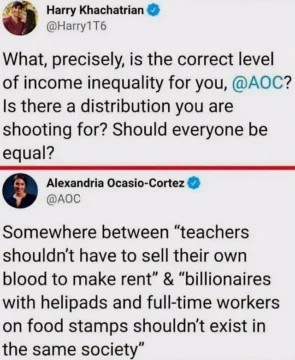

Rents may be too high in some places. Those on average incomes may have to move away from there. That may not be a bad thing in itself. Chances are, their quality of life will improve. Maybe families will move out of areas where there aren't enough teachers. But their children may benefit from growing up in a less congested environment. 

We could get rid of billionaires. But what if they move to places where they pay less in tax and have more opportunities to invest in new high-tec industries? Our tax revenue will fall. We will fall behind in the new industries.  Other countries may be able to dictate terms to us because they control the vital new technology. They can 'sanction' us if we don't comply with their demands.  

The economy is not a force of nature. We have some control over it.

 We can screw it up. But we can also screw up our environment. 

Granted, it’s also not like a machine controlled directly by levers, switches, and buttons either. But when the state acts, intentionally or not, it often influences the distribution of income and wealth.

The State can encourage investment and 'R&D' in new technology. But it can also raise taxes and thus cause a 'brain drain' and 'capital flight'.  

More often than not, it influences the distribution of wealth and income in reasonably predictable ways.

Sadly, this is not the case. There are 'unintended consequences'. If factor elasticity is high, policy interventions may be self-defeating.  

It seems to me that, for this reason alone, we should care what the ideal distribution of wealth should be.

Why should I care about the ideal theory of Physics? I am too stupid to understand that subject. There were philosophers who thought that they could say, on a priori grounds, what was good or bad Physics. But they all turned out to be wrong. Ideals are misleading. Idealism, as a philosophical project, crashed and burned long ago. Kant thought he knew why Newton must be right. But Newton was wrong. 

The ideal distribution is, at a minimum, one factor we have an ethical obligation to take into account in governing.

This is like the claim that Philosophers could arrive at a priori synthetic judgments which must be true. Sadly, no such judgments exist.  

Some people say that any ideal distribution is unrealistic, impossible to achieve.

Others say that talk of this type is a vacuous type of virtue signalling. They are right.  

That’s alright though. Ideals – perfectionism, utilitarianism, the Ten Commandments – are, as they say, honored as much in their breach. We should still have ideals to follow.

There is nothing wrong with obeying or honouring imperative statements- e.g. 'Be nice! Don't be nasty!' But they have no alethic content. Sometimes, being nice involves doing things others find nasty- e.g. my teechur telling me I should stop studying Math. The answer to 2 plus 2 isn't 'Pizza'. I should quit Collidge & try to get training in mopping floors.  

Others say that trying to enforce any particular distribution – equality, first and foremost – leads to coercion and political oppression.

It may do. Alternatively, smart people may simply run away.  

I think they say this mostly because they have frightening real-world cases in mind. But people also do terrible things in pursuit of freedom, justice, or whatever.

Some crazy people who seize power may do so. But the reason they are doing so is in order to have even greater power and impunity.  

You certainly can pursue equality in a repressive way. Say, seize everyone’s property,

and keep it. 

redistribute it,

Don't redistribute it. Those who get it will have countervailing power over you.  

and redo that every so often to maintain equality.

The guys who were with you when you gave them property, may try to kill you if you show signs of taking it away.  

But you could also, as I implied above, mostly regard equality (or whatever the correct principle is) as a kind of tie-breaker.

Two kids are quarrelling over who gets to play with a toy. As a 'tie-breaker', Mummy says that if they can't agree then she will donate the toy to Goodwill. The kids become quiet. They agree to take turns playing with the toy.  

For example, the point of health care is not the distribution or redistribution of wealth per se, but when you must decide between two approaches one of which takes you closer, the other further away, from the ideal distribution, there’s nothing repressive about going with the one that also has a positive effect on the distribution of wealth and income.

Sadly, this may backfire. If people feel healthcare will go disproportionately to the poor refugee, they may support politicians who dismantle the Public Health system.  

In other words, there is nothing inherently oppressive about pursuing more distributive equality. It just depends on how you do it.

You have to be strong to actually oppress people. If you are weak you can talk bollocks but everybody will ignore you.  

Some people (libertarians, for example) believe that people deserve whatever they can obtain from fair or just initial aquations and/or just transfers – where neither the acquisitions nor the transfers involve force, fraud, or theft. Where these are unjust, the state should act to rectify the situation, but at no point does it rely on the distribution of wealth to decide anything.

Speaking generally, this is a justiciable matter- i.e. one resolved by courts of law. Unconscionable contracts may be struck down. If there is a gap in the law, the Legislature may pass a law and set up an Enforcement Agency.  

One problem with this view is that the current distribution of wealth is largely the result of force, fraud, or theft.

Nonsense! It is largely the result of some people having really smart parents or grandparents. Also, if you do stupid shit, chances are you end up poor.  

Robert Nozick, plausibly the most influential libertarian of them all, surprisingly suggests that solution (at least sometimes) is to follow John Rawls’ preferred distributive principle – the least well-off should be as well-off as possible.

The least well-off are dying or close to death.  In any case, nobody knows who is worst-off. Bernie Madoff's investors thought they were well-off. They weren't. 

A more serious problem for libertarians is that it is not clear that one can even define just acquisition or transfers without resorting to distributive claims at some point. John Locke

who lived at a time when Englishmen could go off to the New World and create any type of Society they liked.  

and Nozick both say just acquisitions involve “mixing your labor” with something, but then say it is limited in that you must “leave enough and as good for others.”

the native Americans?  

Isn’t that a distributive principle?

It is meaningless. Still when helping yourself to cake, it is polite to leave enough for the next guy.  

Or consider property rights. Not the version of property rights that philosophers often focus on, because it doesn’t seem crazy, at least about these sorts of property rights, to say they are “natural” rights.

Sadly, those who spoke of 'natural rights' didn't think Native Americans had any.  

Consider zoning law instead. It involves property rights, but zoning law doesn’t seem like it can be derived from natural laws.

It is derived from a 'collective action problem'. Everybody wants to live in a nice residential neighbourhood. But they may also have an incentive to get lots of money by setting up a drug den or brothel in the basement.  

Zoning and rezoning creates or addresses various problems, creates or forecloses various opportunities, and it also impacts the distribution of wealth.

It affects property values- i.e. wealth. It may not change the distribution of it.  

It seems arbitrary to me to say that you should never take the distributive impact of zoning into account.

Unless you are a Town Planner, you should only focus on how you are personally affected. Will the value of your property rise or fall? What about your quality of life? You may have to trade-off the one against the other.  

So, far I have argued that even if distributive justice it is an ideal that we will never fully achieve, it’s still worth trying to figure out what it is.

In mathematics, there are 'existence' proofs. However, if we also have a proof that the thing is not effectively computable, we ought not to waste time trying to figure out what it might be. Since there is a mathematical representation of the economy, we know that it is futile to try to figure out things which are not effectively computable.  

I argued that there is nothing inherently repressive about attempting to achieve a just distribution.

But, it is inherently stupid. The thing may exist but is not effectively computable.  

And that focusing only on rights to obtain or transfer property to avoid distributive questions is probably not workable.

Yet courts in affluent countries work well enough. The problem is always with the cost of enforcement. In practice, this means the Social Contract is 'incomplete'. There is wriggle room. Control rights aren't perfectly aligned with beneficial rights.  

We are likely to fall back onto questions about the fairness of various possible distributions.

Only if we don't understand that problems of concurrency, computability, complexity and categoricity render the thing a complete waste of time.  

So, what is the ideal distribution of wealth and income?

Nice people get plenty of people. Nasty people starve to death.  

In a Kindergarten everybody gets an equal share.

But the mean kid may knock you down and steal your lunch. That's why I gave up teaching.  

Our first thought is probably to distribute the coconut on the desert island on which we are stranded equally. Equality is the default distributive principle in many contexts.

In the short run- yes. We think we will be rescued soon. But the longer we remain on the island, the more likely it is that coconuts will be distributed according to 'Shapley values'. Those who are more productive and who have a higher threat point get more.  

Funny thing about equality, you can always make things more equal, reduce the amount of inequality, by just taking stuff away from the well-off – even if you don’t give it to anybody.

They may kill you.  

You can always get closer to equality by taking stuff away – which makes some people worse off – even if you don’t give it to someone else (who would then be better off). In other words, equality tells us to sometimes prefer situations were some are worse off and none or better off relative to the status quo. This is called the leveling-down problem. Many philosophers take it to indicate that equality, in an of itself, is not what people care about. What do they care about? Maybe, poverty, immiseration, the plight of the worst-off?

No. They care about their own material standard of living and then have some sort of kin selective altruism linked to reproductive success for those of their own lineage. But, because of radical interdependence, (your distant descendants may marry the distant descendants of people you are not currently related to) this may broaden to include everybody.   

Rawls argued for the “difference principle,” which says that inequalities are only justified if they also work to the advantage of the least well-off.

He was wrong. He didn't understand that the way to deal with uncertainty as to your future status (you may be hit by a bus tomorrow) is to go in for 'risk pooling'- i.e. you hedge or buy insurance.  

This is called prioritarianism since it gives distributive priority to the worst off.

This is called stupidity. I buy fire insurance just in case my house burns down. I don't support a law saying all those whose houses burn down will get a big sum of money. Why? Careless people benefit. Cautious people suffer. There is 'moral hazard'. Moreover, the fire insurance company has an incentive to push for better provision of Fire Fighting services as well as for changes in building codes to reduce the risk of fire. 

Rawls argues for absolute priority. But this seems to create a nested leveling-down problem. For example, if there were a policy that would increase middle-class wages, but from which no benefit at all would go to the least well-off, it violates the difference principle.

People dying of old age get no direct benefit from spending on kindergartens. Thus, no money should be spent on kiddies. The least well-off are very old. Their existence is quite miserable.  


Here’s a different way to deal with the least well-off. Why not say that everyone is entitled to a sufficient amount of income and wealth to avoid poverty and have enough to lead a decent life?

Why not say 'It is nice to be nice. Be nice. Don't be nasty.'? 

Call this sufficientarianism. One issue is how to set the sufficiency level. What is the minimum?

Unemployment benefit. Should this be turned into 'Basic Income'. No. There will be a disincentive to work.  

Also, it’s exclusive focus on the less well-off means it ignores another possible concern about inequality.

Limitarianism argue that no one should have more than a certain amount. “No billionaires,” for example. They argue that democracy and liberty are impossible in a society with too much inequality. One problem limitarians share with sufficientarians, however, is how to set a threshold. How much is too much?

The problem is not that nonsense can be talked. The problem is that if shitheads take over, smart people run away. The State goes off a fiscal cliff.  


If we combine these two views, we get a promising distributive approach that we might call sufficiency limitarianism. No one should have too little or too much. But this doesn’t solve the issue of how to set a threshold.

Any cretin can set any threshold. Try to implement it and the State goes off a fiscal cliff.  

Consider this. What if people don’t care about things being as equal as possible, but only about avoiding things being too unequal.

In that case, such people run away from America. They become subsistence farmers in underdeveloped countries. 

The distribution within a certain range would be a matter of indifference, but falling below or exceeding the range would be considered problematic.

This is the view that I have come to. I call it range egalitarianism. Empirical research suggests that most Americans believe that

they have been anally probed by aliens in flying saucers?  

there is too much inequality, but that some level of inequality is morally fine. Most Americans are range egalitarians, then.

That's why Trump won the popular vote- right?  

It is a response, again, to the idea that you don’t have to love equality as such, to fear inequality that leaves some unable to meet their basic needs and others with the power to bend the rest of us to their will.

Americans don't just care about Equality. They also support Diversity. That is why Kamala Harris is POTUS.  


_________________________________

Appendix: Nozick on Rawls

“Assuming (I) that victims of injustice generally do worse than they otherwise would and (2) that those from the least well-off group in the society have the highest probabilities of being the (descendants of) victims of the most serious injustice who are owed compensation by those who benefited from the injustices (assumed to be those better off, though sometimes the perpetrators will be others in the worst-off group),

i.e. African Americans and First Nation people. Should they be given reparations? The problem is that a lot of White Americans are descendants of poor immigrants who worked in sweat-shops or coal mines etc.  

then a rough rule of thumb for rectifying injustices might seem to be the following: organize society so as to maximize the position of whatever group ends up least well-off in the society.”

The least well-off have the strongest incentive to rise in 'general purpose productivity. Raise factor mobility and elasticity (this means high 'transfer earnings'- i.e. workers can easily switch to just as well paid jobs in other industries). This raises total factor productivity and thus increases GNP and Tax Revenue. This in turn means a better welfare 'safety net' can be provided. But this, by itself, reduces risk aversion and thus raises factor mobility and elasticity. It is a virtuous circle.

In the late Sixties, many politicians believed voters cared about equality. Harold Wilson's Government in the UK increased labour's share of National Income to 83 percent. But, it had to devalue the currency. The working class rebelled against having to pay more for their holidays in Franco's Spain. They voted for the Conservative party. Over the course of the Seventies, even the Scandinavians came to understand that the working class didn't like 'solidarity wages'. They didn't care about inequality. They wanted a higher material standard of living in absolute terms. Mitterrand, becoming President with Communist support had to do a U turn and support more free-market policies. But China was more thorough-going in embracing the Market. Equality simply didn't matter- save to some brain-dead academics regurgitating the warmed up sick of the Seventies.  

Monday, 25 November 2024

Tim Sommers on Arrow's theorem

Tim Sommers writes in 3 Quarks 

Why have a democracy?

 Speaking generally, a territory is ruled in the only way it can be and has been ruled. It may deviate from this trajectory briefly, but if it was an autocracy, it will soon revert to being an autocracy- though under a Commissar rather than a Tzar. If it featured the paramountcy of a Dynasty, dynasticism may remain though the House of Nehru supplants the House of Windsor. 

Because democracy is always right.

No one has said anything so foolish. The Condorcet Jury theorem is a separate matter. But it doesn't reply to representative democracy with 'checks and balances'.  

There are two kinds of arguments in favor of democracy:

shit ones and shittier ones 

intrinsic and instrumental. Intrinsic arguments try to show that democracy is good in-and-of-itself – and not as simply a means to some other end or ends.

This is a claim, it is an ipse dixit assertion. But anyone such assertions can be made about the Divine Right of Kings or the historical inevitability of the Dictatorship of the Proletariat or whatever.  

Instrumental arguments try to show that democracy is good because it leads to some good.

It is enough to ask- what is the alternative? How many people would you need to kill to establish that alternative? How do you know you might not end up being killed yourself. A Revolution is a sow which eats its own farrow.  

There are two main kinds of intrinsic arguments: those based on liberty and those based on equality.

In other words, both are obviously false. Democracies put people in jail and are highly unequal.  

The most straight-forward kind of liberty argument says that we should be free, but to be free means not only to govern ourselves, but to have some control of our larger social and material environment.

Just like chimpanzees in the the jungle. Giraffes too have some control over their larger social and material environment more particularly with respect to the leaves atop trees.  

Democracy gives us that control.

It gives us a vote. We get to chose between one lying bastard and another lying bastard.  

The trouble is that in actually existing democracies very, very few people are able to exert any real influence on society or their material conditions via the political process.

But some of those people need to get re-elected and this may constrain their cupidity, stupidity or criminal tendencies.  

Democracy does not make most of us free, at least in this way.

Here’s a different kind of liberty argument. We all have certain basic rights.

Nope. Some have reliable (incentive compatible) remedies for violations of their rights. Others don't.  

Among the basic rights, liberties, and freedoms we possess in a liberal democracy – freedom of religion,

unless Muslims keep stabbing you as you exit the synagogue 

free speech,

unless Muslims keep stabbing you when you say 'Shalom'.  

the right to the rule of law, etc.

unless politicians and policemen are afraid of getting stabbed. Did you know that Pakistan is a democracy? Why not open a synagogue there?  

– there are also rights of political participation – political speech, a right to free assembly, etc.

The Dems weren't able to jail Trump. They blame Merrick Garland.  

What does this kind of pro forma right to some kind of political participation really amount to, though?

Rights are meaningless unless they are linked to effective remedies under a bond of law.  

There’s no right to vote in the US Constitution. And Arrow’s Impossibility Theorem shows there is no way of counting votes that can satisfy all of the seemingly simple and reasonable conditions voting must bear.

No it shows that if you define a Dictator as a guy who is not a fucking Dictator then, by ex falso quodlibet, you prove that all dogs are cats. 

Gibbard-Satterthwaite says that there is no strategy proof voting system and Chichilnisky-Heal says that democracy, or markets, will only exist if a Goldilocks condition re. preference and endowment diversity is met. Even so, by the McKelvey chaos theorem, if the decision space is made multi-dimensional, then there will be an agenda control problem and any outcome whatsoever becomes feasible. But all this was common knowledge to actual politicians.  

To oversimplify a bit, there is no way of voting that always gives us an answer, always depends on the input of more than one person, gives a way of deciding between candidates based on voting (and nothing else), and insures that the choice between any two candidates is independent of how the voter feels about other candidates.

These are undesirable conditions. If there is a benevolent omniscient sage then everybody will want to vote the way he tells them to. This aint Dictatorship. Voting shouldn't be the only thing which matters, there should be 'transferable utility'- i.e. side-deals in smoke filled rooms.  How we feel about third parties should affect how we feel about any two people. Thus suppose I have to choose between a Tamil man like me and a Punjabi bloke, I choose the Tamil till I notice that there is Bengali lady who is running who is saying sensible stuff which, truth be told, the Punjabi but not the Tamil exemplifies. I vote for the Punjabi because though he isn't good at articulating his position, what he stands for is good for me and good for the country. I don't vote for the Bengali lady because I believe a Bengali is unelectable by reason of its marked socio-economic decline relative to Punjab, Gujarat or Tamil Nadu. 

Fortunately, there are also equality-based arguments for democracy.

There were. At one time academics thought voters cared about relative inequality rather than their absolute material standard of living. They were wrong.  

Many political philosophers have argued that democracy is a way of treating people equally.

If all are equally subject to the Absolute Monarch then, arguably, they are treated equally. The Sun King got Dukes and Marquesses to help him bathe and wipe his bum.  

But lotteries treat people equally too.

No they don't. You have to buy a ticket. You don't have to buy a piece of ballot paper.  

Here’s an instrumental argument for democracy from Thomas Christiano:

a cretin 

“The modern democratic societies of Europe, North America, and East Asia have actually been quite successful…

successful countries have actually been quite successful. Maybe not as successful as China or the UAE but still... 

Democracies do not go to war with one another

They have done twice in the Twentieth Century. In America there was a big Civil war in the nineteenth century.  

and respect the rules of war better than other societies.

Nope. That was better done when war was still the 'sport of Kings'. Still, it is true that if Truman hadn't been an Absolute Monarch, there would have been no nuking of Hiroshima and Nagasaki.  

They are responsible for the creation of the international trade system,

which were created by the Kings of Portugal and Spain. 

the international environmental law system,

Which is shit.  

and the human rights regime.

See above. Still, it is true that Afghan women now enjoy the fundamental human right to fist themselves in public. Don't say the War on Terror was a complete waste of blood and treasure.  

In fact, democracies do massively better on basic human rights than other societies,

That will be sweet music to the ears of Hindus in Pakistan.  

and it appears to be more their majoritarian character that explains this

The majority did win the American Civil War. But there were 600,000 casualties- about two percent of the population at that time.  

than their systems of checks and balances.

War is a great check on secession.  

Democracies prevent famines and, since the onset of universal suffrage, have developed powerful welfare states that have been enormously productive, have greatly reduced poverty,

But it is China which has raised most, most quickly, out of poverty.  

and have smoothed out the disastrous economic crises that occurred in their more free market ancestor societies.”

Those 'crises' drove innovation and changes in mores and life-styles.  

But why?

Here’s a different kind of instrumental argument for democracy, one that may well explain all these good outcomes to boot.

This is like giving a better explanation for why garlic is fatal to vampires.  

The epistemic – or the acquisition-of-knowledge-based – argument for the instrumental value of democracy is based on the claim that democracies are more epistemically efficaciously than the alternatives.

Nonsense! No one thinks India is 'epistemically efficacious'. China is a different matter. Smart peeps run away from India. They used to run away from China but then the Communist Party gave them lots of money and built them expensive labs so they could return and concentrate on their research without worrying about funding.  

Which is just to say that, if we have to decide an issue, or choose a leader, doing it democratically will give us the best chance of getting the right answer.

It is just to say stupid shit. Still, it is true that anyone under the age of 70 is unfit to be POTUS. 

Deliberative democratic theorists

are stupid wankers. That's why they 

give a variety of epistemic arguments. But we need only one. And it’s just math.

The Marquis de Condorcet was a moderate democrat during the French Revolution. He advocated universal suffrage and was an early advocate of universal primary education. He went into hiding after voting against the death penalty for Louis XVI, but was captured and died in his cell nine months later. Ironically, his warders had lost track of who he was by the time he died and he was identified only by the copy of Horace’s “Epistles” he had been carrying when he was arrested.

Condorcet had studied voting and concluded that, under the right circumstances, it is an extremely effective procedure for getting right answers. This was a consequence of his famous “Jury Theorem”. On an issue with two alternatives, where the decision is made independently by each participant, where there is also an objectively right decision, and each decision-maker has a greater than 50% chance of making that right decision a group of 5 or more people have a high likelihood of making the correct decision, a group of 12 has a higher likelihood of giving the correct verdict, and a group of a 1000 or more is nearly certain – out to several decimal places certain – to make the right call.

Because, if you toss a coin, often enough the result will converge to its 'bias'. 

In other words, if we think of a voting as a kind of procedure to determine the truth of a question, as long as we add competent voters the more the better.

This has no purchase in the real world because of Knightian Uncertainty. Still, the law of large numbers applies. Craziness cancels itself out as noise.  

And the Jury Theorem is just math.

With no application to the choice of candidate under Knightian Uncertainty. If people voted for Trump, not Kamala, it is because they think he will react in a smarter and faster manner to unexpected contingencies.  

It’s not an empirical claim.

It is an irrelevant claim. Why not say '2 plus 2 equals 4. This explains why Trump is a Fascist. That's not an empirical claim. It is simple arithmetic.'  

Certain simple assumptions lead you inevitably to its conclusion: Democracy is always right.

Certain simpler assumptions lead you to the inevitable conclusion that you are Beyonce and everybody delights in your booty shake.  

More than a hundred and fifty million people voted in the recent presidential election. That’s a staggering number from the point of Condorcet’s Theorem.

It is much smaller than the 640 million who voted in the Indian election.  

That many people cannot possibly be wrong. It’s just math.

Well. There are a couple of caveats. I’ll just mention one. While it’s true that for each person that you add, with enough information and good judgment to vote for the better candidate even 50.00000000001% of the time, you increase the odds of electing the right person, but this cuts both ways.

The problem here is 'right candidate' is 'impredicative'. It depends on the bias of the voters. Supposed they think women are less capable than men. Then  any woman you nominate is the 'wrong candidate' no matter how good she is.  

For every person you add who has a slightly worse than average chance of picking the right person (even 49.999999999%), you decrease the odds of electing the right person. In fact, with too many incompetent people, it becomes a virtual certainty that the voting will give you the wrong answer, choose the wrong person. Virtually certain.

This is foolish. If an election matters, then it is worth finding out what traits voters like. Find a candidate with those traits. The other side will do the same thing unless they are virtue signaling cretins.  

Thankfully, we don’t have to worry about that. Right?

We don't have to worry about anything Sommers says because he is a cretin.  

After the Columbia space shuttle explosion in 2003, astronaut Mark Kelly, classmate to all three of the astronauts who died, ended a conference call on the subject with a line that’s now a poster on a conference room wall at NASA’s Huston complex. It says, “None of us are as dumb as all of us.”

This is irrelevant. NASA was a hierarchical bureaucracy not an elective democracy. 

Tuesday, 13 August 2024

Tim Sommers lying about Liberalism

Tim Sommers argues that- 

Liberalism is the view that the most fundamental principle of justice is that everyone has certain basic rights, liberties, and freedoms.

However, there can be a Liberalism which is wholly unconcerned with Justice and which requires no coercive mechanism whatsoever for contract enforcement or adjudication. One may say 'Liberalism as the political philosophy of a particular polity under the rule of law, must have a fundamental principle of justice'. But this principle may be unconnected to 'Hohfeldian incidents' and be solely concerned with 'due process'. In other words, there can be a Liberalism in a polity without contracts or enforcement mechanisms or 'bonds of law'. Equally, no political Liberalism claims universal jurisdiction or grants 'basic rights' to aliens or invaders.  

These freedoms are not arbitrary.

They are not 'natural'. They feature 'uncorrelated asymmetries'- e.g. the fact that I am the only son of my parents, you are not- which are arbitrary and which promote 'bourgeois strategies' and hence more robust or eusocial correlated equilibria.  

These rights are the liberties required for people to pursue their own good in their own way (as John Stuart Mill put it)

But rights and liberties aren't required for people who are already doing so at this moment. Only if some force is stopping them would they be in a market for a remedy to their predicament. But this remedy may be provided bilaterally. It is not necessarily a collective action problem.  

– including having some input on the political system as a whole (via democracy, for example).

Again, this is not necessary. A 'metic' may have no desire to participate in the collective life of the polis- i.e. the ecclesia. He is content to pursue his own good by trading with others in the agora.  

The rule of law is one of those basic liberties – the oldest, in fact.

No. It is 'positive law' or law as command and has nothing to do with liberties.  

It makes possible the rest by mandating that everyone, including the president or king, must obey the law – and that no one is above or beneath the law.

Sommers is not aware that the sovereign is above the law.  

There’s also an epistemic side to liberalism.

No. It is merely a name given to a particular way of thinking or conducting business.  

There are facts.

No. There are things which for some purpose may be deemed as facts. Thus a Jury might be asked to decide what the facts of the case are. They may be encouraged to grant the benefit of the doubt. 'If the glove does not fit, you must acquit'. But did the glove fit OJ's hand? Some thought so. Others did not. But the Jury's determination was final. OJ was acquitted in the criminal trial where the prosecution faced a greater burden of proof.  

These facts are often knowable.

No. The Jury was not asked to be certain that the glove did not fit. That was not a knowable fact. Maybe it did, maybe it didn't. To be on the safe side, the Jury decided to acquit.  

There are reliable, though fallible, procedures for arriving at them.

We may think so, but then discover we are wrong. The conviction was unsafe.  

These procedures and these facts are potentially available to everyone directly, via reasoning and empirical investigation, or indirectly from reliable sources.

No. It is not the case that a Jury can go back in time and witness the alleged events.  

So, in addition to respecting the rights and liberties of everyone, our social institutions must be responsive to facts and expertise and avoid being overly political.

No. Institutions should be fit for purpose. If they keep responding to random shite, they will cease to be so.  

The basic liberties include, specifically, the (1) freedoms of the person (from physical and psychological assault,

There is no such freedom. You are welcome to give me a dirty look which conveys the message- you are a stupid, fat, bastard.  

the right to bodily integrity, and autonomy),

Though you generally have to supply the remedy for yourself if a dog tries to bite your hand off.  

(2) liberties of conscience (freedom of thought, religion, expression, and association),

Many polities which described themselves as 'Liberal' curtailed them more particular under exigent circumstances.  

(3) the rule of law (habeas corpus, due process, the right to own property, etc.),

these too could be suspended 

(4) political liberties (of thought, speech, assembly, press, voting, holding office, etc.)

ditto.  

(For another enumeration of these liberties, see the Bill of Rights of the U.S. Constitution.

Which was cool with slavery and genocide and no fucking votes for women 

(But don’t forget the Ninth Amendment which says, “The enumeration in the Constitution, of certain rights, shall not be construed to deny or disparage others retained by the people.” See also, the Reconstruction Amendments mandating equal protection, due process, and the right to vote for all.)

Which failed completely within a decade or two.  

Liberalism was a response to the Wars of Religion which killed millions – as much as 30% of the population of some European countries – and raged on and off for two hundred years.

No. It was economic in origin and dated from much after those Wars. The Wars of Religion ended in Germany in 1635. But no liberalism would become visible for more than a century. Even then it was 'beamtenliberalismus'- i.e. an ideology for high ranking bureaucrats hoping to make their Prince- e.g. Fredrick the Great- richer and thus better able to wage war.  

Liberalism brought peace by taking questions of religious conscience, and later how to live the best life, out of the hands of governments and leaving them to individuals and voluntary associations.

Not in England which retained an established Church. Americans, I suppose, were too busy exterminating or enslaving colored folk to have any need for such a thing.  

The philosophy behind liberalism was provided by the Enlightenment with its emphasis on freedom, knowledge, and faith that people could regulate their own lives.

No. It was founded upon the notion of enlightened self-interest which, obviously, women and proles and darkies and Papists and Methodist ranters lacked. Still, if you had a large enough agricultural estate, a mansion in the fashionable part of Town, and a substantial portfolio of stocks and shares, you could pass for a Liberal provided you had spent a couple of years at University learning a bit of Latin and Greek.  

“Liberalism” came to America in a big way during the Presidential election of 1932 both Herbert Hoover and Franklin Delano Roosevelt. Both claimed to be the “true liberal” in the race. Hoover and his more laissez faire view lost to FDR’s New Deal liberalism – which included a commitment to fair equality of opportunity and concern with the material well-being of the least well off. Or, as FDR put it, there are four fundamental freedoms: of speech, of worship, from want, and from fear.

FDR would often release the victims of lynch mobs from the fear that the KKK would string them up- right?  

This style of liberalism was dominant in the U.S. until

the late Sixties and Seventies when nutters like Raws started raving about how, instead of collective insurance, Society should concentrate on creating a high level of material welfare for drug addicted scumbags.  

the 1980s when reactionary conservatives began an organized, well-funded, and sustained project to make liberalism mean something, anything, perceived as bad; e.g.,

higher taxes to pay for Welfare Queens 

Marxism, socialism, atheism, identity politics, etc.

Reagan spoke of the 'L word'. Why? People didn't want to pay more in tax.  

In the early 1990s, for example, Newt Gingrich, the Republican Speaker of the House, instructed his fellow Republicans to always use certain words when referring to liberals and democrats, including “bizarre”, “pathetic”, “radical”, “sick”, and “traitors”. It’s hard to believe that protecting basic liberties is the political philosophy that Gingrich, “conservative” Republicans, Tea Partiers, Trump, and the MAGA movement despise enough to have done violence, and promise to do more violence, to destroy.

It is even harder to believe that Newt Gingrich didn't personally sodomize every Eskimo on the Planet Neptune in his bid to overthrow the Constitution of the Untied States of Amrikaka while pretending to be Sommers dashing off yet another silly screed for 3 Quarks.  

How, specifically, is Trump against liberalism? Here’s the tip of that iceberg.

He joined Gingrich in sodomizing Eskimos on the Planet Neptune.  


Trump and the MAGA movement have given control of women’s bodies to the state,

sadly, the State didn't want those bodies. This is because the State is totes gay for Neptunian Eskimos.  

denying them the right to make their own medical decisions,

like whether or not to chop off their own heads 

even where they have been subjected to sexual violence

by their own heads trying to ram themselves up their rectums 

or their lives are at stake.

or steak knives are for sale.  

They have begun taking steps to track women’s menstrual cycles and to prevent them from traveling out of state while pregnant. They have also promised to put an end to contraception and ”recreational” sex.

Because they are trying to make us all gay for Neptunian Eskimos. Wake up sheeple!  

Trump and other Republicans have assaulted voting rights, throwing out the Voting Rights Act of 1965, pushing for voting suppression one state at a time, and consistently refusing to accept the outcomes of elections. They have denied the rule of law and openly plan to go further if reelected. Their motto is, as another authoritarian fascist put it, “For my friends, everything; for my enemies, the law.”

In that case, fuck Liberalism. It is too weak to protect us. 

Trump’s MAGAs are also planning to do away with freedom of religion in favor of religious nationalism

How many more innocent Muslims do the Yanks want to kill? We have seen plenty of racialist and religious nationalism from the guys who gave us Hiroshima and Vietnam and Afghanistan and so forth. What would be nice is the Yanks stuck to fucking each other over.  

To espouse an ideology or a Belief System does not mean that you have to stick with it under any and all circumstances. It is fine to be Liberal when you are dealing with nice people and to be a gnarly bastard when that's what works best for you. 

and killed off so many, were mostly a dispute between Protestants and Catholics, because whether MAGA Christian Nationalism will be Protestant Christian Nationalism (“establishing an exclusivist version of Protestant Christianity as the dominant moral and cultural order”) or Catholic Integralism (the Catholic faith “should be the basis of all public law and public policy within civil society”) remains to be seen.

Very True. Trump isn't just a Nazi, he will re-introduce the Spanish Inquisition. 

Trump is waging war against facts as well as rights.

He is also cornholing Sommers and making him squeal like a pig. Did you see 'Deliverance'? The hillbilly clan depicted in it was based on Vance's family.  

He ushered in the age of “alternative facts” – better described as “alternatives to facts” or propaganda or simply lies – by himself lying in public 30,570 times during his presidency.

Clinton never lied. As for Biden- he doesn't have the mental competence to maintain a volitional state which is why he can't be prosecuted for anything. That's a pretty good get out of jail free card.  

His Supreme Court is busy cashing out this disdain for facts with a war on expertise. In the face of a global scientific consensus on climate change, SCOTUS denied the EPA the ability to regulate greenhouse gasses.

No. It denied them the right to do so absent the approval of Congress. This was sad. Sommers is emitting greenhouse gasses from his anus. EPA should be allowed to shove a cork up it even if the fucking bleeding hearts in Congress refuse to endorse any such procedure.  

In defending gerrymandering, the Chief Justice dismissed the mathematical models submitted by experts as “sociological gobbledygook” – though these models are already used by gerrymanders to effectively gerrymander.
Eric McGhee and Nicholas Stephanopoulos came up with the notion of an 'Efficiency Gap' which they said was evidence of Republican gerrymandering. But correlation is not causation. Thus what they had produced was gobbledygook good in enough for their profession but which had no fucking probative value. Courts can't send a guy to jail just because he has a dick and most rapists have dicks. There has to be evidence that the guy was wearing a MAGA cap and the lady was a porn star or something of that sort. 
Finally, SCOTUS knee-capped all the Federal Agencies that rely on nonpartisan expertise all at once by throwing out the Chevron Doctrine that allows agencies to appropriately apply regulations to cases.

This was very wicked. Why should Agencies not get to shove things up Sommer's rectum if they think doing so would be in the public interest or entertaining to themselves?  

There are hundreds of Federal Agencies, by the way, with a total of 3 million employees.

All of whom should be allowed to shove stuff up Sommer's rectum if they feel like it.  

These agencies’ fight the proliferation of nuclear weapons,

which Sommers may have hidden in his rectum 

direct air traffic,

airplanes may easily crash into his rectum if it is not properly plugged. 

run lighthouses,

which may be lodged up his rectum 

maintain federal highways, predict weather, track hurricanes and tornadoes, and provide emergency disaster relief

all of which activities are imperiled if Sommer's anus is left unplugged.  

– among many other things. The fact that Republicans have, for a long time, wanted to do away with the Department of Energy – which mainly deals with nuclear safety and nuclear weapons – suggests they lack the most basic knowledge about what these various agencies actually do.

Very true. Did you know that Trump will legalize concealed carry of nuclear weapons? The NRA are already developing a cruise missile you can carry in your purse- or, in Sommer's case, your prison purse or anus.  

And the fact that a recent SCOTUS decision confused the pollutant at issue in the case with “laughing gas” five times, suggests the Court’s also lack the knowledge to take over for Federal Agencies.

SCOTUS issued a correction. Nitrogen oxide was incorrectly referred to as nitrous oxide. However, the legal issue was whether the state of Ohio was right to claim that the EPA was violating dual sovereignty or whether Congress had given it authority to issue a specific order. Perhaps Sommers wants to get rid of States' Rights. But what if Trump comes to power? The thing is a double edged sword.  

That’s all familiar enough, I suppose, but it is essential to see that the basic rights are not simply a list of things that are important. They are a coherent set of liberties that follows from a particular philosophy.

States Rights may prevent you imposing your views on people in other States but equally it can prevent the opposite from happening. On the other hand, everybody would benefit if the EPA put a cork in Sommers.  

The list of rights is liberalism operationalized.

Only if incentive compatible remedies are provided under a bond of law. Liberalism gets unstuck when tax payers can't or won't pay for those remedies.  

So, we should note that there are also things that MAGA people want to add to this list that have no place. I am tempted to talk about masks and vaccines, but here’s a much longer running public health problem.

Viz. the fact that Sommer's arse has not been safely and sustainably corked up this protecting the environment in a manner that is respectful of Lesbian goats/ 


Massive amounts of empirical evidence shows that more guns lead to more suicides, murders, and accidents.

But drug overdoses kill four times as many. Why not ban drugs? Oh. You did that already. I suppose the same thing will happen if you ban guns.  

Lots of people die because of gun proliferation. Nowhere else in the world do school children suffer through mass shooter drills. (After every mass shooting, the Onion’s headline is, “’No Way To Prevent This,’ Says Only Nation Where this Regularly happens.”) 
We are told that the reason all this is unavoidable is that people have a basic right to own guns that is enshrined in the Bill of Rights.

So what? If Americans wanted to scrap that right, they could have done so by now. Kamala Harris's policy is more money for awareness and enforcement of 'red flag laws' which already exist in 21 states.  

This is nonsense. The Second Amendment was meant to give the States (frankly, the slave states in particular)

if that was the intention, then, like slavery itself, the thing would have been restricted to the slave states.  

the right to arm a standing militia to stand against slaves and the Federal Government, if it became necessary (frankly, to defend slavery).

The Constitution obliged the Federal Government to defend slavery by putting down any and every slave rebellion. 

This is not shrouded in the mists of history. Start with Hamilton in the Federalist Papers #29.

Don't bother. He was talking about something which had obtained in England and had to do with the people of a particular community having to house and feed and work for troops (who might be foreign- e.g. Hessians) sent by the Monarch. 

But I don’t want to argue Constitutional interpretation here.

You can't. You are too stupid. 

The deeper point is philosophical.

See above.  

We do not, cannot, have a fundamental right to own any kind of physical object.

So you can't have a right to eat the pasta you just cooked for yourself in your own kitchen. 

You don’t have a basic right to own a gas stove or a microwave oven.

Unless you actually own it. You have a basic right to own stuff you bought unless there is a specific law which forbids it. Currently an American can own gold bullion. But for 40 years, after 1934, this was not the case. 

Nor do you have a right to own particular projectile devices.

You may do. It depends. Harpoons and spears are legal in some states but not in other 

A gun is just metaphysically the wrong kind of thing to be the object of a fundamental right.

If a thing can be sold legally, buying it makes it property and thus an object of the fundamental right to property. I suppose what this nutter is trying to say is 'guns are repugnant. Nobody should own them. They must be banned.' Sadly, American voters don't seem to agree. Currently, Kamala is a bit to the left of Trump on this issue but not by very much.  

Another way to put it is that owning a particular physical thing is at the wrong level of abstraction to be a basic liberty.

No. Sommers is at the wrong level of abstraction. He should understand that some contracts are unconscionable and some markets are repugnant and thus no property claim can arise under them. Thus if I sell myself to Beyonce to be her sex-slave, the police will take me away from her house because it is repugnant that one person own another person, even if that person most ardently consents to the arrangement.  

You could argue that your website not being censored is essential to your free speech, which is a basic right. But the right is not to have a website, the right is to speak freely.

No. The right is to free expression. However it is defeasible. This is a justiciable, not a metaphysical, matter.  

Similarly, you could argue that you have a right to self-defense (against individuals or the government) that requires a gun. But the right is to self-defense not to own anything in particular, including a gun or any certain type of gun.

No. It is a right to use things in self-defense which are your property and which it is legal for you to possess. Thus, I don't have a right to break into your house to use your gun in self-defense against you. I do have the right to use the gun I legally own in my own self-defense even if I am in your house by your express invitation.  


Why does this matter?

It doesn't. Sommers is making a fool of himself, presumably because the EPA has not adequately put a cork in him.  

The degree to which having a gun supports your right to self-defense is an empirical question not a rights question.

Your right to self-defense is supported by the law iff a court judges you had an immunity for killing, wounding or threatening to kill someone you had reasonable cause to believe would do you grievous harm. Your exercise of that right may be more successful if you have a gun and have bullets and are a good marksman. 

For example, if there were robust evidence that reducing the availability of guns (or certain kinds of guns) promoted your self-defense better than you being allowed to own a gun does, there would be no further relevant, rights-based argument that you should get to own one anyway, regardless of the consequences.

No. If it is legal to buy or otherwise own a thing, then your possession of it is part and parcel of your right to property. The legislature may decide, with or without robust evidence, that the possession of a thing is wrong. FDR didn't allow Americans to own gold. Guns, however, they could buy by the dozen. 

In other words, something can be essential to some fundamental right without itself being a fundamental right.

No. It can be claimed of anything at all that it is essential to something else. But if it isn't that thing it isn't essential to it. Consider a property claim. The claim may be upheld by the courts. However, enforcement is impossible. Here the remedy to the right's violation is unavailable. Tough titty. Cry me a river. Them's the breaks, kiddo. In other words, the fact that something essential to make a right meaningful is lacking, does not mean that the right does not exist. 

It could turn out that guns are essential in that way. But the empirical evidence for such a claim is not promising.

So what? This is a case of caveat emptor. The buyer decides what is best for herself. She may be wrong. Tough titty. Cry me a fucking river.  

According to Benjamin Constant, while political rights were central to the “Liberty of the Ancients,”

they weren't. What mattered was fucking over any coalition of cities, or invading tribes, which tried to enslave you and grab all your cool, shiny, stuff.  

since only a small number of people make politics central to their lives now,

in America there were plenty of small towns whose solitary Church could fit in all the citizens.  

the “Liberty of the Moderns” (our nonpolitical liberties) are more important.

The Law Merchant is more important because of Oceanic trade.  

Yet, the courts have consistently privileged, for example, political speech over nonpolitical artistic expression.

Because saying Vance fucks sofas and ottomans (both are Islamic) is 'political speech'. Sadly shoving a sofa up Sommers' bum is considered 'nonpolitical artistic expression' of a meretricious type.  

To be fair, Sommers may be thinking of SCOTUS's decision in Hurley (1995). But that was protecting private speech even if it was not something 'narrow' or 'set' or, indeed, political. It was enough that there was a message and that the Council (which wanted to exclude a Gay contingent) had the right to present it in its own way. 

Why? Because beyond the intrinsic value of these liberties to those engaged in politics,

including  the liberty of making up your own facts or suggesting Vance fucks his sofa. 

political rights play an essential instrumental role.

No. Political rights can be suspended, abrogated or denied remedies. They are not essential. What is essential is that the State survives insurrection, invasion, or financial collapse.  

Democracy is the last line of defense of the rest of our liberties.

Nope. That's the Army and the guys who are supposed to guarding the borders. A Democracy may provide or take away Liberties. An 'enlightened despot' or a commercial enterprise may provide plenty of Liberty. If you don't like how the place is run, you can move. The fact is, 'Exit' is what causes competing jurisdictions to converge in some matters though, as 'Tiebout models', they may maintain different fiscal mixes to appeal to different sorts of potential residents. 

In other words, vote to keep liberalism. Please.

Vote for high spending Kamala who is nice and sweet or vote for Trump who might actually do something useful. The good news is Sanders type lunacy seems to be dying out. Either way, the remainder of this decade is likely to be even more horrible than what went before.  

Sunday, 14 July 2024

Tim Sommers stupid range egalitarianism

Death is a major cause of suffering in the world. Many would agree that it should be abolished- at least for nice people like us. Why is it that Western Philosophers don't ask how we should go about abolishing death- or at least get it to fuck off in our own case? Southern Philosophers like me have suggested different principles which any ethically acceptable method of abolishing death must comply with. The two most important are- 

1) Death should only be abolished by methods which also make my dick bigger

2) Don't expect me to pay a penny towards achieving this. 

If Western philosophers have neglected the issue of Death Abolition, they have shown great interest in a subject- re. Income or Wealth distribution- which is wholly ideographic and economic and which has no ethical or philosophical dimension.

As a case in point, Tim Sommers asks on 3Quarks

Who Gets What?

Suppose a small group of people are stranded together on a desert island.

If one of them can get them back to civilization, what is best is that he gain authority over the others. Thus, the Muth Rational Solution is for sensible people to ensure the allocation of resources is done in a manner which reinforces authority of a type which best solves the collective action problem.  

They have no fresh water or food – until they come across a stash of coconuts. They can drink the milk and eat the coconut meat to survive. But how do they divide up the coconuts fairly between them?

Who gives a fuck? They want to get home not set up a coconut based Utopia on a desert island. 

The coconuts are not the product of anyone’s hard work or ingenuity.

Yet, if they are allocated on the basis of hard work and ingenuity, everybody is better off.  

They are manna-from-heaven. In such circumstances, in a sense, no one deserves anything.

Whereas, in another sense, everybody deserves everything more particularly if it is shoved up his or her respective ass.  

So, the question is how to distribute something valuable, even essential, but which no one has any prior claim upon, in an ethical way.

It is unethical to take on a function- e.g. that of deciding how scarce resources are to be allocated- for which one has no training or expertise. In this particular case, the guy who has most knowledge or experience of surviving on a desert island should make such decisions or else, the person with the highest innate authority or coercive power, should consult with her. 

In other words, what is the appropriate principle of distributive fairness in such a case?

An economist might mention a solution concept involving calculating Shapley values or following a previous convention till the utility of moving away from it becomes common knowledge. 

The most obvious suggestion is that the coconuts should be distributed equally.

After this is done, a coalition which pools coconuts could gain authority over the others. In any case, Coase's theorem applies. The initial distribution does not matter. If people are rational and there is an urgent collective action problem then they will pool the coconuts and allocate them in a manner which best solves that problem. 

And that may well be the right answer. Many people consider equality the presumptive fair distribution, especially in manna-from-heaven situations like this.

If that is the convention obtaining, one may certainly start by equal division before voting to pool the resource so as to tackle pressing collective action problems.  

Distributions that depart from strict equality, many believe, must be justified, but equality requires no justification.

If that is the convention prevailing, start from there by all means. It represents an uncorrelated asymmetry and thus picks out a 'bourgeois strategy' which reduces wasteful conflict. 

For example, suppose we also find buried treasure on the island. Various arguments could be made that one person made a decisive contribution to the discovery that others didn’t, but isn’t the starting place an equal distribution?

No. Treasure is worthless on a desert island. True, it may produce irrational conflict. But so might sexual competition. There are a lot of ways these stranded people could fall out with each other and thus hasten their own collective demise. There is only one way they can survive- viz. pooling resources and executing a viable plan for getting off the island or developing its resources.  


But suppose after most of the coconuts are distributed equally there is one coconut left.

Draw lots for it. 

For the sake of argument, imagine single coconuts are not divisible or fungible for some reason and so one coconut cannot be shared. What do we do with the extra coconut?

Follow the usual convention. This may be to draw lots for it or use it as a reward- e.g. the first to locate a fresh water source gets it.  


Strict equality seems to imply that you should just throw it away to avoid making the distribution unequal.

Fuck off! Strict equality is satisfied by equal expected value.  

This is called the leveling-down problem.

By cretins whose idiocy has bottomed out.  

You can almost always increase the amount of equality in an unequal distribution by taking stuff from the better-off and simply throwing it away.

No. You can almost always get your head kicked in if you try to fuck up society.  

If equality is valuable in and of itself,

it isn't. We want to live rather die in an equal state of impoverishment.  

then any situation can be made fairer (at least in one way) by

ensuring everybody is the same height by chopping off their head and legs and portions of their torso.  

leveling down how much the better-off have so that there is less inequality – even if this makes no one better-off in absolute terms.

Maybe, for this reason, we shouldn’t care about equality in and of itself, after all.

We don't. Only stupid cunts teaching useless shite pretend to do so.  

Why do we? Here’s one theory. What we really care about is not equality, but poverty and the suffering of the least well-off.

The least well-off may be a 120 year old billionaire who has difficulty breathing and can't wipe his own ass. If he can pay for care, well and good. Otherwise, he is welcome to just fucking die already.  

There is another problem here. 'Least well off' is an 'intension' without a unique 'extension'. Everybody is the worst off from some point of view. In any case, suppose you help the least well off so that somebody else becomes the least well off. You might then have to confiscate what you gave to the first bloke to help the second fellow. But you will then immediately have to reverse this outcome and so on ad infinitum. 

This is why 'uncorrelated asymmetries' which pick out 'unique extensions' dictate eusocial 'bourgeois strategies'. These cunts should have read John Maynard Smith. They have been wasting each others time for the last fifty years. 

“Prioritarianism” is a distributive view endorsed by John Rawls and Derek Parfit (with some qualifications) that gives priority to the worst-off in a distribution.

But nobody knows who is worst-off. Bernie Madoff's investors thought they were sitting pretty. Then, quite suddenly, they discovered they were ruined. One wealthy aristocrat committed suicide.  

Perhaps, one or more of our islanders is injured or ill. They might need more coconuts than the rest of us.

The fat guy- speaking as one myself- needs more coconuts. The bulimic should get less in any case. 

As prioritarians, we might think giving the suffering more has greater moral weight than whatever happens, distributively, among the comparatively well-off.

You have shit for brains. What would have 'moral weight' is your admitting this and quitting the Academy to go clean toilets.  

Prioritarianism doesn’t have a leveling down problem because it only tracks the absolute level of welfare of the worst-off.

It can't track shit. Nobody knows who is truly worst off or truly suffering or whatever.  

The problem with prioritarianism is that it only gives advice about helping the worst-off.

The problem with it is that it is stupid and useless.  

And about the worst-off it only says they should get some kind of priority, but not exactly what kind.

Here’s a different view that also starts from the thought that maybe the point of caring about equality is caring about the worst-off. It’s called sufficientarianism. It says everyone should have the minimum number of coconuts to achieve, at least, some minimum level of welfare. Sufficientarians think we can define an objective, noncomparative level of sufficiency.

Some Doctors may think they can do so. But other Doctors may disagree. Still, some minimum ration may be adopted simply as a matter of convenience. However, if Supply falls short, this minimum may be revised or there can be an entitlement collapse for a section of society. Germany had rationing during the Great War. There were probably at least half a million starvation deaths. By 1918, about one third of food was sold through the black market. 

My point is that 'sufficientarianism' failed some fifty or sixty years before Psilosophers started gassing on about it.  

Let’s come back to that. Here’s a different problem.

Sufficientarians say that the only thing that matters is that everyone has a sufficient amount. Imagine I distribute the coconuts such that everyone has a sufficient amount to survive for now, but that this is only half the number of coconuts on hand. I keep the other half. Maybe, that’s unfair for some other reason. For example, maybe equality jumps back in here and says ‘How do we justify any deviation from an equal distribution after we have met sufficiency?’ But on the sufficientarian view it doesn’t seem to be unfair for anyone to have so much as long as everyone has enough.

Nobody knows what is or isn't 'enough'. Fairness does not mean stupidity. It involves admitting that a particular moral shibboleth or convention has only limited applicability. To be fair, only kids worry greatly about fairness. But they soon grow out of it. Rose Macaulay has described the hawk like eye each child keeps upon the Governess cutting up cake for the Nursery tea-table. Great howls of protests and gales of bitter tears erupt if there is any suspicion that Cousin Algie is getting more than his fair share of plum pud. Yet, a decade or two later, those same cousins are terribly solicitous of each other at the dinner table 


However, if one person has half the coconuts, they may have the means to rule over all of the others. Similarly, in a society where the top 10% controls almost 70% of the total resources, that 10% might rule over the other 90%.

We want smart people to rule over us. But, the wealthy don't actually do so because they too prefer that people with greater political and administrative skills do so. The question arises, who should allocate capital to different techniques of production in various industries? The answer is- not me, mate. Let the people who have greatly increased their own wealth by such investments continue to do so. Wealth inequality should increase very greatly as new technologies- which ordinary people don't understand- are invented or otherwise become available. It is likely that as we get richer- because our productivity has increased- others will get much much wealthier because their productivity has sky-rocketed. So what? What should really worry us is inequality in dick size. Did you know that many women have smaller dicks than most men? How is that fair?  

So, limitarianism says that there ought to be an upper-limit on the number of coconuts any one of us can have.

And we say there should be an age limit on this stupid shite.  If you are over the age of ten, don't fucking do it, mate. 

No one should have more coconuts than they need to flourish. Like the view that everyone should have a sufficient amount, the view that there is an upper limit on what anyone should have is incomplete. It only addresses the very top of the distribution. But what if we combine limitarianism with sufficientarians? Sufficilimitarianism is the view that everyone should have a sufficient amount of coconuts and no one should have more than the number of coconuts they need to flourish.

Shoveyourheadupyourrectumism is the view that these cunts should shove their heads up their rectums or further up their rectums if they have already done so.  


There’s a problem that sufficientarians, limitarians, and (to a lesser extent) prioritarians share that is relevant here. In order to get around equality and the leveling down objection, all these views abandon comparing people to each other in favor of an objective, noncomparative standards. So, there’s a certain amount that sufficientarians say is needed by anyone to achieve a certain minimal level of well-being. But how much, exactly, is that?

This is an ideographic matter. Suitably qualified experts may be able to give a good enough specification. The problem is that it will be scaled back or ignored if Supply fails or the relevant agency is disintermediated.  

Limitarianism says there is a certain amount that is too much. How much is that?

If your dick is bigger than mine by an inch, that is an inch too much. Whittle it down to regulation size immediately.  

Here are two reasons to doubt the possibility of noncomparative definitions of sufficiency – or too much.

It is possible for anyone to make any crazy definition. The problem is to find definitions which are non-arbitrary, canonical, and which uniquely identify the same 'extension' no matter what methodology is used.  

(1) Variation. Would an ideal of sufficiency that I formulate now, for the United States in the 21st century, be the same as the ideal I would advocate for contemporary hunter/gather bands or for Medieval Europeans?

No. Don't be silly.  

More to the point, would sufficiency on this desert island be the same as sufficiency if we were on a crowded beach in Hawaii?

No. There is a wide menu of choice on tourist beaches in Hawaii.  


(2) Irrelevance. Even if there was such a thing as “objective noncomparative” sufficiency,

there can be. All human beings may need some minimal level of phosphorus or some other such element in their diet. This is a matter for Scientists.  

it is not clear that that would not be the relevant social or political ideal...ncy thresh......old. Everyone is still owed a distributive share of at least some socially feasible size.

In the sense that Bernie Madoff's investors are owed a lot of money.  

So, even if the size of that socially feasible share is insufficient according to some purportedly objective ideal, that ideal is simply not what is socially relevant.

Nor are unfunded entitlements. The law may say everybody is entitled to enough food but if there isn't enough food some may starve. The State has sovereign immunity in this respect.  

More to the point, what if there are not enough coconuts for anyone to have enough? I don’t know about you, but I still want my share!

I want Bill Gates's share. Fuck all, I can do about it.  

If instead we take a comparative view and think of sufficiency as not too far from the average member of society, and “too much” as not so much compared to what others have as to disempower most people in society you arrive at a view I call range egalitarianism.

Why not take a sensible view instead? The plain fact is, there is an economic reason to provide a welfare 'safety net' more particularly because no economic damage is done when it is abruptly withdrawn. This is the true lesson of the Cities of the Plain.  

The best principle of distributive fairness says that no one should have too much or too little relative to the average amount that most people have.

But no one knows what is too much or too little. In any case, if one country confiscates wealth and income the wealthy or highly productive will exit its jurisdiction. Ultimately, there is entitlement collapse. 

Or simply we should not pursue strict equality, but too much inequality is bad and/or unfair. This avoids the leveling down objection since it does not commit us to thinking that any reduction of inequality is always valuable in and of itself. To see that, think of it like this.


If you think that too much distributive inequality is bad, but that it is not always preferable to make things increasingly equal, that there is a point, for example, well short of strict equality, at which one should become indifferent to further decreases in inequality, then you are already a range egalitarian.

As far as I can tell, surprisingly, I am the first philosopher to explicitly take this view. Why? I don’t know. But many people are already range egalitarians. They just don’t use that label.

If the 'range' is unknown why be a range egalitarian? It would be like claiming to be a hqwxy elephant where no one knows what a hqwxy is.  


In surveys of Americans about

surveys, most Americans say they are hqwxy elephants if that is what the guys doing the survey want to get them to say 

wealth inequality most people say that what they care about, and what one should care about, is simply inequality not being too great.

Why not say 'we don't greatly care about abolishing Death for everybody. What would be great is that it just spares us and our domestic pets." 

While people are willing to describe extreme inequality as morally wrong,

it is morally wrong that some people have only a few moths to live while others will continue to live for eighty or ninety years.  


What I am arguing is that if range egalitarianism is a coherent position,

it isn't. It is meaningless like saying, 'it would be nice if everybody was nice and had the same dick size.'  

and one that people already take, then it belongs on the menu of options as a normative distributive principle.

Economics, not philosophy, provides 'menu of options' to policy makers. Philosophy is useless.  

Who cares?

Only people teaching stupid shit. Or corrupt cunts seeking to gain political power.

The most important reason to care about range egalitarianism is this.

This fucker hopes to make a bit of money by gassing on about it.  

Range egalitarianism may well be the morally correct, fair principle of distribution for certain things in certain contexts.

A guy actually distributing stuff acts in a morally correct and fair manner if he does not give everything to his pals or those who suck him off.  

But there’s also this. Parfit said that distributive fairness has a subject matter as long as there are any cases where “No one deserves to be better off than anyone else;

in the opinion of some cretin 

nor does anyone have entitlements, or special claims.”

If certain entitlements or claims are denied, the Polity turns to shit. Equally, if certain other supposedly 'moral' entitlements or claims are admitted, the country goes off a fiscal cliff.  

But admitted that his real view, “like Rawls and others,” is that at the fundamental level “most cases are of this kind.”

But Parfitt and Rawls had shit for brains. That is the reality. Philosophy of this sort is puerile. It's one thing for kids to scream and shit themselves about how its totes unfair that Daddy gets to stay up to watch TV while they have to go to bed.  

So, if range egalitarianism is the correct principle of distributive fairness,

It isn't a principle because it neither explains nor controls anything nor could ever be 'operationalized' to do so.  

and most cases are fundamentally distributive cases without prior entitlements, range egalitarianism is a widely-applicable, fundamental moral principle

It is nonsense. Take the case where one guy gets half the coconuts and the others get one each. We say 'look, 10 coconuts is moral. 50 is immoral. We can't let you have more than10.' Sadly, the guy gets into his boat and fucks off leaving the original group stranded. You see, the bloke is a coconut trader. With 50 coconuts, he covers his fuel cost. If you don't give him 50 coconuts, he won't believe you will give him a proper reward for arranging your rescue. You may suddenly say 'it is morally wrong for us to reward you in any way for what is after all your duty as a human being.' 

– if not simply the most basic principle of justice.

The most basic principle of justice is that it must only concern itself with what is justiciable. But that is merely a matter of utility. Justice is a Service industry- like Hairdressing. It will be disintermediated if it listens to Philosophers and does stupid shit.  


Tuesday, 31 October 2023

Ben Bradley, Tim Sommers & stupidity as genidentity

Tim Sommers asks at 3Quarks if you can have an obligation to your past self? The answer is- sure. Why not? The problem is you have no remedy if you decide not to honour such obligations. Still, going forward you can pay a Mafia dude to enforce obligations to your present self against your future self.

A different approach would be to assert that ethical beings have 'genidentity'. They generate themselves through time in an ethical manner such that they have an existential authenticity based on keeping faith with themselves. There are two problems here

1) is purely mathematical. The fact is, only certain 'eigenstates' of a quantized dynamic system have a determinable parameter. This is why 'genidentity' could not resolve problems in quantum physics. The 'holistic' Gestalt of the object is only graspable in a global, non-local, manner. Of course, a non quantized dynamic system would not necessarily have this problem. But it would have another- St. Augustine's 'vanishing present'. That sounds more like spiritual theology than scientific theory.

2) something superior to obligation and entitlement arises with respect to what you were and what you will be. There is a type of 'self ownership', or conatus, which endows the self in the moment with a superior Hohfeldian immunity with respect to all past and future selves- including those of the other people you might have become or who might have become you.

Sadly, having 'genidentity' would be a serious handicap in any competitive field. Things which don't have 'survival value', subtract from 'conatus'. To remain yourself, you need to stop doing stupid shit and start imitating what smart people are doing. Tardean mimetics is 'regret minimizing'. You'll feel pretty darn stupid if you remained 'authentic' and starved while everybody else does sensible things and enjoys affluence and security.

One might say, for some immediate purposes it is better to see yourself as a a member of a statistical class and behave 'ergodically' (either mimetically or in response to Schelling focal solutions to coordination games). The alternative is to surrender to 'hysteresis' and do stupid sub-optimal shite so as to remain 'authentic' or some such retarded shite.

The same point can be made of those who go to Grad Skool but choose shite subjects. It may be a promise they are keeping to their younger, stupider, selves, but this does not change the fact that they are authentically cretinous- unless, of course, they are just phoning in shite of the following sort-


The question, as philosopher Ben Bradley puts it is, “If you desired something in the past but you don’t desire it anymore, do you have any prudential reason to bring it about?”

You may have a 'regret minimizing reason'. However, it may counsel against prudence. You may regret not throwing caution to the winds on certain occasions. This is why though 'prudence' is required of a Financial accountant, Regret-minimization is not. The story is different for Fund Managers, a particular Investment Strategy may be 'Hanan consistent' and yet be highly risky. 

Some philosophers – Bradley focuses on Richard Pettigrew and Dale Dorsey – argue that you do. Dorsey’s view is that “[in a case where my future self ignores my current projects] my future self has failed me—failed to do something that my future self had reason to do given the effort I’ve put in.”

This is foolish. You future self can't be said to ignore something it can remember about its past. But it is entitled to refuse to do stupid shit you once thought cool.

According to Dorsey, Bradley says, “I now want my future self to carry out my current plans; so, it would be unfair of me to deny my past self the same courtesy. Expecting my future self to give some weight to what I now want, while denying my past self that courtesy, would be, in a way, inconsistent or ‘unsavory.’”

You should not want your future self to carry out your current plans. Plans must be changed in the light of unanticipated developments or fresh information. Perhaps what is meant is 'I want my future self to have the same commitment or objective that I currently do'. 

Still, it is good to know that some people feel it would be unsavoury not to try to suckle on their aged mother's titty just because it is what they wanted to do when they were a baby. It must be said, courtesy can be taken too far. 

In other words, we might be tempted to think about prudence (using reason to guide our actions) “as involving some sort of cooperation between one’s past, present, and future selves. When I make decisions, I should think of my past and future selves as other people. Just as I must take other people’s welfare into account in order to act morally, I must take my other temporal selves into account in order to act prudently.”

This is not the case. Regret minimization is one thing- the notion of regret is psychological. That is what is at work here. Prudence is associated with foresight and the sagacity to understand that things might not turn out as you fondly imagine they will. The difference between prudential considerations and regret-minimizing considerations in this case is that the former has to be sceptical about your notions of what you owe to 'past' or 'future' selves. Regret-minimization is more loosey-goosey. I think the advantage is it permits more low risk 'discovery' which is why it is ubiquitous as an evolutionarily stable strategy.

In his fascinating new paper, “The Sacrificer’s Dilemma,” Bradley offers a unique argument against the view that we should “think of prudence as involving a negotiation or compromise between distinct temporal selves, each of which makes claims of justice on the other selves.” It’s this argument I want to focus on.

Hopefully, Bradley's next paper will argue against the view that people who start negotiating with their future and past selves aren't either crazy or stuck in a deeply stupid profession. 


But first, there’s a well-known counterexample to the idea that the desires of our past selves might matter at all to us: Brandt’s Roller-Coaster. Suppose as a child you fervently wished to ride a roller-coaster on your fiftieth birthday. Now, it’s your fiftieth birthday, your joints ache and you have a bad back. You are not interested in riding a jerky coaster. Most people have the intuition that having wished to do so as a child, given that you don’t want to now, is no reason at all to ride the coaster.

At least not till you've gone and sucked the titty of your eighty year old mother because that was what you wanted to do on your actual day of birth. 

Pettigrew and Dorsey respond that, while not every past desire – this one, for example – creates an obligation, some do.

A binding obligation is a vow or oath or a contractual or sacramental or other such grave undertaking. Speaking generally, there are reputable people you can consult on the circumstances in which such obligations are defeasible.  

But Bradley uses time travel as a heuristic to get at how this view goes wrong.

But, if we had a time travel machine we wouldn't bother with stupid shit of this sort.  

Suppose the most painful sacrifice you made for yo-yos was persisting in your work on the yo-yo museum despite your partner, first, threatening, and then actually, leaving you. You told yourself at the time that the sacrifice would be worth it – one day you would be a part of yo-yo history. Now that you don’t care about yo-yos you feel bad about the sacrifices made by your former self, but you still don’t want anything to do with yo-yos. Luckily, since you have access to a time machine, you can go back to the past and make sure that either your partner does not leave your past self or that you can compensate your past self in some other way. But wait! If the partner never left, because you prevented it via time travel, then your past self didn’t suffer the suffering that you were motivated to go back to alleviate. “We have a reason to travel back if and only we don’t do it,” Bradley says.

This is silly. We don't need a reason to do something novel- like revisit the Eighties or go ten thousand years into the future to see if dolphins have taken over the world. 

But if you do it, you have no reason to have done it. Time travel always ends in paradox.

There is no paradox here. It's cool to visit the past or the future even if you gain nothing by it. 

So, is this just another time travel paradox? Maybe not.

Bradley argues that we can get stuck with “some of the same kinds of paradoxes and dilemmas that genuine time travel or backwards causation would generate” in these cases even without the time machine.

Only if we are as stupid as shit or are condemned to teaching nonsense to retards.  

One might try to capture the central claim of the ‘you owe your past self’ view with something like Pettigrew’s “Beneficiary Principle: A current self that has justly benefitted from certain sorts of sacrifice made by some of its past selves has an obligation to give a certain amount of weight to the preferences of these past selves.” My former self sacrificed an important relationship to be on the stage and yo-yoing at the grand opening (and more!), I now have some obligation to either follow through or compensate my past self in some way.

One can certainly speak of things you owe yourself. But this is merely a metaphorical way of speaking. It doesn't matter if you genuinely made sacrifices or not. The thing is not justiciable in any real sense. It is merely ipse dixit. You are judge and jury in your own case. The problem is that you may also be the sexy court stenographer. Next thing which happens is you are arrested for outraging public decency. Worse still, it turns out you yourself are the arresting officer. Shit. Maybe going off your meds wasn't such a good idea.

For this to make sense in the case where we don’t have a time machine, we must accept something like “The Redeeming the Past Principle (RPP): someone’s welfare at [a time] can be affected by things happening after [that time].” Dorsey explicitly endorses that principle. “If I value now climbing Mount Everest in [the future], and I do it, that I do so makes me better off now.”

So does valuing valuing climbing that mountain as does valuing that valuing and so on. Equally, not valuing infinite regresses of valuing may be said to make you better off but only in the sense that every goldfish is the cat's whiskers.  

So, here’s Bradley’s argument. Even if sacrifices in the past mean your past selves deserve compensation,

an investment is not a sacrifice. Going to Medical School may involve giving up many of the pleasures your peers enjoy to the hilt. But you believe you will be much better off than them. True, you may be stricken down by mental illness or suddenly suffer some sort of spiritual crisis. But the odds are in your favour. 

and there are ways to compensate your past self in some cases (since someone’s welfare can be affected by things that happen later).

It is true that a guy going to Med School is treated with more respect by other people. Expectations do affect reality and you may be extended credit which is just as good as cash. But this has nothing to do with actual past or future selves. 

To the extent that you compensate your past selves

which is the same extent to which every goldfish is the cat's whiskers 

(time machine or not), you necessarily also take away any reason to compensate them.

But not the reasons why that extent may not suffice. 

RPP allows you to change the past, in a way. But just like changing the past with a time machine, if you do it, you give your present and future self no reason to do it or have done it. If you do it, you have no reason to do it.

But there may be a reason you haven't done enough of it. The other problem is that once you admit liability in a particular case, you may find yourself on the hook for a large class of similar claims. This may involve your trying to suckle on your very elderly mum's titties just the way you planned to do when you were born. 

“This conclusion is unacceptable; it cannot be the case that someone has reason to do something if and only if they do not do it.”

I have a reason to take a piss precisely because I am not currently pissing. What's wrong with that?  


But here’s an objection to that argument. If I am thirsty and I drink a glass of water, I no longer have a reason to drink a glass of water. How is that different from the Bradley case? I had a reason to do something until I did it and now, having done it, I have no reason to do it. Isn’t that a case of someone having a reason to do something if and only if they haven’t done it?

Yes. 


In the water case, first, at a specific time that we will call t, I am thirsty; then, at time t+1, I drink water; until finally, at time t+2, I am no longer thirsty. There’s no time at which I have a reason to drink the water only if I don’t drink it.

Yes there is. At time t you had a reason to drink water because you weren't drinking water.  

I always have or had a reason to drink at time t. But in the RPP case the moment at which I act to change the past is itself one of the moments in which I have no reason to act if I do.

You don't act to change the past.  Still, the RPP nutter can point out that you didn't stab yourself so as to frustrate your own thirst. Surely, this is at least partial redemption? 

The kind of thing that I can do to affect the welfare of my past self is to now honor a preference of theirs that I no longer share. That doesn’t look paradoxical.

It is arbitrary or ipse dixit. Anyone is welcome to say they are honouring their past life as the Queen Victoria by shoving a radish up their bum and running naked around the Albert Memorial. Indeed, if you studied Chemical Engineering at Imperial College, I believe the thing was de rigueur. 

I think Bradley’s argument, again, is that changing the past – even without retrocausality – creates a paradox because it still makes the past different in a way, say drinking water, does not. Once I fulfill my past self’s’ desire, there is a sense in which it was always fulfilled (because it was always in the past). If I can compensate myself in the past, even if just in this quasi-logical way, I am eliminating what would give me a reason to change it.

Sadly this is not the case. Elimination a reason to do a thing does not eliminate a reason for thinking that reason hasn't been fully extinguished. I may admit I have a reason to do the washing up. I may actually do the washing up. But I still have a reason to do the washing up because apparently washing up involves using soap and a scrubber and then stacking dishes in the dishwasher. Fuck that.  


Here’s where Bradley’s titular “sacrifice” language helps. My former self sacrificed a relationship to make the yo-yo venue happen, that’s why I owe it to them to fulfill their desire to go inside and yo-yo. But if I fulfill that desire at any point, what my past self did is no longer a sacrifice,

because it is a radish up your bum?  

and so I have no reason to compensate them for a sacrifice they ended up not making.

You may do or you may not. The thing is purely arbitrary.  

Bradley says that “the agent has reason at t to bring it about that P if and only if the agent does not at t bring it about that P.”

Nothing wrong with that. You can have antagonomic reasons and only do things you have no reason to do except maybe you don't for that same reason. The fact that a lot of reasons are useless, silly or not action guiding in any way doesn't change the fact that they are reasons though, obviously, there's no reason you can't call them the goldfish that is the cat's whiskers.  

You have a reason, hypothetically, to fulfill your past selves preference in this case, but if you do, you no longer have a reason.

We don't know that. 

The point is that “Paying back one’s past self is not a good way to think about the reasons we have, if any, to care about our past values,” Bradley says. That seems right.

It is arbitrary. It may be right in some situations. Gassing on about what you owe your past self alerts your interlocutors to your solipsistic narcissism. This lowers their expectations of what they can get out of you.  

There’s a lot more there detail-wise. And philosophy is all in the details. But let’s hope we got this part straight. I will let you know when a full version of the paper is available. A few final comments.

(1) Recall the “Beneficiary Principle.” A current self that has justly benefitted from certain sorts of sacrifice made by some of its past selves has an obligation to give a certain amount of weight to the preferences of those past selves.

But those past selves have obligations to each other and obligations to you which they didn't meet and so 'netting out' is an infinite process because of impredicativity. Thus, this is a line of reasoning which can't be action guiding. 

What kind of obligation?

An unquantifiable or wholly arbitrary one. 

Do the preferences of past selves have moral or prudential weight? Any given past self is either you, or it isn’t you. If it isn’t you, you could only have a moral, and not a prudential, obligation. If it is you, then why shouldn’t you always do what you want now, and not what you wanted in the past – but no longer want. Derek Parfit, the most influential precursor to the kind of view Dorsey and Pettigrew take, intentionally blurred the line between morality and prudence – our obligations to our own future and past selves are very much like our obligations to others.

Not if those obligations are legal or otherwise enforceable against ourselves.   

But I wonder what happens to the Dorsey/Pettigrew position if the obligation to past selves are not prudential. If you’ve changed enough to be a new person, it seems to me, you have no prudential obligations to a former selves.

Why not? You may have become a worse person. It might be safer to stick with your original plan.  

If you have a moral obligation, why is stronger than your obligations to anyone?

For some ideographic reason. 

Either way, this is not a good model of prudence.

It is not prudent to have a model for prudence though, if you don't have a good Structural Causal Model, you have to content yourself with doing what the guy with a reputation for prudence is doing.  


(2) Finally, under all the abstractions, it seems to me, the view that you can owe it to your past self to do things that you no longer want to do because your past self put so much effort into it, hides some very bad advice about prudence. Saying “my future self has failed me—failed to do something that my future self had reason to do given the effort I’ve put in,” as Dorsey does, seems to embed the fallacy of sunk cost into our very conception of prudence. 

The exception to sunk cost is if it is 'discovery'. You need a model with Knightian Uncertainty.  


(3) Since I wrote (2), Bradley pointed out to me that Dorsey and Pettigrew would likely simply deny that “honoring sunk costs” is a fallacy, as some other recent philosophers also have (e.g., Doody and Kelly). This doesn’t seem promising to me. For example, Doody’s defense of following sunk costs as a rational way to act is “so that a plausible story can be told about you according to which you haven’t suffered.”

But you can always tell a plausible story about how doing stupid shit and ending up being sodomized in a South African prison gave you the dynamite idea for a new crypto-currency which is guaranteed to give early investors a ten thousand percent return.  

A joke from my graduate school days seems apropos here. That’s not a counterexample to my argument, that is my argument. But I have gone on too long.

The joke was that he went to graduate school. The point about pointless arguments is that making them in some contexts has greater imperative force than shitting into the palms of your hand and flinging your faeces around.